Setting up a 70-pound wet saw in a customer’s finished hallway on the second floor is a recipe for high blood pressure. You run extension cords down the stairs, tape off baseboards with plastic, haul five-gallon buckets of water, and spend forty minutes cleaning gray slurry off the walls before packing up.
That is why manual snap cutters exist, and why the Spanish brand Rubi has been sitting in contractor work vans across North America and Europe for decades.
A good manual tile cutter doesn’t use motors, electricity, or water. You score the tile face once with a tungsten carbide or diamond-coated wheel, drop the breaker foot, press down, and snap the tile cleanly along the score line in three seconds. Zero mist, zero mud, and zero noise.
However, Rubi makes dozens of different cutter families - from $150 entry-level models to $1,500 industrial rigs - and their naming conventions are notoriously confusing.
We brought three of Rubi’s most popular cutter lineups into our testing shop - the TX-MAX series, the TZ series, and the Speed-N line - and ran them through 400 cuts across glazed ceramic, extruded quarry tile, and brutal 12mm rectified porcelain planks. Here is what actually holds up and which model matches your real-world tile projects.
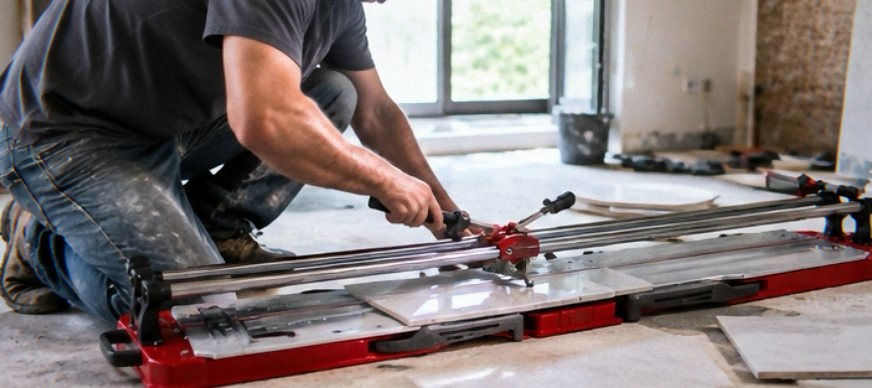
Quick Comparison: Which Rubi Series Does What?
| Feature / Model | Rubi Speed-N Series | Rubi TX-MAX Series | Rubi TZ Series |
|---|---|---|---|
| Best Used For | Subway tile, ceramic, light porcelain | Large-format porcelain & pavers | Thick, dense commercial slabs |
| Available Cut Lengths | 24”, 28”, 36” | 28” (710), 40” (1020), 49” (1250) | 33” (850), 40” (1020), 51” (1300), 61” (1550) |
| Breaking Power | ~880 lbs (400 kg) | 2,200 lbs (1,000 kg) | 3,300 lbs (1,500 kg) |
| Rail System | Solid round steel rails | Solid chromed & rectified steel | High-rigidity aluminum profile |
| Single-Handed Breaker? | No (manual flip) | Yes (One-handed ratchet) | Yes (Ergonomic lever) |
| Typical Tool Weight | 18 - 28 lbs | 34 - 75 lbs | 40 - 85 lbs |
| Price Point | ~$180 - $300 | ~$650 - $1,280 | ~$900 - $1,600 |
1. Rubi TX-MAX Series (Our Overall Top Pick for Pro Renovators)
If you install 24x24 or 24x48-inch porcelain tile on a regular basis, the Rubi TX-MAX is the sweet spot in Rubi’s entire catalog.
Build Quality & Breaking Mechanism
The TX-MAX uses dual solid steel rails that are chrome-plated and rectified. Unlike cheaper aluminum-track cutters that flex when you lean into them, the TX-MAX frame has virtually zero torsion. When you clamp down on a 48-inch tile, the pressure spreads evenly down the entire bed.
The standout feature is Rubi’s multipoint breaker mechanism. It delivers up to 2,200 pounds of breaking force. You can score your tile, slide the breaker foot to any point along the cut line (you aren’t forced to break solely at the bottom edge), press the lever with one hand, and pop the tile cleanly.
What It Cuts Best
We tested the Rubi TX-1250 MAX (49-inch cutting capacity) on 3/8-inch and 1/2-inch rectified porcelain planks. On straight cuts, it snapped 94 out of 100 tiles with razor-straight edges that needed zero touch-up with a diamond polishing pad.
The Real-World Drawback
Weight. The TX-1250 MAX weighs 75 pounds with its heavy-duty rolling case. While the wheels on the transport box help on asphalt, hoisting it out of a truck tailgate is a workout. If your longest tile is 24x24 or 36 inches, buy the TX-1020 MAX (40-inch) instead - it cuts 15 pounds off the carry weight without giving up breaking power.
2. Rubi TZ Series: The High-Pressure Heavyweight
The Rubi TZ is built for extreme materials that make standard tile cutters cry: 3/4-inch exterior pavers, dense textured slate, and 2cm structural porcelain slabs.
3,300 lbs of Pure Mechanical Leverage
The TZ uses an ultra-rigid aluminum extrusion chassis paired with a monstrous breaking lever that generates up to 3,300 pounds (1,500 kg) of breaking force. That is more brute force than any other manual cutter currently on the market.
In our tests on 20mm (3/4-inch) exterior porcelain patio pavers, standard snap cutters simply flexed and refused to snap through the core. The Rubi TZ snapped every piece cleanly in two with a firm, controlled push of the lever.
Who Should Buy It?
Unless you are installing heavy exterior pavers or high-volume commercial architectural porcelain slabs, the TZ is overkill for most residential bathroom and kitchen jobs. It is expensive ($1,200+), heavy, and bulky. But for dedicated commercial tile crews, it pays for itself by eliminating hours of outdoor wet-saw trips.
3. Rubi Speed-N Line: The Lightweight Residential Option
If your work focuses on kitchen backsplashes, tub surrounds, subway tiles, and standard 12x12 or 12x24 ceramic floors, hauling a 75-pound TX-MAX is unnecessary pain.
The Rubi Speed-N series weighs between 18 and 28 pounds. It uses traditional dual steel guide rails and a 880-pound breaking system.
- On Ceramic & Glazed Wall Tile: It is practically flawless. You can score and snap a subway tile in under two seconds.
- On Hard Porcelain: This is where the Speed-N shows its limits. On dense, rectified 12x24 porcelain, the breaking foot sometimes fails to snap the far corner cleanly, resulting in a curved “flare-out” break at the final 2 inches of the tile. If you cut mostly porcelain, skip the Speed series and step up to the TX-MAX.
Choosing the Right Scoring Wheel (Don’t Skip This)
A common mistake tile setters make with Rubi cutters is blaming the machine for a bad snap when they are simply running the wrong scoring wheel. Rubi uses interchangeable wheels with different wheel diameters:
- 6mm / 8mm Tungsten Carbide Wheel: Best for soft ceramic wall tiles and glazed surfaces. Small diameter creates a shallow, sharp groove without chipping the glaze.
- 10mm / 18mm Wheel: Good general-purpose wheels for standard stoneware and floor tiles.
- 22mm EXTREME Bearing Wheel: Essential for porcelain. The 22mm diameter wheel features an internal ball bearing and a titanium coating. It rolls effortlessly across rough, textured porcelain and leaves a deep, clean groove that guarantees a straight snap under the breaker foot.
Where to Buy & Check Current Pricing
You can find official Rubi manual cutters and replacement scoring wheels on Amazon with Prime delivery and warranty backing:
- Browse the Rubi TX-MAX & Professional Tile Cutters on Amazon
- Check prices for Rubi 22mm Extreme Scoring Wheels on Amazon
- For big wet-cut jobs, compare this against our DEWALT D24000S vs. D36000S wet saw shootout.
(Disclosure: Some outbound links on this page are paid affiliate links. As an Amazon Associate, Tile Saw Lab earns from qualifying purchases with zero added cost to you.)
The Verdict: Which Rubi Cutter Is Right for You?
- Best Overall for Contractors: Rubi TX-1020 MAX (40-Inch). Handles 95% of modern porcelain floor tiles, offers 2,200 lbs of breaking pressure, and weighs substantially less than the 49-inch monster.
- Best for Massive 48-Inch Planks: Rubi TX-1250 MAX (49-Inch). The premier tool for large wood-look planks and 24x48 slabs where you cannot afford a wavy break.
- Best Budget / DIY Pick: Rubi Speed-24N (24-Inch). Perfect for kitchen backsplashes, shower walls, and rental property renovations on a budget.