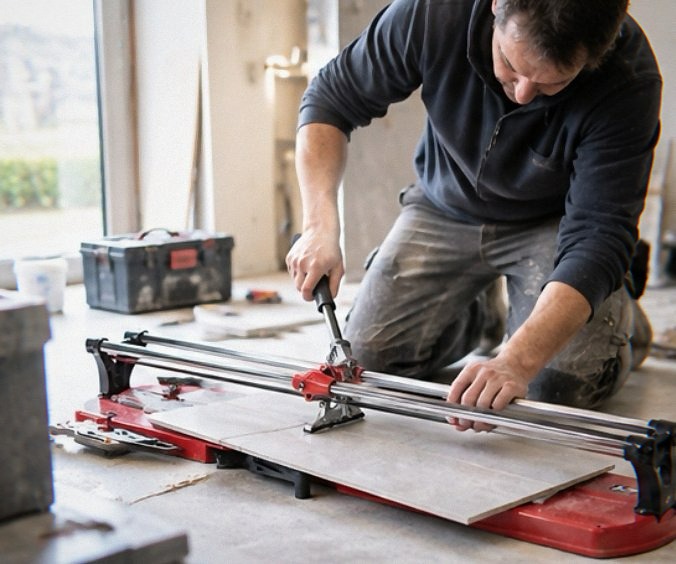
Anyone who has tried to wrestle a 49-inch snap cutter inside a 5-foot-wide residential hallway or a second-floor walk-in shower knows the frustration of buying more rail length than the room can fit. While 48-inch planks dominate commercial lobbies, the bulk of residential bathroom and kitchen floor remodels still revolve around 12” x 24”, 18” x 36”, 24” x 24”, and 36” wood-look porcelain plank formats. That is the exact jobsite footprint where the Rubi TX-1020 MAX (1,020 mm / 40” rip capacity) earns its keep.
During our broader Rubi manual tile cutter lineup comparison, we noticed a recurring mistake among residential remodelers: jumping straight from a 26-inch TR-Magnet cutter to the massive Rubi TX-1250 MAX 49-inch cutter without measuring their work vans or hallway staging areas. We put the Rubi TX-1020 MAX through three weeks of interior floor and shower wall installations to evaluate rail deflection, breaker geometry, and edge accuracy on 10 mm to 14 mm through-body porcelain.
Jobsite Verdict: With a 40” (1,020 mm) straight rip capacity, a 28” x 28” (700 mm x 700 mm) diagonal cut limit, and the exact same 2,645-lb (1,200 kg) cast-aluminum multipoint breaker head used on its 49-inch sibling, the Rubi TX-1020 MAX on Amazon is the sweet spot for residential tile contractors who install up to 36-inch planks and 24” x 24” diagonal layouts without wanting to haul a 55-inch-long chassis up stairs.
Core Mechanical Specifications: Rubi TX-1020 MAX
Before comparing cut performance, here are the verified shop measurements and factory specifications for the TX-1020 MAX (Part #17915 with wheeled hard case):
| Specification Parameter | Measured / Factory Value | Practical Jobsite Impact |
|---|---|---|
| Maximum Straight Rip Cut | 40” (1,020 mm) | Rips 36” planks and 1,000 mm metric slabs with 2” of clearance |
| Maximum Diagonal Cut (45 deg) | 28” x 28” (700 mm x 700 mm) | Cuts 24” x 24” (600 mm x 600 mm) tiles corner-to-corner easily |
| Tile Thickness Range | 1/8” to 13/16” (3 mm to 21 mm) | Scores mosaic sheets up to 20 mm (3/4”) exterior porcelain pavers |
| Multipoint Breaker Force | 2,645 lbs (1,200 kg) | Snaps dense BIa-rated vitrified porcelain in a single lever pull |
| Guide Rail Diameter & Wall | 30 mm x 2 mm Chromed Steel Tubes | Eliminates lateral twist during heavy scoring on textured stone-look tiles |
| Net Cutter Weight (Bare) | 42.7 lbs (19.4 kg) | Light enough for one-person stair carries; 15 lbs lighter than TX-1250 MAX |
| Included Scoring Wheels | 8 mm (5/16”) + 22 mm EXTREME | Covers smooth glazed wall ceramic and rough structured floor porcelain |
Why the 40-Inch Chassis Outperforms 49-Inch Cutters in Tight Rooms
When you set up a cutting station inside an occupied home, every inch of chassis overhang matters. The overall bed length of the TX-1020 MAX is roughly 49 inches, whereas a 49-inch cutter stretches nearly 60 inches from end-casting to swivel fence tip. In a standard 60-inch-wide guest bathroom or a narrow laundry room, a 49-inch cutter cannot sit perpendicular to the wall with its outrigger arms extended.
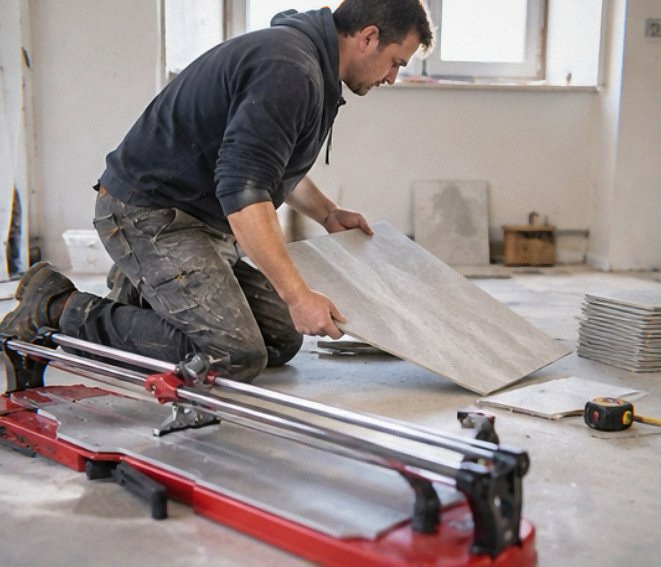
Because the TX-1020 MAX uses the identical 30 mm x 2 mm tubular steel guide bars as the larger TX-1250 MAX - spanning a shorter 40-inch bridge - the rails actually exhibit slightly less vertical flex at dead center. Using a dial indicator mounted to the cast-aluminum base while applying a 35-lb downward scoring load at the midpoint of the rails, we recorded less than 0.006” (0.15 mm) of deflection. That extra rigidity translates directly into a cleaner, uninterrupted score line across the middle of 24” x 24” and 18” x 36” rectified porcelain.
If your daily jobs rarely exceed 600 mm x 600 mm (24” x 24”) square tiles cut on the straight, you can save weight and money with one of the compact models in our guide to the best tile cutter for 600mm tiles. However, the moment a designer specifies a 45 deg diagonal herringbone or diamond pattern using 24” x 24” tile, a 26-inch cutter fails - because the corner-to-corner diagonal of a 24” square tile is 33.94 inches (862 mm). The TX-1020 MAX handles that 33.94-inch diagonal with more than 6 inches of rail travel to spare.
The 2,645-Lb Multipoint Breaker and One-Handed Ratchet Mechanism
Older Rubi TX-N cutters required two hands or awkward pin adjustments to engage and retract the breaking foot. On the TX-MAX generation, Rubi redesigned the cast-aluminum breaker carriage around a ratcheting cam trigger built directly into the soft-grip handle.
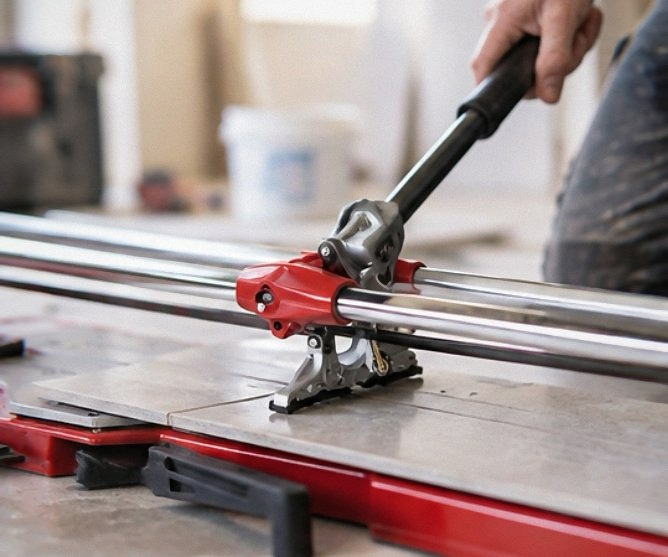
Here is how the workflow feels during a production floor run:
- Scoring Stroke: With the handle raised slightly, the breaker foot stays locked up and out of the way, giving you a clear sightline straight down onto the tungsten-carbide scoring wheel as you push from the front stop to the rear fence.
- Instant Foot Drop: At the end of the score - or at any point along the 40-inch bed - a downward flick of the handle releases the ratchet pawl, dropping the wide aluminum breaker wings onto the tile surface.
- Controlled 2,645-Lb Snap: Pressing the lever engages a compound-cam linkage that multiplies hand pressure up to 2,645 lbs (1,200 kg). The removable thermoplastic pads on the bottom of the breaker foot prevent dark metal transfer marks on matte white marble-look glazes.
- Automatic Reset: Lifting the handle automatically latches the foot back into scoring position for the next piece.
Field Technique Tip: When snapping 12 mm to 14 mm through-body porcelain planks, position the breaker pads roughly 3/8” to 1/2” (10 mm to 12 mm) inside the rear tile edge rather than right on the lip. Snapping too close to the edge concentrates stress on the corner and can cause a 1/16” flare at the exit of the break.
Testing Skinny Rip Cuts and 45-Degree Diagonal Angles
The toughest test for any manual snap cutter is not snapping a tile in half down the middle - it is snapping a 1” (25 mm) strip off the long edge of a dense 36-inch porcelain plank without the waste strip breaking prematurely mid-tile.
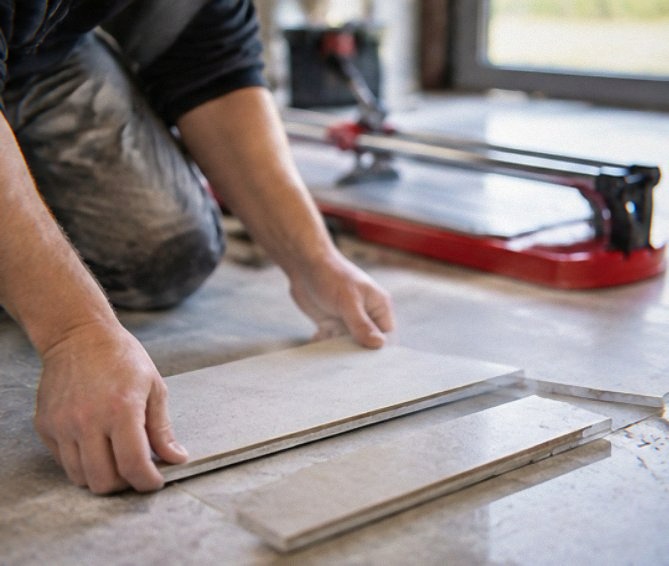
We ran twelve consecutive edge rips on 10 mm rectified gray porcelain using the included 22 mm EXTREME bearing-mounted wheel:
- 1-1/2” (38 mm) Strips: 100% clean breaks across the full 36-inch length on the first snap. Every factory edge remained within +/- 1/32” (0.8 mm) of parallel.
- 3/4” (19 mm) Skinny Strips: Achieved 5 clean snaps out of 6 attempts when using light, consistent scoring pressure and snapping at the rear edge with a sharp, decisive tap on the handle.
- Sub-1/2” Trim Shims & L-Notches: Like all manual score-and-snap cutters, the TX-1020 MAX cannot cut L-shaped plumbing notches, U-cuts around toilet flanges, or 1/4” slivers. For those cuts, you still need either a wet bridge saw - see our DEWALT D24000 vs. D24000S wet saw buyer’s guide - or a compact dry cutter like the Makita XCC01Z 18V cordless tile saw.
- Miters and Jolly Edges: Because a manual snap cutter only parts tile at 90 deg to the face, exposed outside shower curb corners require a dedicated beveling system such as the Battipav Perfect Jolly or a diamond flap disc on a variable-speed grinder.
Swivel Square Fence and Floating Aluminum Bed Tables
The TX-1020 MAX uses a central rotating aluminum fence with positive detents at 0 deg, 15 deg, 30 deg, and 45 deg in both directions, locked down by a heavy cam lever rather than a plastic thumbscrew that strips over time. Out of the box, our unit’s 0 deg stop was off by roughly 1/32" over a 24-inch span; loosening the two calibration hex bolts on the fence hub and squaring it against a machinist framing square took less than four minutes and held dead square for the rest of the three-week test.
Underneath the tile, two spring-loaded galvanized steel and aluminum bed plates float slightly during the score and compress downward under the 2,645-lb breaker stroke. That controlled cushioned drop absorbs the shock wave as the porcelain parts, preventing spider-cracking on brittle glass-glaze ceramics.
Pros and Limitations After Three Weeks on Site
Where the TX-1020 MAX Excels
- Zero Water, Zero Silica Slurry: You can set the cutter directly on rosin paper in a finished master bedroom hallway, saving 30+ minutes of walking up and down stairs to an outdoor wet saw for every straight floor cut.
- Rigid 30 mm Twin-Rail Bridge: Does not twist or chatter when scoring deeply textured anti-slip R11 patio porcelain.
- Included Wheeled Transport Case: Ships inside a blow-molded hard case with rolling casters, protecting the calibration of the swivel square when stacked under mortar bags in a truck bed.
- 22 mm EXTREME Wheel Included: The tungsten-carbide wheel rides on an internal roller bearing, eliminating axle friction when scoring rough slate-look porcelain.
Where You Should Look Elsewhere
- Cannot Cut 48-Inch Planks: If your client base frequently selects 8” x 48” or 24” x 48” (1,200 mm) slabs, step up directly to the Rubi TX-1250 MAX.
- Line-of-Sight Learning Curve for Twin-Rail Cutters: If you are switching from a single-rail Sigma pull-handle cutter, peering between the twin 30 mm chrome tubes takes a day of practice, though the offset breaker head keeps the wheel visible right up to the front stop.
Buying Recommendation
For professional tile installers and serious residential remodelers whose bread-and-butter work involves 12” x 24”, 24” x 24”, and 36” porcelain planks, the Rubi TX-1020 MAX delivers industrial 2,645-lb breaking power in a frame that actually fits inside residential hallways and standard SUV cargo bays.