
Anyone who has dragged a 100-foot extension cord and a garden hose up three flights of stairs just to notch two bathroom floor tiles around a toilet flange understands the appeal of a Makita cordless tile saw. While Makita offers a tiny 12V CXT 3-3/8” glass and tile trimmer (CC02R1) meant only for thin ceramic wall subway tile, the real workhorse for professional remodelers is the Makita XCC01Z 18V LXT Lithium-Ion Brushless 5” Wet/Dry Masonry and Tile Saw.
Built around an 8,800 RPM brushless motor, a nickel-plated beveling baseplate, an onboard gravity water bottle kit, and Makita’s Auto-Start Wireless System (AWS) for Bluetooth vacuum pairing, the XCC01Z aims to replace corded 5-inch handheld cutters on punch-list jobs and rooftop patio installs. We tested the Makita cordless tile saw across 10 mm rectified porcelain, 3/4” granite thresholds, and cement backer board - comparing its torque and runtime directly against our Makita 4101RH 5-inch corded masonry saw review.
Field Test Verdict: Running on a 5.0Ah or 6.0Ah 18V LXT battery pack, the Makita XCC01Z Cordless 5-Inch Wet/Dry Saw on Amazon cuts 3/8” (10 mm) porcelain and marble thresholds at nearly the same feed rate as a corded 5-inch saw - without tripping sensitive kitchen GFCI breakers or tangling cords across wet thinset. It is not a replacement for a full-size sliding table wet saw on whole-house floors, but for L-notches, electrical box plunge cuts, and cordless outdoor hardscape trims, it is the best 18V handheld cutter on the market.
Makita Cordless Tile Saw Lineup: 18V XCC01Z vs. 12V CC02R1 vs. Corded 4101RH
Because buyers searching for a makita cordless tile saw often confuse Makita’s 12V mini trimmer with the 18V brushless 5-inch cutter, here is how the three Makita handheld tile saws compare side by side:
| Specification Parameter | Makita XCC01Z (18V LXT Brushless) | Makita CC02R1 (12V max CXT) | Makita 4101RH (120V Corded) |
|---|---|---|---|
| Blade Diameter & Arbor | 5” (125 mm) / 20 mm Arbor | 3-3/8” (85 mm) / 15 mm Arbor | 5” (125 mm) / 20 mm Arbor |
| No-Load Blade Speed | 8,800 RPM (Automatic Speed Change) | 1,600 RPM (Brushed Motor) | 12,200 RPM (7.9 Amp Corded) |
| Max Cutting Depth at 90 deg | 1-9/16” (40 mm) | 1” (25.5 mm) | 1-5/8” (41.5 mm) |
| Max Cutting Depth at 45 deg | 1-1/16” (27 mm) | 5/8” (16 mm) | 1-1/16” (27 mm) |
| Dust & Water Control | Gravity Water Bottle + Rotating Vacuum Port + AWS | Gravity Water Bottle Only | Pressurized Hose Hookup + GFCI Cord |
| Tool Weight (With Battery/Cord) | 6.7 lbs (3.0 kg with 5.0Ah LXT pack) | 4.0 lbs (1.8 kg with 2.0Ah CXT pack) | 6.5 lbs (2.9 kg bare tool) |
| Primary Jobsite Role | Porcelain L-cuts, stone thresholds, backer board | Thin 1/4” ceramic backsplash trim only | Continuous heavy stone & brick trenching |
8,800 RPM Brushless Motor and Automatic Speed Change (ADT)
Cutting vitrified floor porcelain with a small 5-inch diamond blade demands high rim speed. Under no-load conditions, the XCC01Z spins at 8,800 RPM - more than five times faster than the 1,600 RPM 12V trimmer. More importantly, Makita equipped the brushless controller with Automatic Torque Drive Technology (ADT).
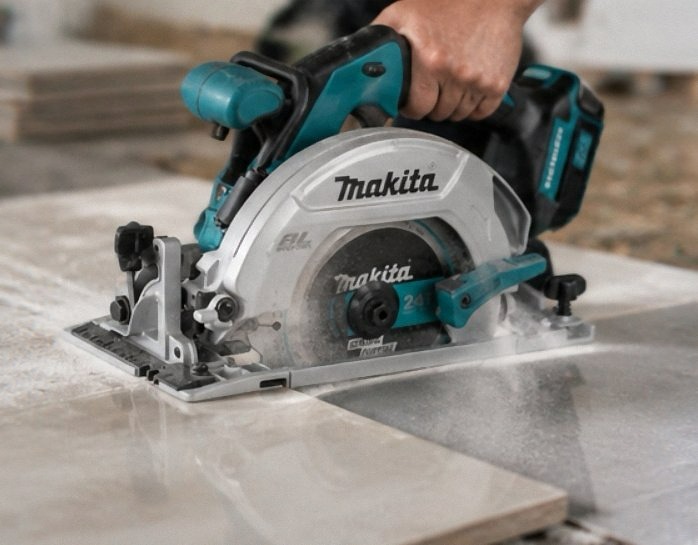
When you ease the diamond rim into the glazed edge of a porcelain tile, the saw maintains full 8,800 RPM speed to prevent initial glaze chipping. As the blade buries into the dense body of a 12 mm tile or a 3/4” (19 mm) engineered quartz saddle and load current spikes, ADT automatically shifts the motor commutation to prioritize rotational torque over raw speed. During our test cuts on 10 mm rectified porcelain, the blade never stalled unless we deliberately twisted the baseplate off-line in the kerf.
Battery Sizing Rule: Never run the
XCC01Zon compact 1.5Ah or 2.0Ah slim packs. Slim single-row 18V packs suffer from voltage sag under heavy masonry loads and will trip the thermal overload cutout after three or four plunges. Always pair this saw with a dual-row 5.0Ah (BL1850B) or 6.0Ah (BL1860B) LXT battery.
Real-World Battery Runtime on a 5.0Ah LXT Pack
To measure realistic jobsite runtime rather than laboratory marketing numbers, we fitted a fresh continuous-rim 5” porcelain diamond blade and ran cuts using a fully charged BL1850B 18V 5.0Ah battery in dry mode with a shop vacuum attached:
- 10 mm (3/8”) Rectified Porcelain Tile: Completed 22 linear feet of continuous cuts (equivalent to eleven full 24-inch cross-cuts or roughly 35 toilet flange and outlet L-notches) on a single 5.0Ah battery charge before the one-bar LED indicator flashed.
- 1/2” (12.7 mm) HardieBacker Cement Board: Completed 48 linear feet of straight scoring and through-cutting on a single 5.0Ah pack.
- 3/4” (19 mm) Carrara Marble Door Thresholds: Completed 14 full cross-cuts across 4-inch-wide marble saddles with the gravity water drip open at 1/2 flow.
If you carry two 5.0Ah LXT batteries and a Rapid Optimum Charger (DC18RC, 45-minute charge cycle), you can run punch-list and trim cuts all day without waiting on a pack.
Dry Cutting with Vacuum Extraction vs. Gravity Water Bottle Feed
The XCC01Z ships ready for both wet and dry operation, and knowing when to use each attachment saves a tremendous amount of cleanup time.
1. Dry Cutting with the 360-Degree Dust Port and AWS
For 90% of indoor bathroom and kitchen remodels, installers run the XCC01Z dry with a HEPA dust extractor connected to the rotating 1-3/8” dust shroud port. Because the blade housing encloses the upper two-thirds of the 5-inch wheel, a standard shop vacuum captures virtually all airborne silica plume during straight passes. If you own an AWS-equipped Makita dust extractor, the Bluetooth chip inside the saw automatically starts the vacuum the instant you pull the trigger and runs for 3 seconds after you release it to clear the hose.
If you want a dedicated tabletop dry saw that captures 99.5% of dust without needing an external vacuum hose, check out our iQ Power Tools 7-inch dry-cut tile saw review and our broader waterless dry tile cutting guide.
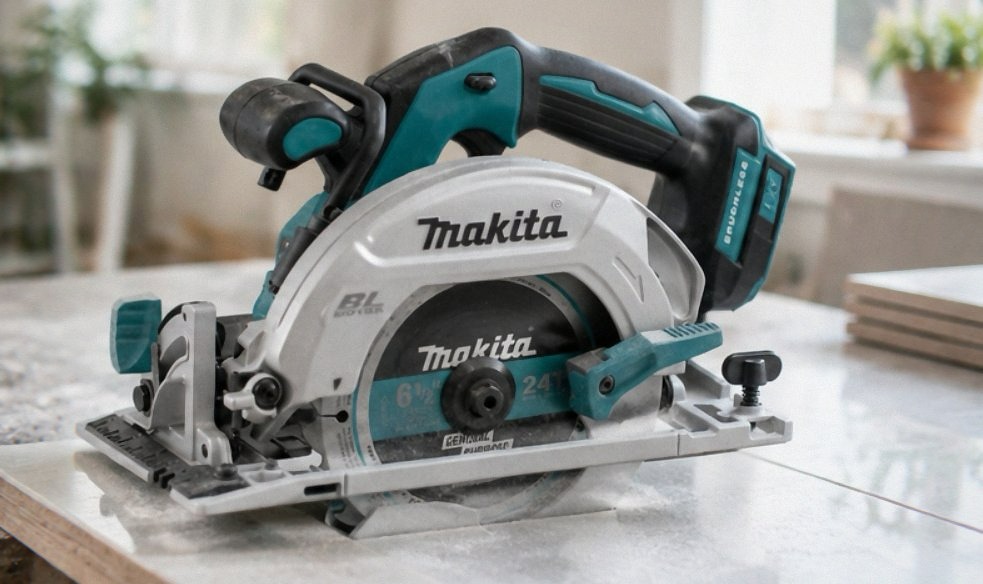
2. Wet Cutting with the Onboard Water Bottle
For hard granite thresholds or glass-glaze tiles that micro-chip when cut dry, the XCC01Z includes a snap-on plastic water reservoir with an adjustable flow petcock that drips water directly onto the blade face. While the gravity bottle holds enough water for 3 to 4 minutes of continuous cutting before refilling, it eliminates the need to drag a 50-foot garden hose into a finished courtyard. Inside the housing, Makita’s Extreme Protection Technology (XPT) channels water droplets away from the trigger switch and brushless stator so wet slurry does not corrode the internal electronics.
Plunge Cuts, Bevel Miters, and Baseplate Accuracy
Unlike a fixed benchtop wet saw where the blade height is stationary on affordable models, the XCC01Z features a spring-assisted plunge pivot (0" to 1-9/16" depth) and a beveling shoe that tilts from 0 deg to 45 deg:
- Centered Square Cutouts (Electrical Boxes & Shower Valves): By loosening the depth lever, setting the front nose of the nickel-plated baseplate flat on the tile face, and plunging the spinning 5” blade straight down into your layout lines, you can cut clean 4” x 4” mixing-valve squares in the dead center of a 24” x 24” tile without overcutting the corners.
- 45-Degree Bevel Miters: Tilting the baseplate to
45 degreduces max cutting depth to1-1/16"(27 mm), which is still more than enough to back-miter 10 mm and 12 mm porcelain wall tiles for outside shower niche corners.
How the Makita XCC01Z Fits Into a Complete Tile Rig
To be clear about where a handheld 5-inch cordless saw belongs: you should not buy the XCC01Z expecting to rip fifty 24-inch floor tiles freehand and get factory-straight edges. Freehand cutting follows the steadiness of your wrist.
Instead, smart contractors pair the XCC01Z with two complementary tools:
- For fast, dead-straight indoor cross-cuts on 12” x 24” and 36” porcelain planks, pair it with a 40-inch manual snap cutter like the Rubi TX-1020 MAX.
- For high-volume, guided wet miter cuts and whole-house stone installations, pair it with a full-size sliding bridge cart saw - see our DEWALT D24000 vs. D24000S wet saw buyer’s guide.
- If you are a homeowner tackling a single bathroom remodel on a tight budget and do not already own Makita 18V batteries, compare affordable corded benchtop options in our SKIL 3550-02 7-inch wet tile saw review.
Pros and Cons Summary
What We Liked
- True Corded-Class Blade Speed (
8,800 RPM): Slices dense porcelain without chattering when fitted with a thin-kerf continuous diamond blade. - 1-9/16” (
40 mm) Cut Depth: Deep enough to cut 2 cm (3/4”) porcelain patio pavers and natural stone window sills in a single pass. - Sealed Battery Cover: A latched protective door with a rubber gasket shields the 18V LXT battery terminals from water spray and abrasive tile dust.
- Electric Brake: Stops the spinning diamond wheel within 2 seconds of releasing the trigger, preventing accidental nicks when setting the saw down on a tile stack.
What Could Be Better
- 20 mm Arbor Bore: Requires a 20 mm arbor blade (or removing the knockout ring on standard 7/8”-to-20mm diamond blades) rather than a 5/8” angle-grinder bore.
- Bare Tool Packaging: The
XCC01Zships without batteries or a charger; buyers new to Makita 18V LXT must factor in the cost of two 5.0Ah packs.
Where to Buy
If your truck is already stocked with Makita 18V LXT batteries, adding the Makita XCC01Z is one of the highest-return upgrades you can make for bathroom cutouts, backer board trimming, and cordless punch-list work.