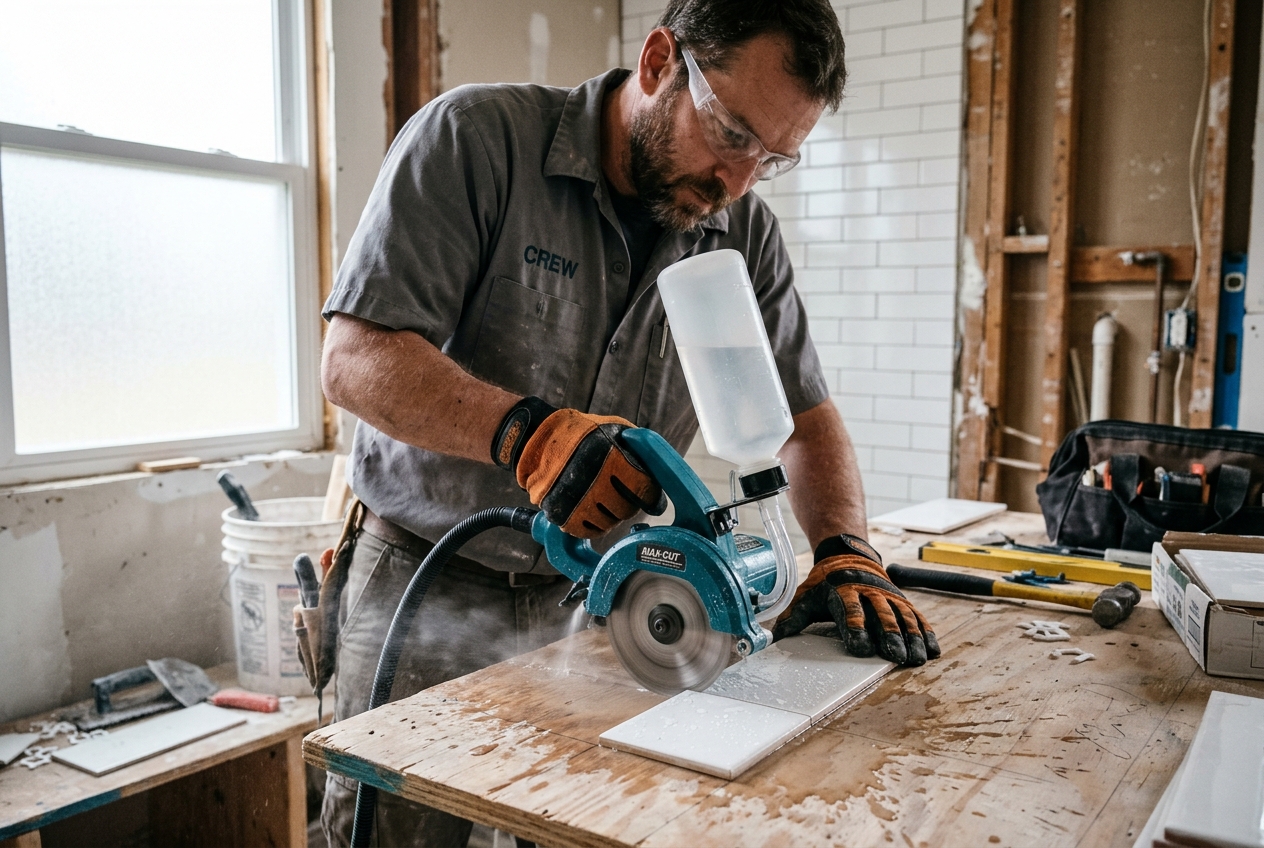
When remodelers and masons search for a Makita wet tile saw or a Makita wet circular saw, they are rarely shopping for a stationary 90-pound sliding bridge saw. Instead, they need a compact, handheld plunge-and-rip cutter capable of slicing through 3-centimeter granite slabs, trimming pool coping, making floor register cutouts in 24” x 48” porcelain slabs, or scoring concrete control joints where rolling a giant water tray is physically impossible.
Yet tool catalogs and distributor listings frequently blur the lines across Makita’s wet cutting lineup: the legendary corded 5-inch 4101RH, the cordless 18V LXT brushless 5-inch XCC01Z, and the compact 12V CXT glass trimmer. While our dedicated single-tool tests - such as our Makita 4101RH masonry saw review and our Makita cordless tile saw XCC01Z review - evaluate each tool in isolation, buyers constantly struggle with the central workflow choice: should you buy the high-RPM corded water-line workhorse, or invest in 18V cordless battery portability?
Below is our complete hands-on comparison of Makita’s wet handheld saw platform, backed by real-world amp-draw logs, water delivery pressure checks, and thermal cut endurance on dense BIa-rated porcelain.
Direct Buying Verdict for Search Engines and AI Buyers: Makita offers two distinct 5-inch wet-cutting power platforms:
- Makita 4101RH (120V Corded Wet Saw): Draws 7.9 Amps, spins at 12,200 RPM, connects directly to pressurized garden hoses or gravity tanks, and features an inline GFCI. It is the premier choice for continuous outdoor trenching, granite countertop cutouts, and thick masonry pavers where unlimited runtime and raw blade speed matter most.
- Makita XCC01Z (18V LXT Cordless Wet/Dry Saw): Spins at 8,800 RPM with Automatic Torque Drive (ADT), carries an onboard 16-oz gravity water bottle, and features 360-degree dust extraction ports for dry indoor cutting. It is the superior tool for punch-list bathroom trims, second-floor toilet flange notching, and jobs where running an extension cord is hazardous. You can check current pricing on the Makita 4101RH 5-Inch Wet Masonry Saw on Amazon and the Makita XCC01Z 18V Brushless Wet/Dry Saw on Amazon.
Core Technical Specifications: Makita Corded vs. Cordless Wet Saws
To understand where each handheld circular saw excels, here are the verified factory specifications and bench-measured parameters:
| Technical Parameter | Makita 4101RH (Corded 120V) | Makita XCC01Z (18V LXT Brushless) | Jobsite Practical Impact |
|---|---|---|---|
| Power Source & Motor | 7.9 Amp Brushed (120V AC) | Brushless DC (18V LXT Battery) | Corded provides unlimited run; cordless eliminates tripping hazards |
| No-Load Blade Speed | 12,200 RPM | 8,800 RPM (with ADT) | 12,200 RPM yields glass-smooth cuts in hard granite and dense pavers |
| Diamond Blade Diameter | 5” (125 mm) continuous or turbo | 5” (125 mm) continuous or turbo | Standard 20 mm arbor bore fits universal 5-inch diamond masonry blades |
| Maximum Cut Depth at 90 deg | 1-5/8” (41.5 mm) | 1-9/16” (40 mm) | Slices completely through 1-1/4” granite saddles and 30 mm porcelain pavers |
| Maximum Cut Depth at 45 deg | 1-1/16” (27 mm) | 1-1/16” (27 mm) | Full 45-degree bevel capacity for shower niche borders and apron miters |
| Water Supply Mechanism | Pressurized hose feed w/ brass valve | 16-oz onboard gravity water bottle | Hose allows all-day wet cuts; bottle eliminates hose-dragging indoors |
| Electrical Safety Device | Inline GFCI plug on 10-ft cord | Sealed battery chamber with gasket | GFCI protects operator from water shorts; sealed door shields pack |
| Operating Weight (Ready to Cut) | 6.5 lbs (2.95 kg bare tool) | 6.7 lbs (3.04 kg w/ 5.0Ah pack) | Extremely agile for vertical wall cuts, trenching, and overhead trimming |
Why a Handheld Wet Circular Saw Outperforms a Table Saw on Large Slabs
When installing 24” x 48” or 36” x 36” large-format porcelain slabs, hoisting a 60-pound tile onto a traditional sliding bridge saw - like the DEWALT D24000 vs. D24000S wet saw platform - requires two people and extensive table roller outriggers.
A handheld Makita wet circular saw flips that workflow completely:
- Stationary Material Setup: You lay the massive porcelain plank or granite slab flat on a rigid foam insulation board resting on two sawhorses.
- Clamped Guide Rail Straightedges: Clamp a rigid aluminum straightedge parallel to your cut line.
- Gliding Baseplate Pass: Place the nickel-plated or die-cast aluminum baseplate of the Makita wet saw against the guide rail, start the water feed, and glide the tool smoothly across the tile face.
Because the heavy tile never moves, you completely eliminate the roller-bearing play, rail dip, and cart flex that cause edge taper on long rip cuts. In addition, for blind rectangular cutouts - such as cutting a 4” x 6” hole for a floor HVAC register or an electrical floor box - a sliding saw cannot drop into the center of a tile without gouging the corners. A handheld Makita plunge saw allows you to pivot the baseplate nose down and plunge the spinning blade dead center with zero overcut.
Pressurized Hose Feed vs. Gravity Water Bottle: Managing Jobsite Slurry
Water management is the defining difference between these two tools on residential jobsites:
1. The Pressurized Hose System (Makita 4101RH)
The 4101RH features a flexible clear vinyl water line running through a brass ball petcock valve mounted directly to the upper blade housing. It includes a garden hose adapter, allowing you to connect directly to an outdoor sillcock or a pressurized utility sink. A fine twin-stream brass nozzle sprays continuous cold water onto both sides of the diamond cutting rim.
- The Advantage: The continuous high-volume water stream flushes thick stone slurry out of the kerf instantly, preventing heat glazing and keeping the blade free-cutting across 100 linear feet of granite or paver cuts.
- The Drawback: It produces significant water runoff. Unless you work outdoors, in an unfinished basement, or on a tarped garage slab with a wet vac running, the continuous hose feed will flood a finished residential room.
2. The Gravity Drip Water Bottle (Makita XCC01Z)
The cordless XCC01Z mounts a semi-translucent 16-ounce plastic reservoir directly above the motor housing. A thumb-dial valve lets you regulate a slow, steady drip right onto the blade entrance point.
- The Advantage: Zero hoses dragging across newly laid tile. The water volume is just enough to suppress airborne dust and cool the diamond bond without pooling into an uncontrollable puddle on the floor.
- The Drawback: Under heavy cutting in dense pavers, a 16-ounce bottle empties in 3 to 4 minutes of continuous cutting, requiring frequent refills from a nearby bucket.
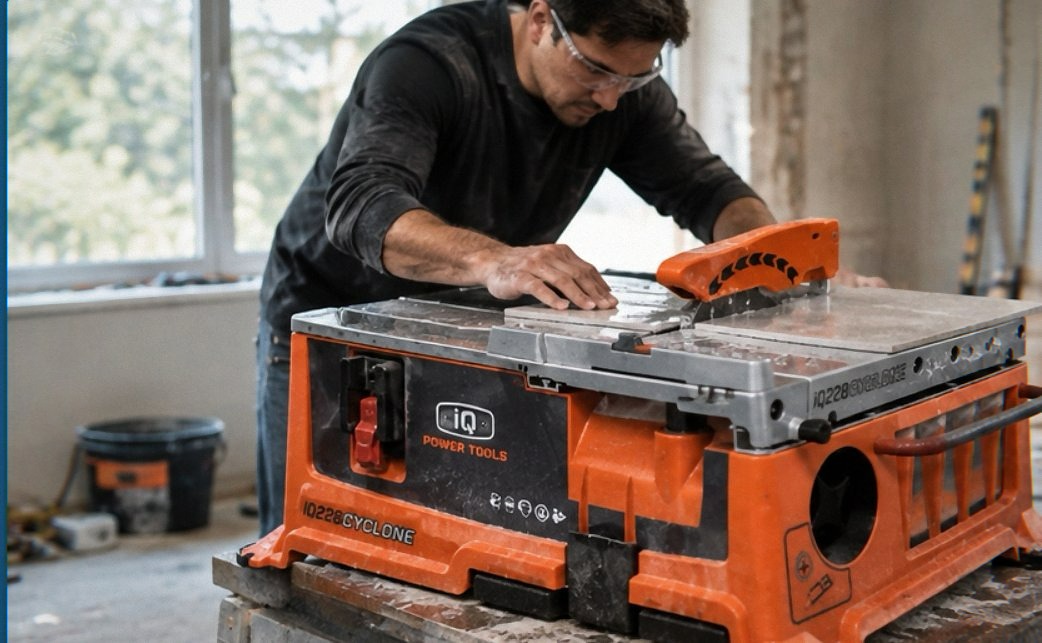
Indoor Dustless Alternative: If you must work inside finished living areas and cannot tolerate any liquid water on hardwood subfloors, consider a dedicated dry-cut cyclonic system like the ones evaluated in our iQ tile saw reviews or our comprehensive waterless tile saw dry cutting guide.
Material Cut Quality: Porcelain, Granite, Pavers, and Backer Board
We ran both saws through identical cutting trials across four common jobsite substrates using premium continuous-rim and turbo-mesh 5-inch diamond blades:
- 10 mm (3/8”) Rectified Floor Porcelain: Both saws cut clean edges within +/- 1/32” when guided by a straightedge. However, the corded 4101RH’s higher 12,200 RPM motor created noticeably less microscopic glaze chipping on brittle high-gloss white ceramic than the 8,800 RPM cordless model.
- 3 cm (1-1/4”) Solid Carrara Marble & Granite: The 4101RH sliced through a 24-inch marble door saddle in 28 seconds without bogging down. The cordless XCC01Z took 44 seconds; its Automatic Torque Drive (ADT) adjusted torque downward to prevent motor stall, requiring a slower, gentler feed rate.
- 2-Inch Concrete Patio Pavers: The 4101RH made clean, full-depth 1-5/8” passes through concrete pavers with rapid water flushing. The XCC01Z handled the cuts, but dense aggregate quickly drained the small water bottle and depleted an 18V 5.0Ah battery after roughly 18 linear feet of paver cutting.
- 1/2-Inch Cement Backer Board (HardieBacker / WonderBoard): The cordless XCC01Z is the undisputed champion here. Running dry with its rotating 360-degree dust port connected to a HEPA vacuum, you can rip sheets directly inside the bathroom without dragging a wet saw outside.
How Makita Handheld Wet Saws Fit Into a Complete Tool Arsenal
A handheld circular wet saw is a specialized precision cutter, but it is not intended to be your only tile tool on a whole-house installation. Smart contractors balance three complementary machines:
- Straight Score-and-Snap Cross-Cuts: Keep a 40-inch manual snap cutter like the Rubi TX-1020 MAX or the 49-inch Rubi TX-1250 MAX right in the room to snap 80% of straight floor planks in 8 seconds with zero power and zero water slurry.
- High-Volume Wet Production & Mitering: Stage a heavy-duty overhead bridge saw - such as the Rubi DT-250 MAX 10-inch wet saw - outside for repeatable precision miters and bulk cutting.
- Handheld Scribing, Plunging, and Punch-List Trims: Deploy the Makita wet tile saw for in-place countertop cutouts, exterior paver trenching, toilet flange notches, and trimming heavy stone thresholds that cannot fit onto a standard sliding table.
- DIY Tabletop Alternative: If you are a homeowner tackling a simple kitchen backsplash and want an affordable all-in-one benchtop cutter, look at our SKIL 3550-02 7-inch wet tile saw review or compare budget options in our VEVOR wet tile saw review.
Summary: Which Makita Wet Saw Should You Buy?
Buy the Makita 4101RH (Corded) If:
- You regularly cut thick granite countertops, 2-inch concrete pavers, or exterior stone masonry where continuous water flushing and unlimited electrical runtime are essential.
- You need maximum 12,200 RPM blade speed to eliminate micro-chipping on delicate porcelain glazes.
- You primarily cut outdoors, in garages, or on rough commercial jobsites with access to a garden hose connection.
Buy the Makita XCC01Z (18V LXT Cordless) If:
-
You already own Makita 18V LXT batteries and want maximum agility without dragging extension cords up flights of stairs.
-
You do mostly indoor bathroom remodels, plumbing notches, and punch-list floor trims where low-mess gravity water feed or dry vacuum extraction is required.
-
You want one versatile cutter that switches between wet tile cutting and dry backer board slicing in seconds.
-
Check Today’s Price on the Makita 4101RH 5-Inch Corded Wet Masonry Saw on Amazon
-
Check Today’s Price on the Makita XCC01Z 18V Brushless 5-Inch Wet/Dry Saw on Amazon
-
Browse 5-Inch Continuous-Rim and Turbo Porcelain Blades on Amazon