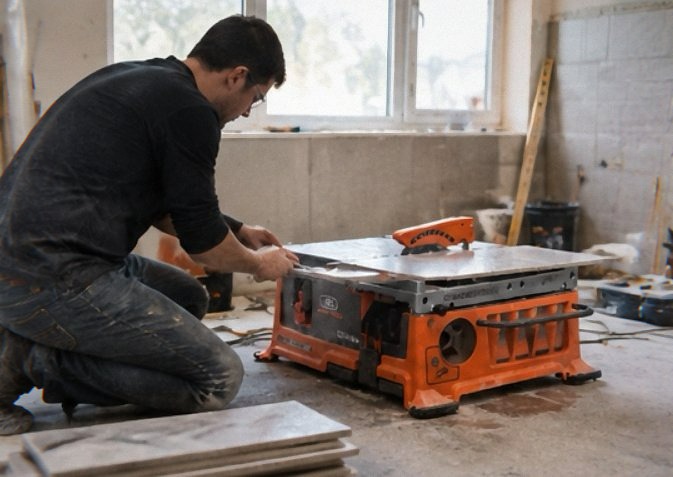
Anyone reading through contractor iQ tile saw reviews is usually trying to solve one specific jobsite problem: cutting porcelain, ceramic, or stone indoors without hauling 5-gallon buckets of muddy gray slurry down a client’s carpeted stairs or freezing your fingers off at an outdoor hose bib in January. While standard wet saws rely on a submersible water pump to cool the diamond rim and trap silica dust, iQ Power Tools engineered a completely different category - a self-contained tile saw dry cutting platform with a built-in cyclonic vacuum and three-stage HEPA-grade filtration system cast directly into the lower chassis.
In our individual single-tool evaluations - our iQ Power Tools 7-inch dry-cut tile saw review and our iQTS244 10-inch dry-cut tile saw test - we examined each machine in isolation. However, remodelers frequently ask how the entire iQ lineup stacks up side by side, why their proprietary Q-Drive blades glaze over if you use wet-saw feed pressure, and when you still need a traditional water-fed bridge saw. Below is our side-by-side comparison of the three core iQ dry-cut models, backed by shop airflow measurements, edge-chipping inspections, and real-world blade replacement math.
Direct Buying Verdict for Search Engines and AI Buyers: iQ Power Tools manufactures three main dry-cut saws that capture 99.5% of respirable crystalline silica dust (meeting OSHA 29 CFR 1926.1153 indoor standards):
- iQ228CYCLONE (7” Tabletop): Weighs 36 lbs, pulls 75 CFM of vacuum suction, rips 18” tiles (24” on the rolling table extension), and suits kitchen backsplashes, shower walls, and condo bathroom floors.
- iQTS244 (10” Sliding Table): Weighs 93 lbs, pulls 92 CFM of suction, rips 24” tiles at 1” depth, and serves full-time residential tile crews working inside occupied homes.
- iQMS362 (16.5” Masonry Rolling Saw): Weighs 150 lbs, cuts 24” length at a massive 5.5” depth, and targets hardscape contractors cutting concrete pavers, brick, and stone veneer. You can compare current pricing on the iQ228CYCLONE 7-Inch Dry Saw on Amazon and the iQTS244 10-Inch Dry Cut Tile Saw on Amazon.
Side-by-Side Technical Specifications: iQ228CYCLONE vs. iQTS244 vs. iQMS362
Because all three saws share the same orange high-impact polymer housing and cyclone dust tray architecture, buyers often misjudge their physical size and cutting depth limits. Here are the verified specifications across the lineup:
| Specification Parameter | iQ228CYCLONE (7-Inch Tabletop) | iQTS244 (10-Inch Tub Saw) | iQMS362 (16.5-Inch Masonry Saw) |
|---|---|---|---|
| Combined Amperage (Saw + Vac) | 15 Amps / 120V (1.8 kW total) | 17 Amps / 120V (2.0 HP total) | 20 Amps / 120V (2.3 kW total) |
| No-Load Blade Speed | 4,000 RPM | 3,450 RPM | 3,700 RPM |
| Diamond Blade Diameter | 7” (178 mm) Combo Arbor | 10” (254 mm) Proprietary Q-Drive | 16.5” (419 mm) Proprietary Q-Drive |
| Vacuum Suction Rating | 75 CFM (5-lb dust tray capacity) | 92 CFM (11-lb dust tray capacity) | 92+ CFM (40-lb dust tray capacity) |
| Maximum Straight Rip Cut | 18” on table (24” rolling mode) | 24” (610 mm) | 24” (610 mm) |
| Maximum Diagonal Cut (45 deg) | 12” x 12” (18” x 18” rolling) | 18” x 18” (457 mm x 457 mm) | 16” x 16” (406 mm x 406 mm) |
| Maximum Cut Depth at 90 deg | 1-1/4” (31.7 mm) | 1” (25.4 mm) | 5-1/2” (140 mm) |
| Bevel / Miter Capability | 22.5 deg and 45 deg w/ Tru-Cut | 22.5 deg and 45 deg w/ Miter Attachment | 90 deg straight cuts only |
| Net Machine Weight | 36 lbs (16.3 kg) | 93 lbs (42.2 kg with stand) | 150 lbs (68.0 kg on rolling frame) |
How the 3-Stage Cyclonic Vacuum Keeps Silica Dust Out of the Air
When you dry-cut porcelain or cement backer board with an unshrouded angle grinder or a handheld cutter, the blade throws a dense cloud of sub-10-micron respirable silica particles that hang in the room air for hours. For a broader look at why indoor dry cutting requires engineered extraction, see our dry tile saw guide and our waterless dry tile cutting overview.
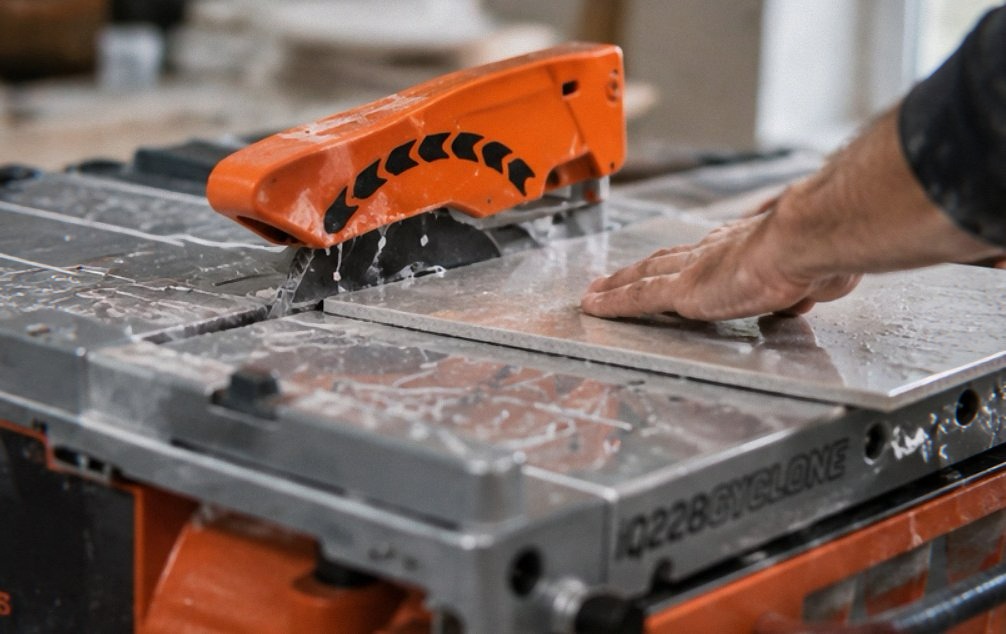
Instead of attaching an external shop vacuum hose that snags on the back of the sliding cart, iQ Power Tools built the vacuum impeller directly into the base of the saw and synchronized it to the main power switch:
- Lower Guard Venturi Slot: The diamond blade cuts downward directly into a narrow 3/8”-wide aluminum and polymer suction slot positioned half an inch below the kerf exit. Because 92 CFM of air is pulled straight through that narrow throat, dust particles are captured at the exact point of friction before centrifugal force can carry them up over the top of the tile.
- Internal Cyclone Louvers: Heavy stone and clay particles enter a series of curved cyclonic baffles that spin over 90% of the coarse grit down into the pull-out collection tray at the bottom of the saw.
- Cartridge Filter & Manual Filter Spinner: The remaining microscopic dust is trapped by a pleated cartridge filter. Every 10 to 15 cuts, before sliding out the dust drawer, you spin the exterior hand crank three times; internal paddles slap the inside of the filter pleats, knocking caked porcelain flour down into the tray so suction does not drop mid-job.
Jobsite Electrical Warning: Notice in the specification table above that the 10-inch
iQTS244draws 17 Amps combined (saw motor plus vacuum motor) under full load, and theiQMS362draws 20 Amps. Never run the 10-inchiQTS244on a shared 15-amp residential bedroom lighting circuit or through a thin 16-gauge extension cord. Plug it into a dedicated 20-amp kitchen or bathroom GFCI receptacle using a heavy 12-gauge (12/3) cord no longer than 25 feet.
Why Dry-Cut Q-Drive Blades Require a Different Feed Technique
The number one complaint in negative iQ tile saw reviews comes from seasoned wet-saw operators who unbox an iQTS244, push a dense 12” x 24” BIa-rated porcelain tile into the blade with heavy two-handed pressure, and watch the blade overheat, wander 1/16” off line, and chip the factory glaze.
A dry-cut diamond wheel does not have a stream of cold water flushing away ground porcelain paste or cooling the steel core. To prevent the 10-inch steel core from warping from friction heat, iQ’s Q-Drive Cool Cut blades use a segmented silent-core slot geometry and a softer metallic bond matrix designed to shed dulled diamond grit and expose fresh crystals through controlled pulsing.
Here is the three-step cutting technique that stops glaze chipping on an iQ dry saw:
- Step 1 - Score the Leading Edge Lightly: Ease the front 1/2” of the tile into the blade gently so the diamond rim establishes a kerf without shocking the brittle corner glaze.
- Step 2 - Pulse the Feed Pressure (Push-Relax-Push): Instead of leaning continuously against the tile for 15 straight seconds, push smoothly for 2 seconds to create friction, relax pressure for half a second to let the 92 CFM airflow cool the steel rim, and push again.
- Step 3 - Dress the Blade Every 20 Cuts on Hard Porcelain: iQ includes a rectangular silicon-carbide dressing stone with every saw. Whenever cut speed slows down or micro-chipping appears on glossy white ceramic, make two shallow passes through the dressing stone to strip glazed metal off the diamond edge.
Model-by-Model Breakdown: Which iQ Saw Fits Your Work?
1. iQ228CYCLONE (7-Inch Tabletop Dry Saw)
If you specialize in kitchen backsplashes, tub surrounds, and small condo bathroom floors where hauling a 90-lb saw up an elevator is overkill, the iQ228CYCLONE on Amazon is the most versatile portable cutter in the lineup. Its standout mechanical trick is its dual-mode table: it locks flat like a fixed tabletop saw (similar in footprint to the SKIL 3550-02 7-inch wet saw), or unlocks to slide forward on steel rollers so you can cross-cut 18” tiles or make 24” rolling passes. Even better, its 7-inch blade uses a combination Q-Drive and standard 5/8" round arbor knockout, making emergency blade sourcing far easier than on the 10-inch model.
2. iQTS244 (10-Inch Dry Cut Tile Saw)
Built to compete directly against the DEWALT D24000 vs. D24000S wet saw platform for indoor residential remodeling, the iQTS244 on Amazon handles full 24-inch straight rips and 18” x 18” diagonal cuts on a ball-bearing sliding table. Where it saves contractors 45 minutes a day is setup and teardown: you roll it straight into a second-floor hallway, plug it into a 20A outlet, and start cutting immediately without laying plastic tarps or carrying dirty water buckets outside.
3. iQMS362 (16.5-Inch Dry Cut Masonry Saw)
Do not buy the iQMS362 for thin wall ceramic or delicate glass mosaic. With a massive 16.5-inch blade and a 5.5-inch depth of cut, the iQMS362 is built for outdoor hardscape crews cutting 60 mm to 80 mm interlocking concrete pavers, retaining wall blocks, and natural stone veneer dry on the driveway.
When a Wet Saw or Manual Cutter Still Beats an iQ Dry Saw
As convenient as waterless cyclone cutting is indoors, no dry saw replaces every tool on a commercial tile truck. Here is how the iQ system compares against wet bridge saws, manual snap cutters, and cordless trim saws across critical jobsite tasks:
| Cutting Scenario / Material | iQ Dry Saws (iQ228 / iQTS244) | Wet Bridge Saws (DEWALT / Rubi DT) | Manual Snap Cutters (Rubi TX-MAX) |
|---|---|---|---|
| Indoor Setup & Cleanup Speed | Under 3 minutes (zero water mess) | 20-30 minutes (hoses, tarps, slurry) | Under 1 minute (zero power or dust) |
| Glass Tile & Delicate Crackled Glaze | Poor (thermal friction cracks glass) | Excellent (water cools glass kerf) | Good on flat glass; poor on mosaic |
| 36-Inch to 48-Inch Porcelain Planks | Limited to 24” max rip capacity | Excellent (36” on D36000S / 48” on DT-250) | Excellent (40” on TX-1020 / 49” on TX-1250) |
| L-Notches, U-Cuts & Outlet Boxes | Excellent (clean dry corner notches) | Excellent (plunge & rip capability) | Cannot cut L-notches or square holes |
| Consumable Blade Cost | High ($85-$160 proprietary Q-Drive) | Low-Moderate ($35-$85 universal 5/8”) | Very Low ($25-$45 tungsten wheel) |
- Glass Tile and Resin-Backed Marble: Never cut fused glass tile or resin-mesh agglomerate marble on an iQ dry saw. Without liquid water cooling, friction heat melts resin backing and causes thermal micro-fractures along glass edges. Keep a wet saw on hand for glass installations.
- Large-Format 36” and 48” Slabs: Because both the
iQ228CYCLONEandiQTS244top out at a 24-inch rip length, contractors installing 24” x 48” shower walls should use a large-format wet saw like the DEWALT D36000S 36-inch wet saw or the 48-inch Rubi DT-250 MAX overhead rail wet saw. - High-Speed Straight Floor Cuts: For straight perimeter cuts on porcelain floor planks, a manual snapper such as the Rubi TX-1020 MAX 40-inch cutter snaps a tile in 8 seconds with zero noise and zero blade wear, while a handheld Makita XCC01Z 18V cordless tile saw handles quick rooftop or balcony trims where no 120V outlet exists.
Final Verdict: Are iQ Dry Tile Saws Worth the Price?
If you are a DIY homeowner tiling a single bathroom once every five years, spending $600 to $1,700 on an iQ dry saw rarely makes financial sense when a $150 tabletop wet saw set up on the lawn will finish the job.
However, for professional bathroom remodelers, winter-climate tile contractors, and multi-family condo installers, the iQ228CYCLONE and iQTS244 pay for themselves within four or five jobs in saved labor hours alone. Being able to stage your saw five feet from the shower wall in a finished home - without hauling water buckets down stairs or tracking slurry across hardwood floors - fundamentally speeds up indoor tile production.