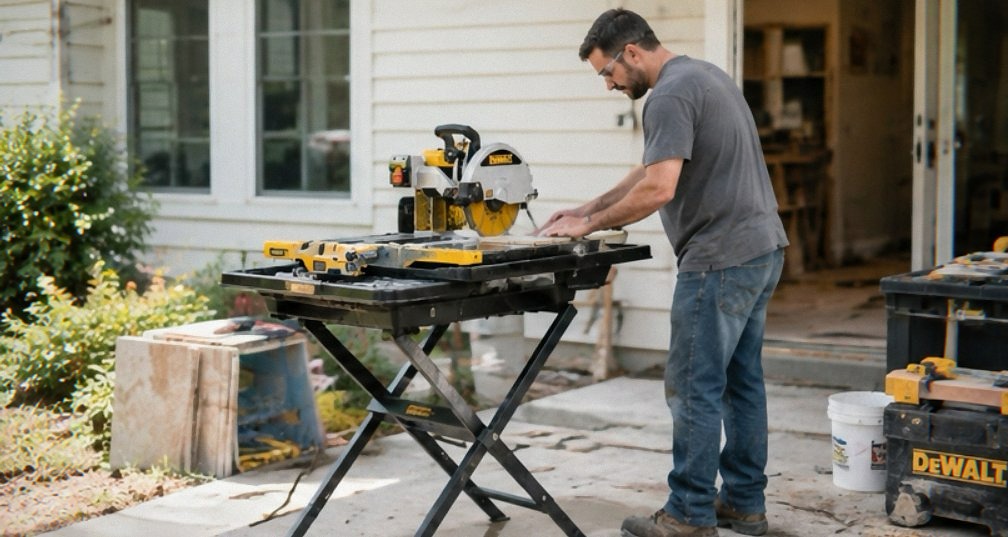
Whether you search supplier catalogs for DEWALT D24000 vs. D24000S or type DEWALT 2400 tile saw (DEWALT D2400) into an online parts house, you are looking at the most widely deployed 10-inch sliding-cart wet tile saw in North American residential remodeling. Yet tool distributors, used equipment listings, and replacement parts diagrams routinely mix up four distinct designations: D24000, D24000S, D24000B, and the factory Type 1 versus Type 2 hardware revisions.
Ordering the wrong SKU can leave you on a Monday morning jobsite with a 69-lb saw head, a 5-gallon water pan, and nowhere to set either of them except on the dirt - or conversely, paying $180 extra for a folding stand you never plan to use because you cut off a truck tailgate. In our earlier DEWALT D24000S hands-on field review, we tested the saw’s cutting accuracy and 1.5 HP motor performance. Below is the complete breakdown of how the D24000 and D24000S packages differ, what changed between Type 1 and Type 2 production runs, and whether the factory D24001 stand is worth the price difference.
Quick Model Answer: The saw head, 15-amp motor, stainless-steel rail assembly, water tray, and submersible pump are 100% identical between the
D24000and theD24000S. The trailing “S” in DEWALT D24000S on Amazon simply indicates the factory bundle that includes the heavy-duty folding steel stand (D24001). Meanwhile, “DEWALT 2400” and “DEWALT D2400” are common shorthand truncations used by contractors and Craigslist sellers referring to theD2400024-inch-rip platform.
SKU & Package Breakdown: D24000 vs. D24000S vs. D24000B
When comparing distributor quotes or shopping online, verify the exact suffix on the carton before checking out:
| Model / SKU Code | Included Hardware in Box | Total Shipping Weight | Typical Buyer Profile |
|---|---|---|---|
| DEWALT D24000 | 10” Wet Saw Head, ABS Water Pan, Rear/Side Drip Attachments, Submersible Pump, DW4764 Blade (No Stand) | ~69 lbs (31.3 kg) | Contractors mounting the saw on a custom rolling miter cart, workbench, or pickup tailgate |
| DEWALT D24000S | Everything in D24000 plus the D24001 4-Position Folding Steel Stand | ~86 lbs (39.0 kg) | Residential tile installers setting up in driveways, garages, patios, or second-floor balconies |
| DEWALT D24000B | Bare Saw Head Only (Special-order replacement SKU, often shipped without stand or external accessories) | ~62 lbs (28.1 kg) | Fleet replacement for a dropped or burned-out saw head where the crew already owns the stand and trays |
| DEWALT D24001 | Folding Steel Stand Only (Sold separately for bare D24000 owners) | ~17 lbs (7.7 kg) | Installers who bought a bare or used D24000 and later realized table-mounting blocks the drain plug |
Why Tabletop Mounting a Bare D24000 Often Frustrates Installers
At first glance, skipping the S bundle to save money and setting a bare D24000 on a pair of sawhorses with a sheet of 3/4” plywood sounds logical. In actual field use, setting the D24000 water pan flat on a solid plywood tabletop creates two annoying ergonomic headaches:
- Blocked Bottom Drain Plug: The molded ABS main water pan empties through a rubber twist-plug recessed into the bottom center of the tray. When the saw sits inside the open rectangular frame of the
D24001stand, a standard 5-gallon bucket slides directly underneath that drain hole so you can pull the plug and drain dirty porcelain slurry in 45 seconds. When the pan sits flat on a plywood workbench, you cannot pull the plug without sliding or lifting a pan full of 5 gallons (41 lbs) of gray water - which almost guarantees sloshing muddy water over your boots. - Deck Height and Lower Back Strain: The
D24000rail bed sits higher off the bottom of its water pan than a compact 7-inch tabletop saw. Placed on top of a standard 30” to 32” worktable, the sliding tile cart ends up nearly 42” off the ground. Unless you are over 6’2”, pushing 12” x 24” porcelain slabs at chest height for six hours fatigues your shoulders and reduces your downward sightline over the blade kerf.
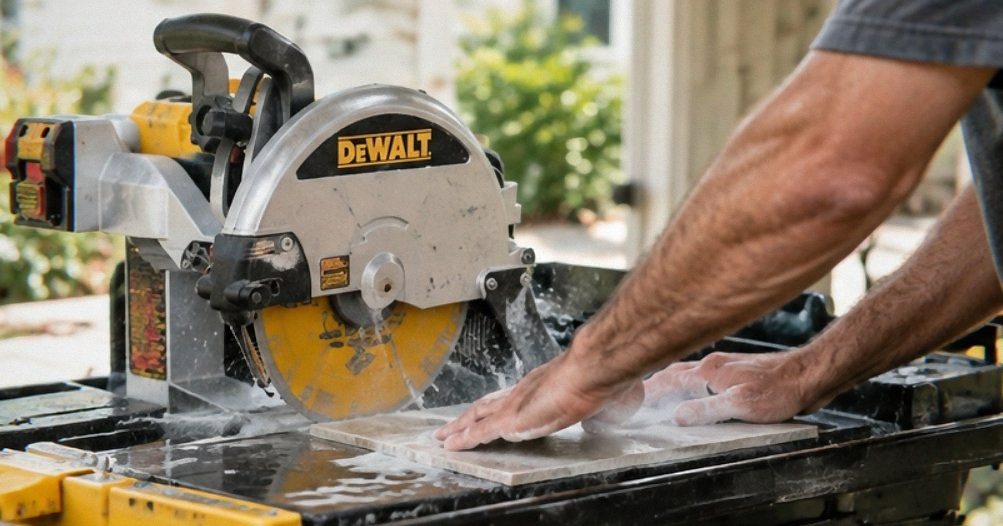
The included DEWALT D24001 folding stand on Amazon solves both issues. It features four pin-locked height positions (26.5", 30.0", 32.5", and 34.5" to the top of the stand frame), allowing you to set the sliding table right at waist level (~34" to 36" off the floor) while leaving the underside completely open for your 5-gallon wastewater bucket.
Cost Math Note: Purchased separately, the
D24001folding stand typically retails between $145 and $185. In almost every retail cycle, the complete DEWALT D24000S bundle with stand costs only $60 to $90 more than the bareD24000- making theD24000Sthe far smarter financial purchase even if you only use the stand on half of your jobs.
DEWALT D24000 Type 1 vs. Type 2: What Actually Changed?
If you are inspecting a used DEWALT 2400 tile saw or ordering replacement guide rollers, switches, or water nozzles, the serial data plate on the motor housing will state either Type 1 or Type 2. While the 1.5 HP (15A) motor specs, 24” rip capacity (25” with plunge), and 18” x 18” diagonal capacity remained unchanged, DEWALT made several internal part revisions between Type 1 and Type 2:
- Dual Water Nozzle Assembly: Early
Type 1saws used a stiffer plastic Y-manifold at the blade guard that could crack if bumped while changing blades in freezing winter weather.Type 2updated the nozzle barb fitting and flexible dual-line routing so you can aim water independently at both the leading edge of the diamond rim and the side of the blade core. - Cart Guide Roller Bearings and Eccentric Studs: Both
Type 1andType 2rely on sealed V-groove steel rollers riding along the solid stainless-steel round rail and flat rear rail. However,Type 2updated the part numbers on the eccentric adjustment bushings and locking nuts underneath the die-cast aluminum cart to hold alignment longer when cutting heavy natural stone. - Submersible Pump Impeller Housing: Later
Type 2units ship with a revised 120V submersible pump featuring a snap-off intake filter cover that is much faster to clear when mortar grit or red clay body dust clogs the intake screen.
Regardless of whether you own a Type 1 or Type 2, the fastest upgrade you can make to either machine is swapping out the factory DW4764 blade once it glazes over. Our shop test of the best 10-inch tile saw blades details which continuous-rim and mesh-turbo blades eliminate micro-chipping on brittle rectified glazes.
Why People Search for “DEWALT 2400” or “DEWALT D2400”
Newer apprentices and homeowners frequently search for a DEWALT 2400 tile saw or DEWALT D2400 because DEWALT’s model numbering system encodes the nominal rip length in the first two digits:
- D24000 / D24000S: Nominal 24-inch rip capacity (actual maximum straight rip:
24"standard cart pass, or25-1/2"by starting with the motor head plunged at the front and lifting over the tile at the end of the cut). - D36000S: Nominal 36-inch rip capacity (actual maximum straight rip:
36"standard pass, or37-1/2"with plunge).
If your upcoming remodel involves 24” x 48” large-format porcelain wall slabs or 8” x 48” wood-look floor planks, the 24-inch rail on the D24000S will fall a full foot short. Before ordering, read our side-by-side DEWALT D24000S vs. D36000S comparison and our dedicated DEWALT D36000S 36-inch wet saw review to decide whether you need the longer 36-inch rail frame.
Pairing the D24000S With a Manual Cutter and Cordless Trim Saw
Very few professional tile crews use a 10-inch wet saw for 100% of their cuts anymore. Walking outside to the driveway wet saw for every straight cross-cut on a 300-square-foot floor wastes hours of labor. Instead, seasoned installers run a three-tool system:
- Straight Score-and-Snap Cuts Indoors: Keep a 40-inch manual snap cutter like the Rubi TX-1020 MAX right inside the room to knock out 80% of your straight perimeter and plank cuts in 10 seconds with zero water mess.
- Precision L-Cuts, U-Notches, Miters, and Narrow Slivers: Stage the DEWALT D24000S outside on its folding stand for complex electrical box cutouts, shower niche miters (
22.5 degand45 degbevels), stone thresholds, and 3/8” trim strips that would shatter on a manual snapper. - Quick Dry Punch-List Trims: Keep a handheld cordless cutter such as the Makita XCC01Z 18V cordless tile saw in the van for trimming a single toilet flange notch or adjusting a transition strip after the wet saw is already packed up.
Final Verdict: Buy the D24000S Bundle, Not the Bare Saw
Unless you are replacing a damaged saw head on an existing crew rig that already has a D24001 stand in the trailer, always choose the DEWALT D24000S over the bare D24000. The folding stand sets the sliding cart at the right ergonomic height, keeps the bottom drain plug accessible for a 5-gallon bucket, and folds flat against the wall of your garage or work van in ten seconds.