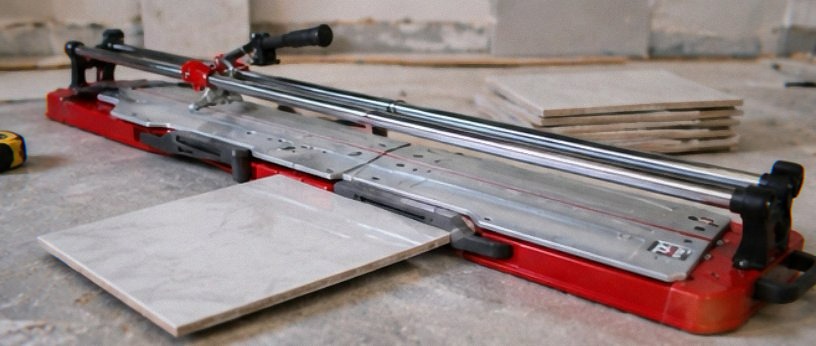
I see from the listing that the Rubi TX 1250 MAX is a 48 inch manual tile cutter aimed at large-format porcelain, and at $1,538.85 at the time of writing it sits in the upper tier of hand-operated cutters. That price buys capacity and a specific cutting mechanism, not electronics. This article covers what the 1250 mm bed actually lets you cut, how the scoring and breaking system works, where a manual cutter stops being the right tool, and how the TX 1250 MAX compares to the smaller TX-1020 MAX.
Contents
- What the 1250 mm Cutting Capacity Actually Covers
- How the Scoring and Breaking Mechanism Works
- The Case and Wheels: Transport in Practice
- TX 1250 MAX vs TX-1020 MAX: Which Bed Size You Need
- Where a Manual Cutter Loses to a Wet Saw
- Who Should Buy the Rubi TX 1250 MAX
- What to Check Before Ordering
What the 1250 mm Cutting Capacity Actually Covers
The model number is the spec. TX 1250 MAX means a 1250 mm maximum straight cut, which is 49.2 inches, and Rubi markets the tool as a 48 inch cutter for that reason. For a tiler working with 1200 x 600 mm porcelain planks or 1200 x 1200 mm slabs, the bed takes the tile in one pass without repositioning. That matters more than it sounds. Every time you flip or shift a large-format tile mid-cut, you introduce a chance of a misaligned score, and a misaligned score on a $40 porcelain slab is scrap.
Diagonal cuts are the number that catches people out. On a square bed, the maximum diagonal is shorter than the maximum straight cut, and the usable diagonal on a 1250 mm machine lands well below what you can cut straight. If your job is 1200 x 1200 mm tiles laid on the diagonal, measure the actual tile diagonal before assuming this machine covers it. The diagonal of a 1200 mm square is roughly 1697 mm, and no 1250 mm bed handles that.
Depth of cut is the other limit. Manual cutters score and break through the tile body, but they do not cut around a thick profile or through a deep relief. For standard porcelain and ceramic in the 6 to 12 mm range this machine is in its element. For thick 20 mm stone-look porcelain, expect to score and break with more force and a higher risk of a ragged edge.
How the Scoring and Breaking Mechanism Works See Today’s Deal on Amazon
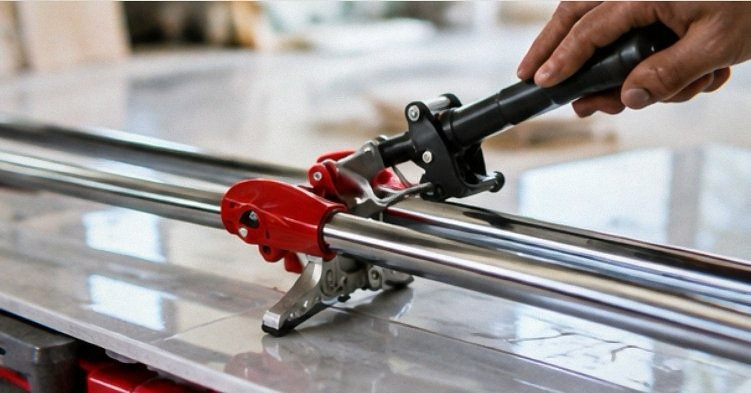
Rubi’s TX series uses a two-part action: a scoring carriage that runs on rails over the tile, then a separate breaker that applies downward pressure along the score line to propagate the crack. The separation of those two steps is the reason these machines handle dense porcelain that a cheap single-lever cutter will not touch.
The scoring wheel is a consumable. It wears, and a dull wheel produces shallow scores that break badly. Replacement wheels are widely available and inexpensive relative to the machine, but you need to keep spares on hand. A tile cutter that scores poorly is not a tile cutter.
The breaker on the TX 1250 MAX is a lever-actuated system with adjustable pressure. On very hard porcelain you increase the pressure; on softer ceramic you back it off so you do not shatter the tile. That adjustability is the practical difference between this and a fixed-pressure budget cutter. If you have ever had a tile snap in the wrong place on a cheap machine, the cause was usually insufficient or misapplied breaking pressure, not the tile.
One thing to be clear about: this is a scoring and breaking tool, not a cutting tool in the saw sense. It does not remove material. It creates a controlled fracture. Cuts that need a finished edge, a curve, or a hole go to a wet saw or a grinder regardless of how much you spent here.
The Case and Wheels: Transport in Practice
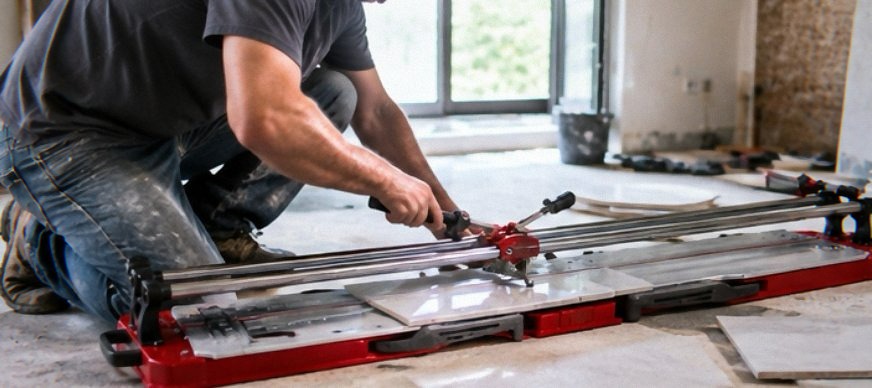
A 1250 mm cutter is a long object. The bed alone is over four feet, and the assembled machine is heavy enough that carrying it by hand across a site is not realistic for one person over any distance. The included case and wheels are not accessories bolted on for marketing; they are the difference between a tool you can move between jobs and one that lives permanently in a garage.
The wheels let you roll it upright rather than carry it flat, which is the only sane way to move something this length through a doorway. The case protects the rails and the scoring carriage during transport, and rails are the part most likely to be damaged by careless handling. A bent rail makes the carriage bind, and a binding carriage scores unevenly. Treat the case as load-bearing equipment, not packaging.
Storage is the cost nobody mentions. A 48 inch cutter needs a wall, a rack, or a corner where it can stand without being leaned on anything that could flex the bed. If you work out of a van, measure the interior length first. This will not fit diagonally in a short-wheelbase van with a full load.
TX 1250 MAX vs TX-1020 MAX: Which Bed Size You Need
The Rubi TX-1020 MAX with case is the same family at 1020 mm, roughly 40 inches. The mechanism, the scoring carriage design, and the breaking action are the same idea at a smaller scale. The decision between them is almost entirely about the largest tile you will actually lay.
| TX 1250 MAX | TX-1020 MAX | |
|---|---|---|
| Max straight cut | 1250 mm (approx. 49 in) | 1020 mm (approx. 40 in) |
| Handles 1200 mm tile | Yes, straight cuts | No |
| Handles 600 x 1200 mm plank | Yes, lengthwise | Yes, crosswise only |
| Footprint and weight | Larger, heavier | Smaller, easier to move |
If your work is 600 x 600 mm and 600 x 1200 mm tile laid in a standard grid, the TX-1020 MAX covers the vast majority of cuts and is easier to live with. The 1250 MAX earns its extra size and cost when 1200 mm square tile or 1200 mm planks are routine rather than occasional. Buying the bigger bed “just in case” means carrying and storing 20 extra centimetres of machine on every job for a capability you may use twice a year.
Where a Manual Cutter Loses to a Wet Saw
A manual cutter is faster, cleaner, and quieter than a wet saw for straight cuts on porcelain. No water, no slurry, no drying time before you set the tile. That is the whole argument for a machine like this, and it is a strong one on a production tiling job.
It loses on three things. First, L-shaped cuts, notches, and holes: a manual cutter can score and break simple notches with practice, but complex shapes need a saw or grinder. Second, very hard or very thick porcelain where even a good score will not break cleanly: a wet saw cuts through regardless of hardness. Third, any cut where the edge will be exposed and needs to look factory-finished. Manual breaking leaves a slightly rougher edge than a diamond blade, and on a visible cut you will be dressing it with a stone either way.
If your work is mostly straight cuts on standard porcelain, a manual cutter at this level replaces the wet saw for the majority of your day. If your work is mostly mosaics, curves, and cutouts, this machine is the wrong purchase at any price.
Who Should Buy the Rubi TX 1250 MAX
This is a professional tool at a professional price. At $1,538.85 on the current listing, the buyer who gets value from it is someone regularly laying 1200 mm format porcelain, where the alternative is either a much larger wet saw or a lot of slow, error-prone work with a smaller cutter. The break-even is not many jobs. A single mis-cut 1200 mm slab can cost a meaningful fraction of the machine, and the 1250 MAX is the tool that removes that failure mode for straight cuts.
The buyer who should spend less is the DIY tiler doing one bathroom in 300 x 600 mm ceramic. The TX-1020 MAX is cheaper, smaller, and covers that job completely. Buying the 1250 MAX for a single small-format project is paying for capacity you will never use and storage space you will resent.See Today’s Deal on Amazon
The buyer who should not buy either is anyone whose cuts are mostly curved, notched, or on very thick stone. That work belongs to a wet saw, and no manual cutter substitutes for it.
If you buy through a link on this page I may earn a small commission. It does not change what you pay.
What to Check Before Ordering
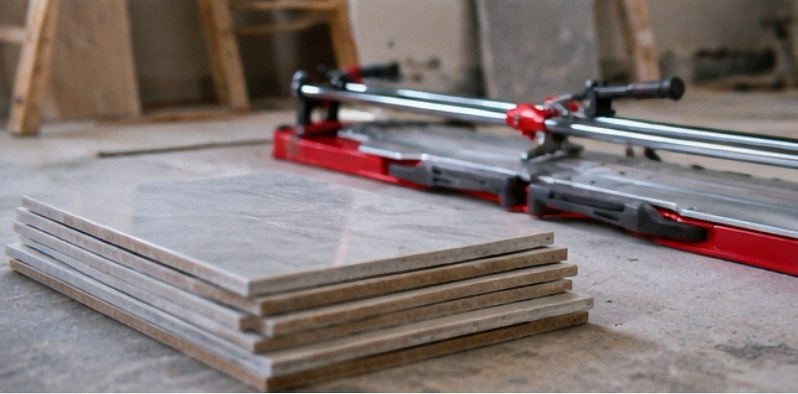
Confirm the tile sizes on your actual job, not the sizes you might use someday. Measure the longest straight cut and, separately, the longest diagonal cut you need. If the diagonal exceeds the bed, this machine cannot do it and you need a saw.
Check that the listing includes the case and wheels, since the case is the transport solution and a cutter this size without one is a permanent fixture. Check the replacement scoring wheel part number for your region and buy spares with the machine, because a worn wheel is the most common reason a good cutter starts performing badly. And confirm the current price and availability on the listing for this model, since tool pricing moves and the figure above is only accurate at the time of writing.
One last thing worth checking: the warranty terms and who services Rubi tools in your country. On a machine at this price, the availability of parts and service matters as much as the spec sheet.