The DEWALT D24000S is a 10-inch corded wet tile saw sold with a folding stand, It sits in the category of sliding-rail wet saws that trade portability for capacity, This article covers what the machine actually does, where the wet-cutting design helps and hurts, and whether it makes sense over a smaller dry tile saw or a budget wet saw.
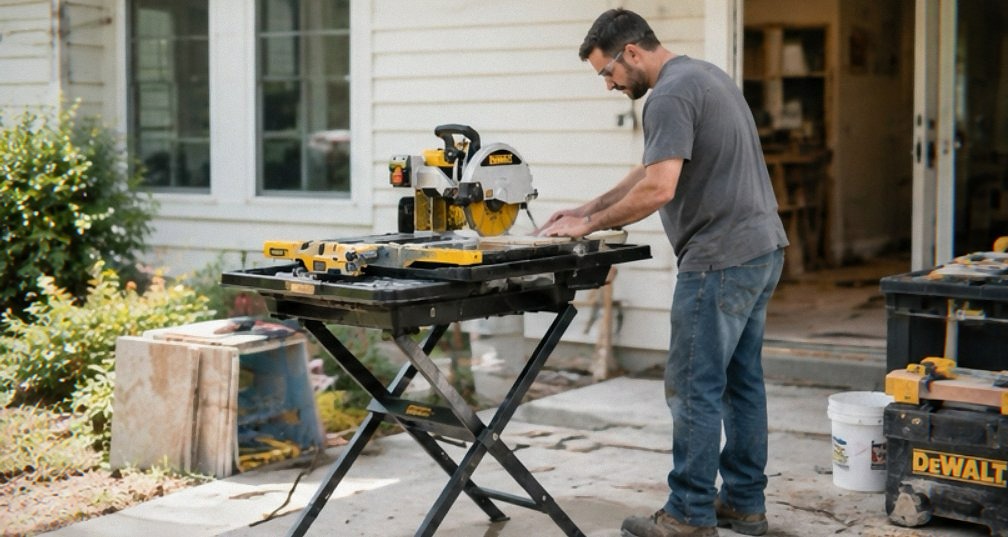
What the D24000S Actually Is
The D24000S is a rail-style wet saw. The blade stays fixed and the table slides past it, which is the opposite of a typical benchtop wet saw where you push the tile into a stationary blade. That layout is the reason this machine can cross-cut a large-format tile that would jam against the fence on a smaller saw.
The 10-inch blade gives it the depth to cut through thick porcelain and natural stone that a 7-inch saw cannot reach in one pass. DEWALT pairs the saw with a rolling stand that folds down for transport, which matters because the saw body itself is heavy enough that carrying it loose is unpleasant.
It is a corded tool. There is no battery option here, and that is a deliberate trade: wet saws draw continuous current for the water pump and the motor at the same time, and a cordless version of a saw this size would not survive a full day of cutting.
Wet Cutting vs a Dry Tile Saw See Today’s Deal on Amazon
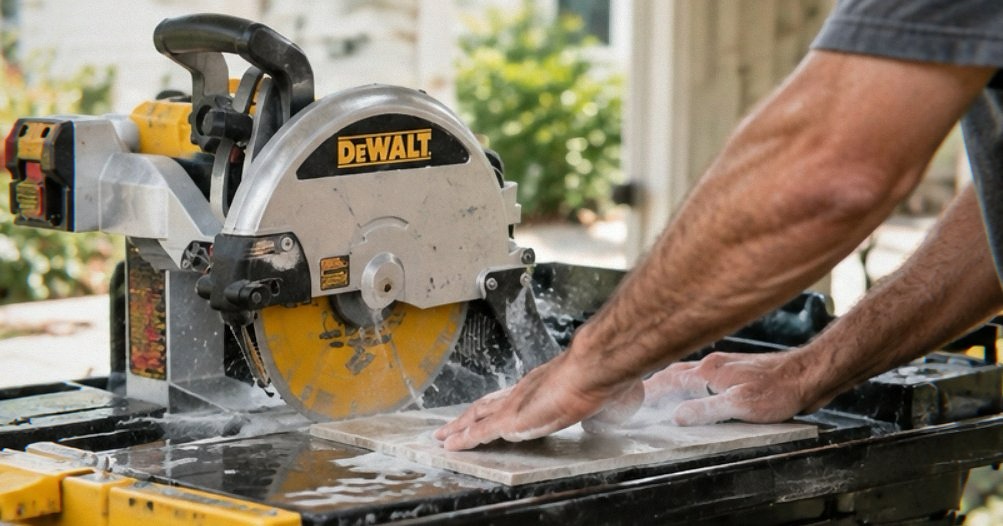
The name of this category causes real confusion, so it is worth being direct. A dry tile saw uses a blade and dust shroud to cut without water, and it trades finish quality and blade life for the convenience of not dealing with a water tray. A wet saw like the D24000S runs water over the blade continuously, which suppresses silica dust and keeps the blade cool.
Those two things matter more than most buyers expect. Silica dust from cutting tile is a genuine health hazard, and a wet saw keeps almost all of it out of the air. The water also extends blade life considerably, especially on hard porcelain. The cost is that you are working with a reservoir that needs filling, a pump that needs to keep running, and a slurry of water and tile dust that has to be cleaned out before it dries into cement.
If your cutting is mostly small ceramic and you are working indoors in a finished room, a dry saw like the [Iq Power Tools 7-inch dry cut bench saw with integrated dust control] avoids the water management problem entirely. If you are cutting large porcelain, natural stone, or anything in volume, the wet approach is the one that produces a clean, chip-free edge.
Capacity and Cut Types
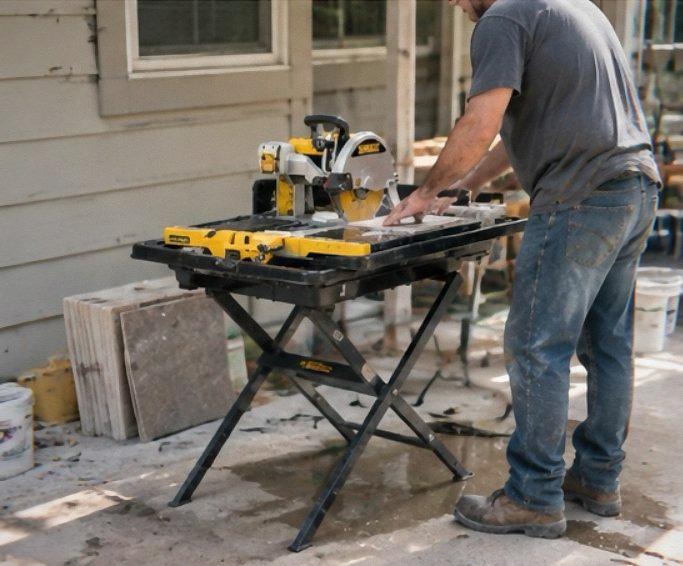
DEWALT rates this saw for rip cuts and diagonal cuts on large-format tile, and the sliding table is what makes both possible. The table rides on rails, so the tile moves rather than the blade, and the work piece stays fully supported through the cut.
Straight and diagonal cuts
Rip capacity on a 10-inch wet saw of this layout is generous enough for standard 12x24 porcelain laid flat, and diagonal cuts across that same tile are achievable because the table travel is long. If you are installing large-format floor tile, this is the class of saw that stops you from making relief cuts and snapping the tile, which is where most amateur installs go wrong.
Bevel and miter cuts
The saw head tilts for bevel cuts, and the table has miter detents for angled cuts. Both features are useful for edge trim and for meeting tile at an outside corner, though bevel cuts on thick porcelain are slow going regardless of the saw.
Depth of cut See Today’s Deal on Amazon
A 10-inch blade gives you more depth than a 7-inch blade, which is the single biggest reason to step up to this size. Thick porcelain and stone that would need two passes on a smaller saw cut in one here.
The Stand and Portability
The folding stand is the part of this package that buyers tend to underestimate. A saw of this size on a pair of sawhorses is unstable, and instability is how you get a wandering cut. The stand puts the table at working height and folds down so the whole assembly can be moved in a truck bed or against a wall in a garage.
Portability is relative, though. This is a saw you move between jobs, not a saw you carry up a ladder. It is heavy, it needs a water source, and it needs somewhere to drain. If your work is on a second floor or in a tight bathroom, the setup and teardown time is real.
Water Management and Cleanup
The pump recirculates water from the tray, which means you are not running a hose. That is convenient, but it also means the tray fills with slurry as you cut. On a long day of porcelain, the water turns opaque and the pump intake can clog if you do not top up and rinse.
Cleanup is the honest cost of owning a wet saw. Drain the tray, rinse the pump, wipe the rails, and let everything dry before storage. Skip it and the slurry hardens into something you will be scraping off with a putty knife. Buyers who cut tile a few times a year should weigh that against a dry saw they can vacuum out in two minutes.
Where a Smaller Saw Makes More Sense
A 10-inch rail saw is not the right tool for every tile job. If your work is backsplash tile, small ceramic, or occasional repairs, this machine is more capacity, more weight, and more cleanup than the job requires.
A cordless option like the [Makita XCC01Z 18V brushless 5-inch wet/dry masonry saw] covers small cuts without a cord or a tray, and it fits in a bag. It will not cross-cut a 12x24 porcelain tile, but it will handle the trim work around it. Many installers end up owning both a large wet saw for the field and a small saw for detail work.
If you buy through a link on this page I may earn a small commission. It does not change what you pay.
What the Rating Does and Does Not Tell You
A 4.7 average across 826 ratings is a strong signal for a tool in this price bracket, and it is consistent with a machine that does one job well and is bought by people who already know why they need it. It is not evidence that the saw is easy to set up, light, or cheap to maintain. Ratings on professional tools skew toward people who bought the tool for its intended purpose.
The documented limitations are the ones to weigh: corded only, heavy, needs water, needs cleaning. None of those are defects. They are the design.
Who Should Buy the DEWALT D24000S
Buy this saw if you are cutting large-format porcelain or natural stone, if you do it often enough to justify the setup, and if you have a space where water and slurry are not a problem. The sliding table, the 10-inch blade, and the included stand are the three things that separate it from a benchtop saw, and together they are what the price buys.
Spend less if your tile work is small ceramic, backsplash, or occasional repair. A compact wet saw or a dry saw with dust control will do that work for a fraction of the money and a fraction of the cleanup.
Before ordering, check two things: that the current listing includes the stand rather than the saw alone, and that you have a level surface and a power source where you plan to cut. The [current price on Amazon](See Today’s Deal on Amazon) moves, and the stand is the part of the bundle most often sold separately.