The old rental saw died mid-cut on a Saturday. Just stopped. No warning, no courtesy, just a sad little hum and then nothing. I was halfway through a 12x24 porcelain tile in the middle of my master bathroom floor, surrounded by mortar dust and questionable life choices. That’s when I decided—fine. I’m buying one. No more renting, no more borrowing, no more praying that the guy before me didn’t run a nail through the blade.
I bought the DEWALT D24000 wet tile saw with stand. The big one. The one that costs a thousand bucks and weighs as much as a small adult. And honestly? After wrestling this thing out of the box, I’m still not sure if I bought a tool or adopted a very heavy, very loud pet that occasionally shoots water at me.
Let me be real with you. I’m not a contractor. I’m a guy who has spent way too many weekends fixing things that were supposed to be “fine.” I tiled a kitchen backsplash with a $60 angle grinder once and spent the next three years apologizing to anyone who looked at it too closely. So this saw is overkill for me. Way overkill. But overkill feels really, really good when you’re staring down 400 square feet of limestone.
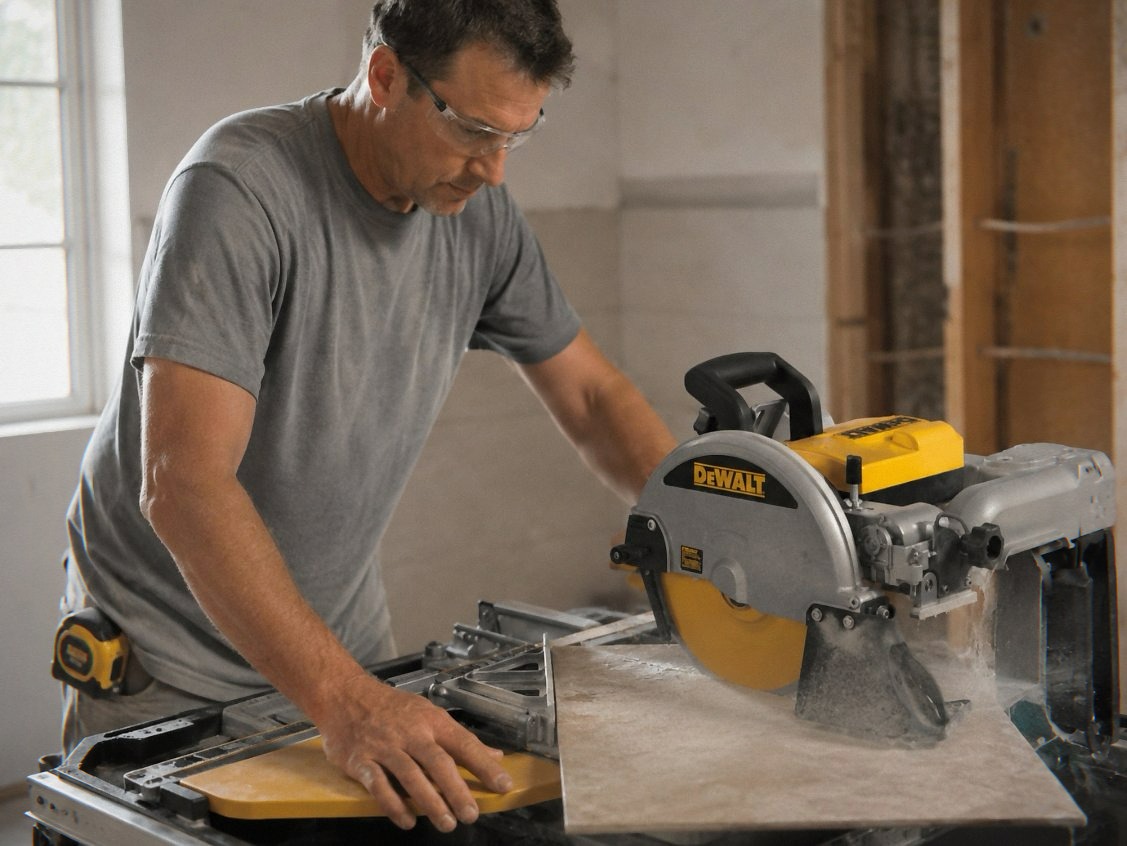
First Impressions: This Thing Is A Monster
The box arrives. Two boxes, actually. One for the saw, one for the stand. My neighbor asked if I was building a motorcycle. I dragged them into the garage and stood there for a solid minute, just looking at the sheer mass of it. The D24000 itself is 69 pounds. That’s not a typo. Sixty-nine pounds of American-made muscle, stainless steel rails, and a motor that does not apologize for its 15 amps. The stand folds up, which is great if your truck has a bed, but I’m moving this thing from my garage to the bathroom through a doorframe that’s exactly two inches wider than the saw. I had to take the door off. Hinges and everything.
Assembly took about 20 minutes, but only because the manual is an absolute disaster. I’m not exaggerating. It’s like someone translated it from another language that was itself poorly translated from interpretive dance. The pictures don’t match the parts. The bolts are in bags with no labels. At one point I was holding a hex wrench and a spring and just staring at the diagram of a screw that apparently exists in a parallel dimension. I ended up doing what any reasonable person would—I found a YouTube video from some dude named Ed in Florida who sounded like he was recording in a wind tunnel, and I followed that instead.
But once it’s together? Oh man. The stand is surprisingly stable. It looks a little flimsy when it’s empty, like it’s going to fold up on you the second you sneeze near it. But once you drop the saw’s plastic tub into the frame, it locks in solid. Zero wobble. I leaned on it, shook it, tried to make it tip. Nothing. My dining table has more give than this thing.
The Cut Line Indicator Isn’t Lying
Here’s where it gets good. The cut line indicator—that little built-in light and guide thing—is dead accurate. I’m talking within 1/32 of an inch across an 18-inch tile. I didn’t believe it at first. I marked a pencil line, fed the tile through, and the cut was so close to the mark that I had to squint to see the difference. That’s the stainless steel rail system doing its job. The cart rolls smooth, the rollers keep the tile aligned, and the whole thing feels like it was machined by people who really, really hate chipped edges.
I threw a 18x18 porcelain tile at it first. Diagonal cut. The saw laughed. The D24000 has a diagonal cut capacity up to 18x18, which means you can slice a massive tile corner-to-corner without having to flip it or fudge the measurement. Max rip capacity with plunge is 28 inches. Twenty-eight. I could cut a cinder block in half if I wanted to. Not that I’ve tried. Yet.
The 1.5 HP motor is no joke. It doesn’t bog down. I cut through some really dense ceramic—the kind that usually scoffs at cheap blades and sends them into a chipping frenzy—and the saw just… went. The blade it comes with is the DEWALT XP4 porcelain tile blade, and it handles its own well, but I’ll get to that in a minute because there’s a catch.
That Catch About the Blade
The blade it ships with? Fine for rough cuts. Borderline annoying for finish work. I read a ton of reviews before buying, and one guy said it chipped his cheap Mohawk porcelain so bad he almost returned the whole saw. I used it for some test cuts on a scrap piece, and yeah, it’s not the smoothest. It’s acceptable for job-site stuff—pavers, cheap subway tile, anything that’s getting grouted to hell anyway—but if you’re doing visible edges or polished marble, swap it out. Immediately. I put a Pearl P5 mesh blade on mine, and the difference was night and day. Smooth as butter. Clean edges, zero fractures. The D24000 didn’t care what blade I used; it just powered through. So don’t blame the saw. Blame the accessory budget.
If you grab one through the links here, I might get a small cut — costs you nothing extra and keeps the lights on. DEWALT D24000 Wet Tile Saw on Amazon
Water, Water Everywhere (But Actually Not)
This is the part that blew my mind. The water containment is ridiculous. In a good way. I was fully prepared to tarp off half my bathroom and mop up a flood every ten minutes. I’ve used wet saws before. They spray. They mist. They coat you and your floor and your dignity in a fine gray sludge. But this thing? The pan holds five gallons, and the rear and side attachments catch basically everything. The side water tray moves with the cutting cart, so water doesn’t spill when you push the tile through. I ran 50 cuts on my kitchen floor—hardwood, no less—and there wasn’t a single puddle. A very fine mist settled within a couple feet of the saw, but nothing a quick wipe couldn’t handle. The two adjustable nozzles let you aim the water right where it needs to go. It’s weirdly satisfying, watching that stream hit the blade just right.
Although my wife came in and asked why there was a weird “burning and wet concrete” smell in the house. That’s the motor and the blade and the water all doing their thing. It fades after a couple cuts, but yeah, that first one will make you think something’s wrong. Nothing’s wrong. It’s just the smell of progress.

Bevels, Angles, and That One Cut That Fits Perfectly
The motor tilts. 45 degrees. 22.5 degrees. Locks in solid. No accessory cart block needed. I needed to make some miter cuts for a shower niche and some bullnose edges, and I was dreading it. You know that moment where you set up a cut, measure twice, cut once, and still end up with a gap you could park a car in? Not here. I locked it at 45, ran a scrap through, and it was perfect. I made eight bullnose pieces for a 13-inch tile in maybe ten minutes with a radius blade. The flip-style edge guide made corner cuts snap into place. I didn’t have to futz with a separate jig or a clamp system. It’s all built in, and it works.
Also, the bevel capacity? 45 degrees. That’s standard, but the way it holds the angle—tight, no creep—is what matters. I’ve used saws where you lock the bevel and then the vibration slowly nudges it a degree or two off. You don’t catch it until the piece is already cut and you’re holding it up to the wall like, “huh, that’s not quite right.” This thing stays put.
The Not-So-Great Stuff (Because Nothing Is Perfect)
Okay. Let’s get the downsides out of the way, because this isn’t a love letter, it’s a review.
-
It’s heavy. 69 pounds. You’re not carrying this up a flight of stairs without a break. The stand helps for transport on flat ground—it folds up and rolls if you lift one end—but if you have a job site with stairs, mud, or tight corners, you’re gonna sweat. I set it up once and left it in place for the whole project.
-
The pump. It’s fine, but it’s better to run it from a separate five-gallon bucket instead of the pan. If you use the pan, it circulates muddy water. Muddy water doesn’t cut as clean. And it clogs faster. I followed the advice from a review and dropped the pump in a bucket next to the saw. Clean water in, muddy water out. The saw doesn’t care. The pump runs quieter, and the blade stays cooler. It’s a weird quirk but works perfectly.
-
The LED. There’s a cut line indicator, but it’s not the brightest. In a well-lit garage, it’s fine. In a shadowy bathroom with a single work light, it’s a little faint. Not a dealbreaker—I use a pencil line anyway—but worth noting.
-
The blade alignment. It’s not dead square out of the box. Mine was off by maybe half a degree. Took me seven minutes with a square and an Allen wrench to fix. The manual doesn’t tell you how to do this properly. But it’s simple: loosen the two bolts behind the blade guard, adjust the tilt, and tighten. If you’re not comfortable doing that, maybe ask a friend who is, or watch a video. It’s basic, but annoying that it wasn’t set at the factory.
-
The price. It’s a thousand dollars. Or, well, $999.00. Or $949 if you get the Amazon Visa instant discount. That’s a lot of money. That’s “I could have bought a used car and a really nice dinner” money. But I also spent $300 on rentals for a single weekend last year, so over the course of a full bathroom and kitchen reno, this pays for itself. If you’re doing one backsplash and never touching tile again? Rent something cheaper. If you have multiple projects, or you’re a glutton for punishment like me, this is the one.
The One Detail Only An Owner Would Know
The charging light? There isn’t one, because it’s corded. But there’s a weirdly specific thing—the pump makes this soft, rhythmic gurgling sound when the water level gets low. It’s not a warning, it’s not a buzzer, it’s just a subtle change in the water flow tone. I didn’t notice it the first time and ended up running the pump dry for a minute. Now I listen for it like it’s a tiny aquatic heartbeat telling me to top off the bucket. It’s oddly reassuring, actually. Also, the tub has four molded sections on the bottom that lock into the stand, and those sections collect tile dust like a coffee filter. You’ll find a fine gray powder in every crevice, even after cleaning. Just accept it. That’s your new permanent accessory.
Use It On the Floor or On a Workbench
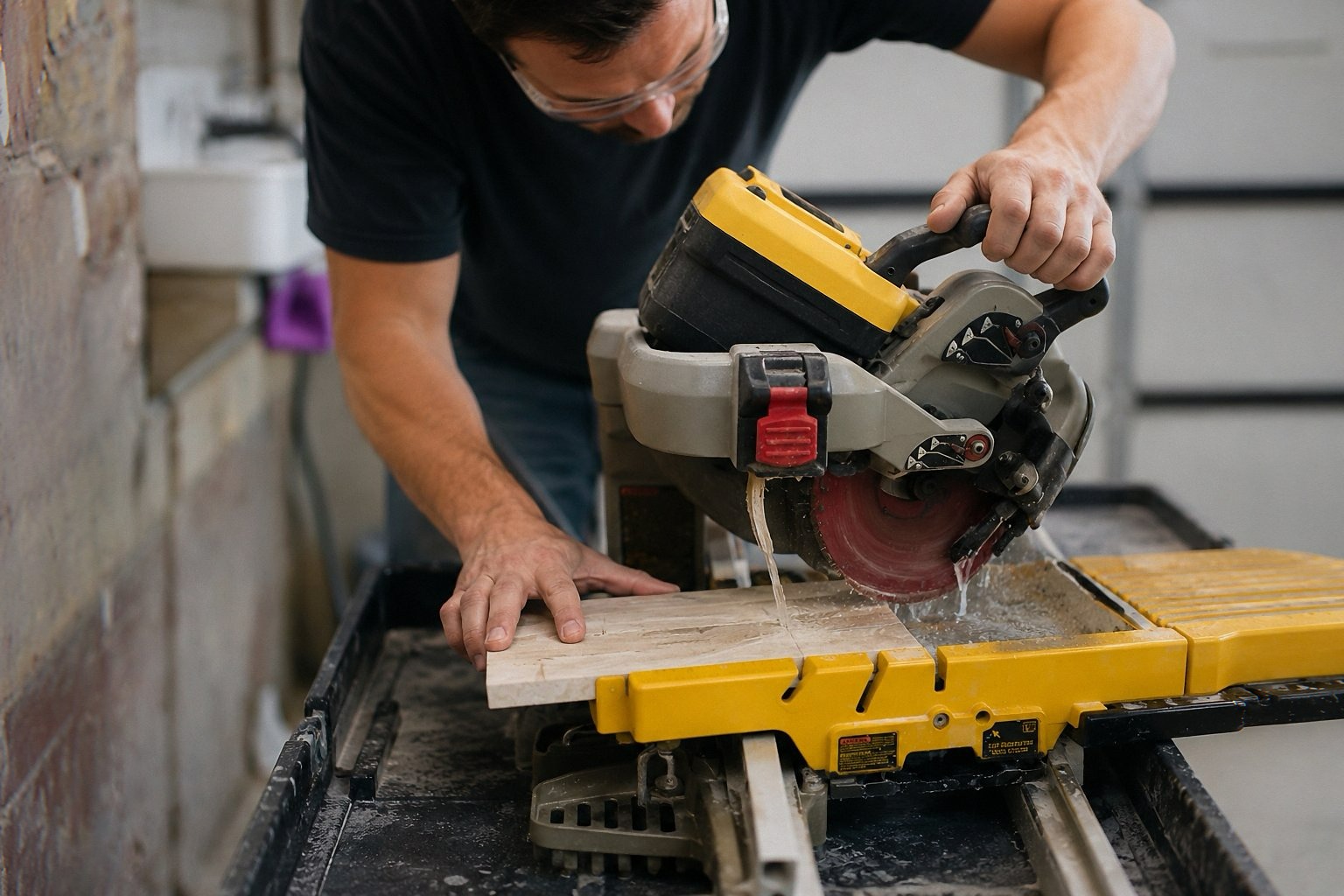
The stand is good. I like the stand. But you can also use the saw without the stand if you’re setting it on a workbench or sawhorses. The tub has a flat bottom, so it’s stable. If you have a more permanent shop setup, you might skip the stand entirely. But for job sites, the folding stand is a lifesaver. It’s aluminum and stainless steel, so it won’t rust in a damp garage. Folds down to fit in the back of a minivan, believe it or not.
One thing: the stand doesn’t have wheels. It’s a folding skeleton with little feet. If you want to move it, you either slide it, lift it, or partially fold it and drag it like a reluctant suitcase. I ended up getting a cheap furniture dolly from Harbor Freight and just strapped the whole thing on when I needed to move between rooms. Not ideal, but functional.
Final Rambling Thoughts
I cut 400 square feet of tile with this thing. Not a single broken cut. Not one chip I couldn’t hide with grout. The cuts were straight, the bevels fit like they were meant to be there, and the water stayed where it belonged. I used it for a floor, a shower, a backsplash, and a fireplace surround. It handled all of them. No drama. Just work.
The blade that came with it is garbage for fine work. The manual is a joke. The weight is a literal pain in the back. But the saw itself? It’s the best I’ve ever used. I’d buy it again. I might even buy a second one just to have a spare, if I had the space and a very generous credit limit. But I don’t. So I’ll just keep this one clean, replace the blade, and hope my kids don’t sell it for pennies when I’m gone.
Anyway, I’m almost done. I have to go clean out the water tray. There’s a brown ring around it that’s starting to look like a permanent reminder of my stubbornness. Let me grab a sponge.
DEWALT D24000 Wet Tile Saw on Amazon
If you’re tiling a bathroom, a kitchen, or just have a bizarre passion for cutting rocks, this is the saw. Just be prepared to wrestle it into your life. And maybe buy a better blade.