The third tile broke exactly like the first two. Clean score, one confident snap, and instead of splitting along the line it shattered into three jagged pieces and a puff of dust on the kitchen floor. My manual scorer had become a tile confetti machine, and the stack of porcelain in the hallway was staring at me.
I stood there with a shard in each hand and a very quiet wife behind me. You know that silence. It’s the one that says “we paid real money for this tile and you are breaking it.”
So I went hunting for a wet saw, angry and cheap. That combination usually ends in regret and a return label. This time it ended with a dented box on my doorstep and a machine I’ve spent a month deciding how to feel about. The VEVOR Wet Tile Saw with Stand showed up with a 10-inch 65Mn steel blade, a 4500 RPM motor, a wheeled stand, and a set of expectations I kept deliberately low.
First Contact With the VEVOR Wet Tile Saw
The box looked like someone had used it as a step stool at a bus stop. The outer packaging did its job by the skin of its teeth, because the inner carton had a crease straight down the middle and foam that had clearly been through something. One corner was basically styrofoam crumbs. I lifted the lid expecting carnage.
Inside: the saw, a manual, and two wrenches. That’s the entire list. Saw, manual, two wrenches. Read it twice, because the water pump isn’t on it.
I did not notice this at the time. I was too busy dragging the saw out of the box without scratching anything, which is impossible. It’s a big machine, a full table-on-legs unit, and it weighs enough that you’ll use both hands and one bad word. The rubber wheels on the base are honest little things, hard and slightly squeaky on the laminate, and once you accept that you’re steering a small shopping cart rather than a precision instrument, they roll fine.
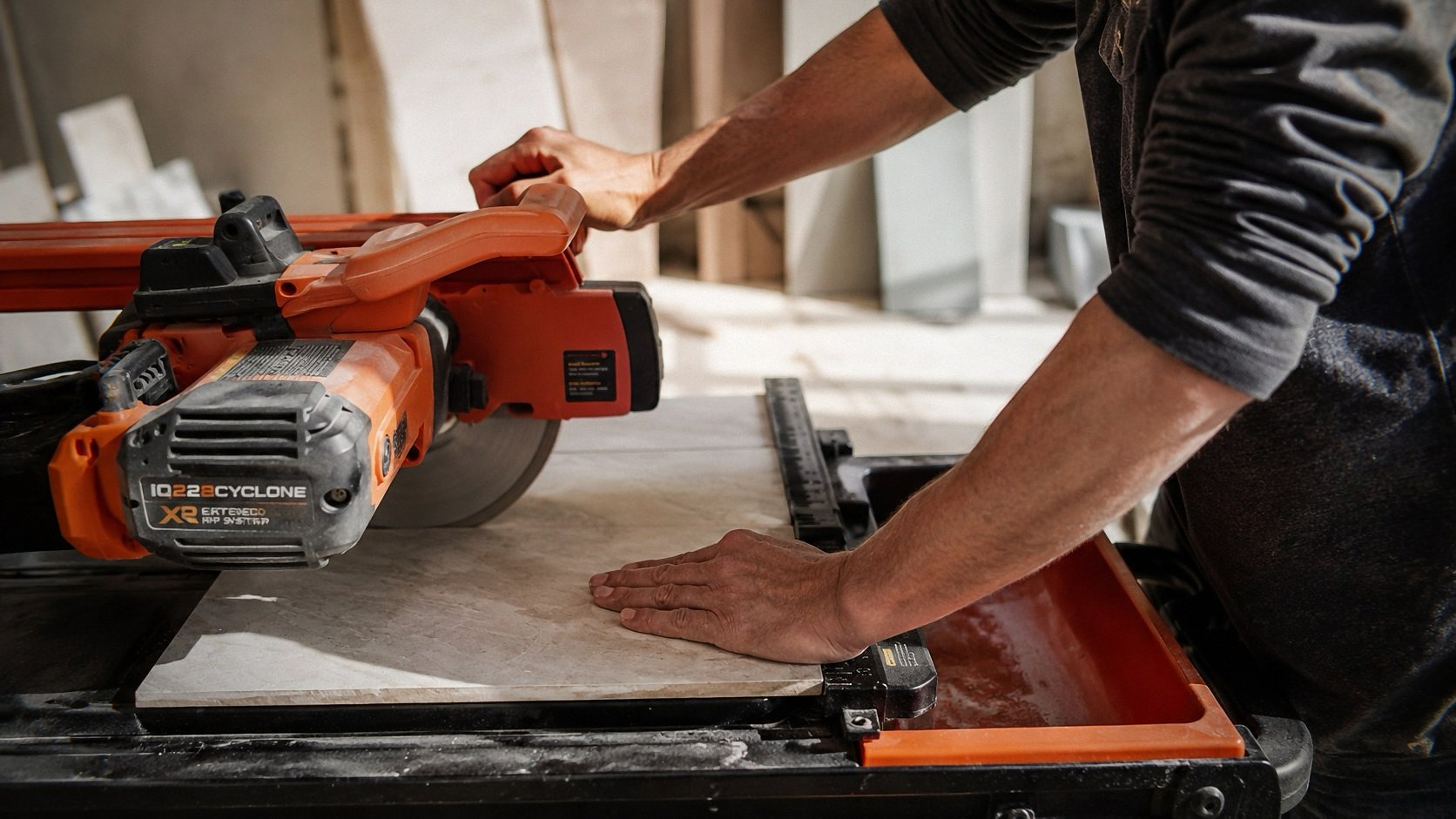
The switch is the first thing that surprised me. It clunks. A solid, satisfying clunk, like a good car door, not a cheap plastic click. I appreciated that, because the next twenty minutes were me wrestling with the manual, which reads like it was machine-translated twice and never proofread. I got it assembled anyway. It’s a table on legs with a blade under it. You’d have to try to get it wrong.
Cutting Porcelain Without Losing My Mind
The honest spec sheet: 10-inch 65Mn steel blade, 4500 RPM induction motor, miter angles from 0 to 45 degrees with detents at 0, 22.5, and 45, and a listed cutting length of 36 inches / 914 mm. The blade that ships with it is decent. Not premium, not garbage — the kind of blade that cuts clean through a year of weekend projects before you start researching replacements.
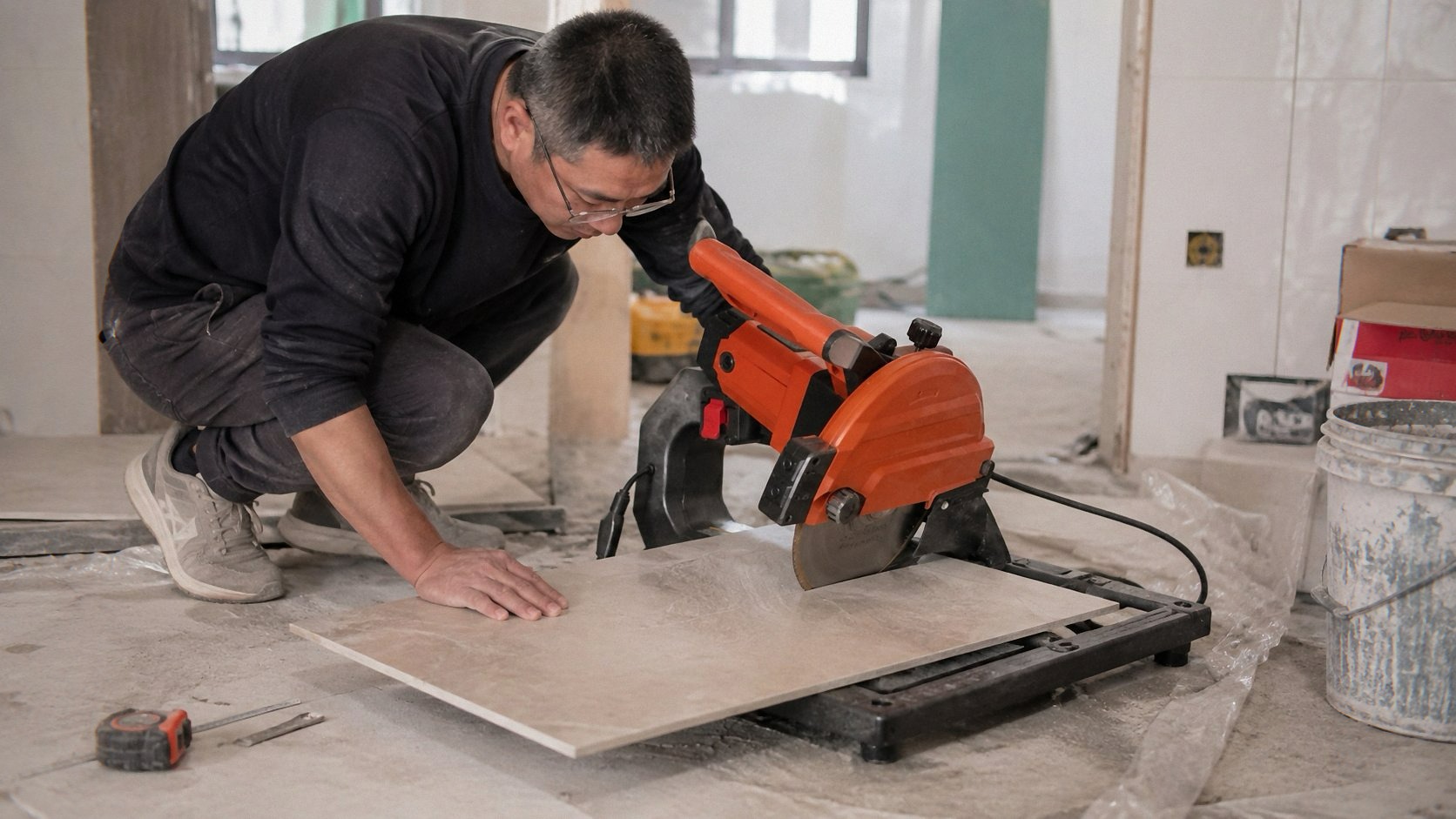
My first real job was ripping a porcelain tile lengthwise, the exact task that murdered my manual scorer. I lined up the built-in scale, hit the clunk switch, and pushed. The motor doesn’t strain; it chews. The cut came out straight, and the edge was clean — no chipped glaze, no screaming, no dust cloud. My wife’s silence turned into a skeptical “huh,” and then actual approval when the piece sat against the wall with a gap you could measure in paper-thicknesses.
The infrared line is a red guide that shows where the blade is going to land, and it’s genuinely useful in a garage at dusk. In direct sunlight it’s basically a rumor. I spent a full afternoon squinting at it with my hand cupped over the emitter like a caveman before I gave up and started cutting in the shade. Plan around that.
The miter detents click into place with a small, satisfying thunk. I cut a mitered edge for a shelf lip and it came out square enough that I stopped double-checking it with the square. The blade guard is a partial shell — it covers the top and the front, and the back of the blade is out there living its life. I got used to it in about ten minutes. Don’t get complacent anyway.
The Water Situation
The whole point of a wet saw is the water, and this is where the review gets personal. The VEVOR has a PP reservoir under the table, and when you fill it and let the blade dip in, the slurry stays contained. No dust. My lungs noticed. The floor noticed. The layer of fine powder that used to coat everything after every cutting session simply did not happen, and that alone was worth the price of admission.
But the pump that recirculates water from the reservoir to the blade is not in the box. I found this out mid-project, reading the manual’s accessories page while holding a wrench and feeling like I’d been tricked at the register. One of the Amazon reviews says the exact same thing — “the water pump which I bought separately because the tile cutter I purchased didn’t come with it.” Another reviewer’s unit arrived with the pump and blade missing entirely, and when they went to the seller for help, nobody did anything useful. Amazon refunded them in the end, which tells you where the real warranty lives.
So budget for a pump, or be ready to hand-drip water onto the cut like a Victorian aqueduct. I bought a cheap submersible pump and it’s been fine. The saw cuts beautifully even without one as long as the blade keeps dipping into the reservoir; it’s just messier, and you top it up every few cuts.
Owner detail nobody mentions: the drain plug on the reservoir is positioned to drip exactly onto your shoes. Every single time, both feet, like it’s personal. And if you leave water in the tray for a week, it smells like a neglected aquarium. Drain it when you’re done. Mop up. Move on.
The Parts I’d Warn a Friend About
The packaging is the first honest complaint. Thin cardboard, weak foam, and a blade rattling loose in the box — one reviewer had theirs arrive battered on both sides with the foam in pieces, and mine was a coin flip away from that. Unbox carefully. Photograph everything before you power it on. If something’s missing, you’ll want the evidence.
The manual is bad. Not quirky bad — instructions-unclear, assembled-a-chair-instead bad. If you’ve never owned a wet saw, spend ten minutes watching someone use one first, because the manual will not save you.
The support story is real too. The angry one-star reviews aren’t mostly about the saw cutting badly; they’re about the company going quiet when the box shows up wrong. That’s the risk you accept at this price, and Amazon’s 30-day return window is the actual safety net.
The saw is big, and there’s no good place to store it. Mine lives against the garage wall under a tarp, and I trip over the stand legs at least weekly. The wheels make it easy to move around, which is the whole trade — mobility in exchange for footprint.
The price also moves around like a flea market vendor. I paid one number, and two days later the listing showed a different one with a coupon attached. It’s still well under a hundred dollars, which is the point. Name-brand saws with stands run two or three times that, and for the money there isn’t a serious alternative that cuts porcelain with clean edges and zero dust. That’s why, after a full backsplash and a bathroom floor, I’d still point anyone at the VEVOR Wet Tile Saw with Stand.