The laminate planks were stacking up in the hallway. I had the jigsaw out, the circular saw out, and a miter saw in the garage that I didn’t want to carry up two flights of stairs. One cut with the jigsaw took thirty seconds and chipped the edge. The circular saw made a clean cut but required a guide, a clamp, and a prayer that I wasn’t cutting into the flooring underneath. My wife asked, “Is there a tool that just does this?” And I knew there had to be something better.
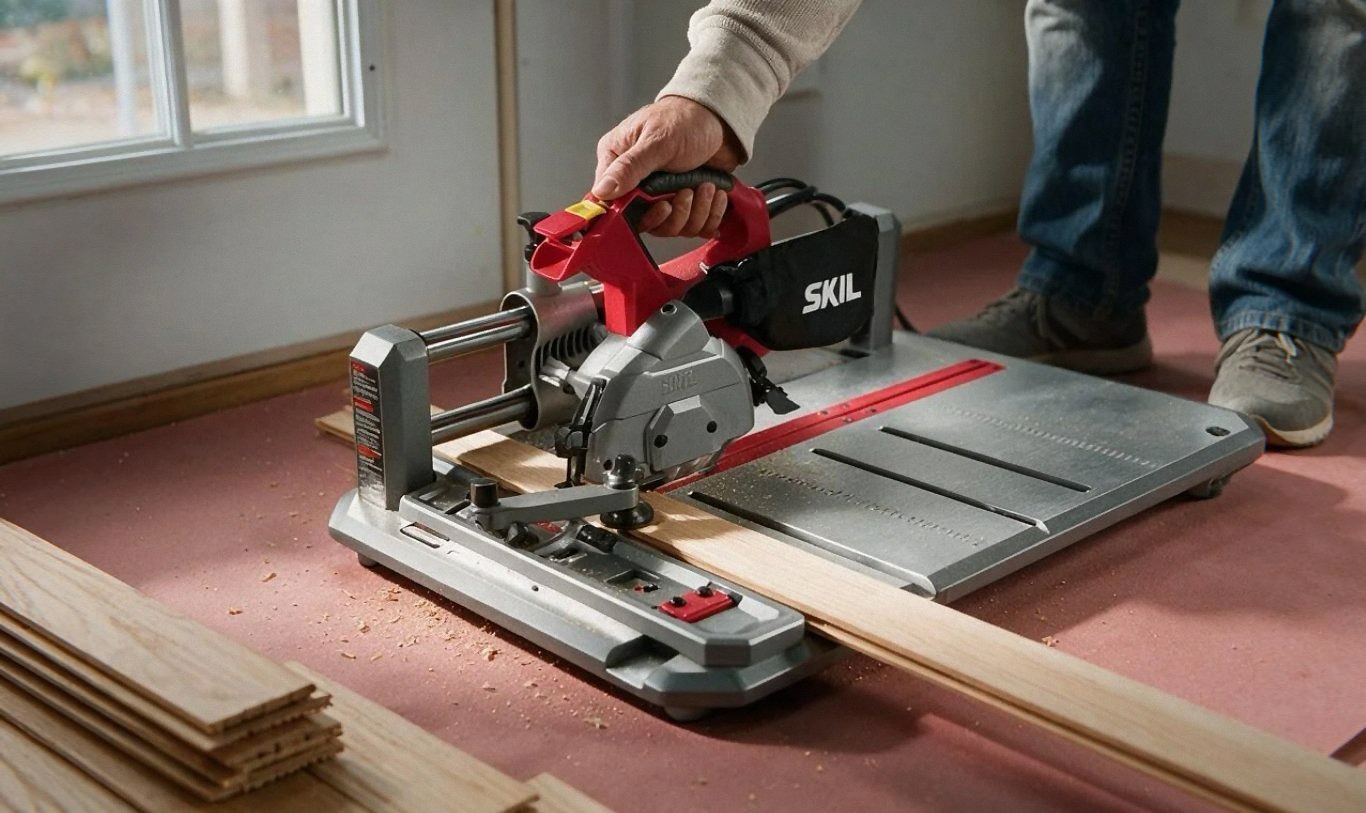
Enter the SKIL 3601-02 flooring saw. It’s a weird little machine. Compact, red, weighs about 24 pounds, and looks like a miter saw that got stepped on by something heavier. I bought it because I’d already reviewed the SKIL 3550-02 wet tile saw and thought, “Okay, SKIL can make cheap tools that work.” This one costs $208.70 — or $198.70 if you get that Amazon Store Card discount. For that price, I figured it was worth a shot.
I installed a whole house of laminate with this thing. Let me tell you how it went.
First Cuts: This Thing Is Surprising
I set up the SKIL 3601-02 in the corner of the room I was flooring. No trips to the garage. No extension cords snaking through doorways. Plug it in, flip the little switch, and it spins up a 4-3/8-inch blade at 11,000 RPM. That’s fast. Like, “don’t put your finger anywhere near it” fast. The blade that comes with it is a 36-tooth carbide contractor blade, and it’s honestly decent. I cut 8mm laminate with attached padding, and the saw went through it like it was balsa wood. Smooth edges, minimal chipping, and the cuts were square right out of the box.
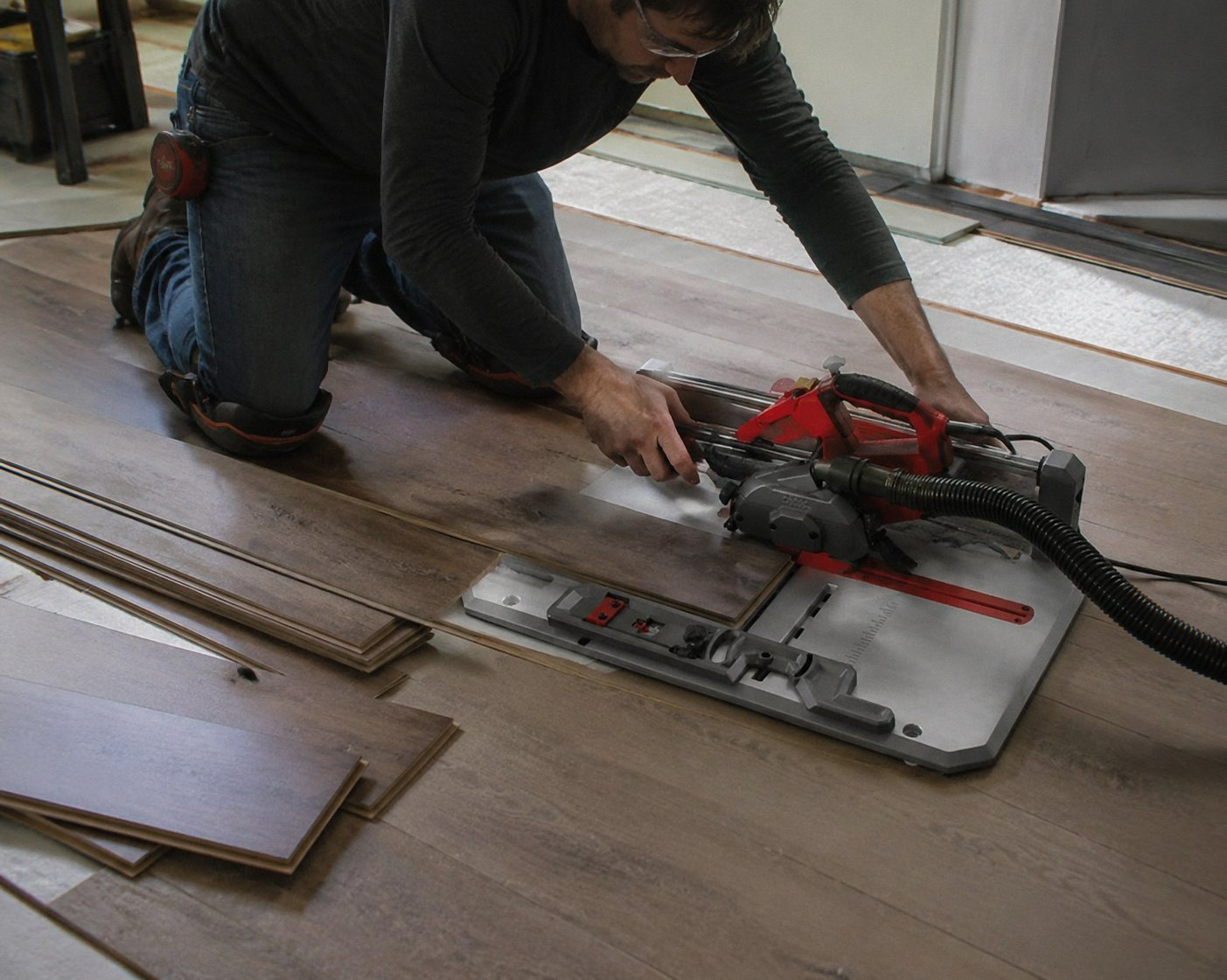 The secret is the dual function. This saw does cross cuts and rip cuts. You flip a lever, slide the fence over, and suddenly you’re ripping boards lengthwise. No table saw. No circular saw and guide. Just one tool that does both.
Cross cuts are the main event. You drop the board onto the table, push it against the miter fence, and lower the blade. It’s exactly like using a small miter saw. The miter detents at 0, 22.5, and 45 degrees are accurate enough for flooring work. I cut angle after angle for my hallway, and everything fit together. No gaps. No swearing.
Rip cuts are where this thing shines. You move the fence across the table, and the board slides along a guide rail. The blade is fixed, and you push the board through. It’s not a table saw — you don’t have a riving knife or splitter — so you have to be careful with thinner materials. But for laminate planks and vinyl flooring, it works great.
I even used it on some 3/4-inch engineered hardwood for a transition. The saw handled it, but I had to slow down. The motor is 7 amps, which is fine for flooring, but it’s not meant for heavy lumber. You can feel the strain if you push too hard. Back off, let the blade do the work, and it cuts cleanly. No burn marks, surprisingly. The blade stayed sharp for the entire project.
Switching Between Modes: A Little Annoying
Here’s the thing. Switching from cross cut to rip cut is easy—loosen a couple of knobs, slide the fence, tighten. But switching back and forth on the same job gets old. You’re doing rip cuts for a few boards, then cross cuts for the next row, then a miter cut for a corner, and you’re constantly adjusting. I got used to it after the first couple of rooms, but it’s not seamless. It’s a trade-off for having one tool instead of three.
The rip fence is okay. It’s die-cast aluminum, sturdy, but there’s some play in the guide. Not enough to ruin a cut, but enough that I checked measurements twice. On long rip cuts—I’m talking 4-foot planks—the blade felt a little grabby. I found that feeding the board at a moderate speed, not too fast, gave the best result. Too fast and the blade chatters. Too slow and you get a polished edge from heat. There’s a sweet spot.
Dust: The Bag Is Useless
The saw comes with a dust bag. It’s laughably small. I filled it in maybe ten cuts, and half the dust still ended up on the floor. I hooked up a shop vac to the dust port, and that changed everything. The port is standard size, so any vacuum fits. With the vac running, dust was minimal. But if you don’t have a vacuum handy, you’re going to make a mess. The dust isn’t toxic—it’s sawdust from wood and laminate—but it’s fine and gets everywhere. I wore a mask, but honestly, with the vacuum, it wasn’t bad.
One reviewer said the dust bag catches “barely anything,” and they’re right. Toss the bag. Use a vacuum. Your lungs will thank you.
The Cut Quality: Good Enough for Flooring
Laminate flooring is forgiving. The tongue-and-groove system hides small imperfections. This saw produces cuts that are straight and square, but they’re not table-saw perfect. On 45-degree miters, I had a tiny gap on a couple of corner pieces. Nothing a little caulk or quarter-round couldn’t hide. For visible edges where no trim covers the gap, you’ll want to be careful. I sanded a few edges with a block to get them exactly right.
Some reviewers complained about chipping. I didn’t have that problem. I cut with the finished side facing down, which the manual recommends. That way, the blade exits on the finished side, and the teeth don’t tear the surface. It’s a simple trick that works. I also replaced the blade after about 200 square feet. The original blade was still cutting, but it was slowing down. Blades are cheap—around $10–16 for a replacement—and they’re easy to swap. The saw has a spindle lock that makes blade changes quick.
Speaking of blades, the SKIL 3601-02 uses a 4-3/8-inch blade with a 5/8-inch arbor. That’s a weird size. You can’t just grab any blade from the hardware store. You have to order SKIL-specific blades or compatible aftermarket ones. I bought a three-pack of 40-tooth blades for about $17, and they worked fine. But it’s a consideration. If you run out mid-project on a Sunday, you’re not finding a replacement at the local home center. Order ahead.
Comparing to Other Tools I’ve Used
I’ve used a miter saw and a table saw for flooring before. They’re faster and more precise, but they’re also bulky and require a dedicated workspace. The SKIL 3601-02 is like a table saw and miter saw had a baby that lives in a corner of your job site.
I own the iQ Power Tools dry cut saw for tile work, and that thing is a specialty tool. This SKIL is also a specialty tool, but for wood and vinyl. It’s not as well-built as the iQ, and the dust collection isn’t as good, but it’s a fraction of the price and does the job it’s meant to do. It’s a budget tool that doesn’t feel like a total compromise.
The Weight: Perfect for Moving Around
At 24 pounds, I carried this saw up and down stairs, around hallways, and from room to room without breaking a sweat. I set it up on a piece of plywood on the floor and cut right where I was working. No trips to the garage. No balancing boards on sawhorses. It’s small enough to stash in a closet when you’re not using it. I kept mine in the corner of the dining room for three weeks, and no one tripped over it.
That portability is the biggest selling point. If you’re doing a whole house, you can move the saw with you. If you’re doing a single room, you can set it up in the room and never walk more than ten feet to make a cut. It saves so much time.
The Downsides: Honest, Specific
- Rip fence play. It wiggles slightly. On long cuts, that wiggle translates to a cut that’s off by a hair. I learned to compensate by holding the board firmly against the fence and feeding it steady. It works, but it’s a minor frustration.
- Dust collection. The bag is a joke. Use a vacuum or you’ll be sweeping for hours.
- No compound angle. The blade doesn’t tilt. You can cut 0, 22.5, and 45 degrees horizontally, but you can’t do a bevel cut. That’s fine for flooring planks, but if you need to cut baseboard or quarter-round on a bevel, you’ll need a different tool.
- Power. The 7-amp motor is adequate for laminate and vinyl, but it struggles with 3/4-inch solid hardwood. It’ll do it, but you have to go slow. If you do a lot of hardwood, get a real miter saw.
- Switching modes. Cross cut to rip cut involves adjusting fences and knobs. It’s not hard, but it’s repetitive.
The Thing That Made Me Laugh
The blade path was partially blocked by red plastic when I first unboxed the saw. The manufacturer left a little extra plastic in the guard, and the blade cut through it on the first use. I heard a little zzzip and saw red shavings fly out. Not a defect, just a sloppy detail. The saw worked fine after that. I also noticed scratches on the table right out of the box. It didn’t bother me—it’s a tool, not a museum piece—but it’s worth mentioning. Quality control seems to be “good enough,” not “perfect.”
Who Should Buy This
If you’re installing laminate, LVP, or engineered flooring in one or two rooms, this saw is a game-changer. It saves you from buying or renting a table saw and miter saw. It saves you from the jigsaw struggle. It’s affordable, portable, and accurate enough for any floor.
If you’re a professional installer, you might want something with more power and better dust collection. But for a DIYer or a handyman doing occasional flooring, this is perfect. I’ve used it for three projects now—two laminate, one vinyl plank—and it’s still going strong. I bought a couple of extra blades, hooked up a vacuum, and I haven’t looked back.
If you grab one through the links here, I might get a small cut — costs you nothing extra and keeps the lights on. SKIL 3601-02 Flooring Saw on Amazon
One Last Thought
I had a friend help me lay flooring once, years ago. He spent an hour cutting planks with a circular saw and a speed square. He complained the whole time. I bought this saw, and I didn’t complain once. The cuts were straight, the work went fast, and the floor looks great. If you’re on the fence about buying a flooring saw, just get it. It’s $200. The time you save on one job pays for it. The frustration you save is priceless.
Also, clean the saw after each use. Laminate dust is fine and sticky. I blew mine out with compressed air and wiped down the rails. The table slides smoother now than when it was new. That’s something the manual doesn’t tell you, but it’s true.
Anyway, I’m done. The floor is in. The dog is sliding on it. I need to go fix the quarter-round.