I was standing in a bathroom in December. The homeowner had just had the floors refinished—hardwood, beautiful, and absolutely terrified of water. The tile backsplash was going in behind the vanity, and the only place to cut was either the living room or the driveway. Driveway was frozen solid. Living room had cream carpet. I stared at the DEWALT D24000 in the back of my truck and realized there was no way I was hauling that wet saw into this house. No way. Not with that water tray, not with that mess, not with my luck.
That’s when I remembered the iQ Power Tools 7-inch dry cut tile saw. The one that doesn’t need water. The one that promises to cut tile indoors with “integrated dust control” and something called the TRU-CUT system. A contractor buddy of mine had been raving about it for months, saying it changed his whole business model. No more setting up a wet saw outside, no more running back and forth, no more cold fingers. I borrowed it from him for a weekend.
I’ve since bought my own. And I’ve got complicated feelings about it. Let me walk you through it.
First Impression: This Thing Is Light, But It Screams
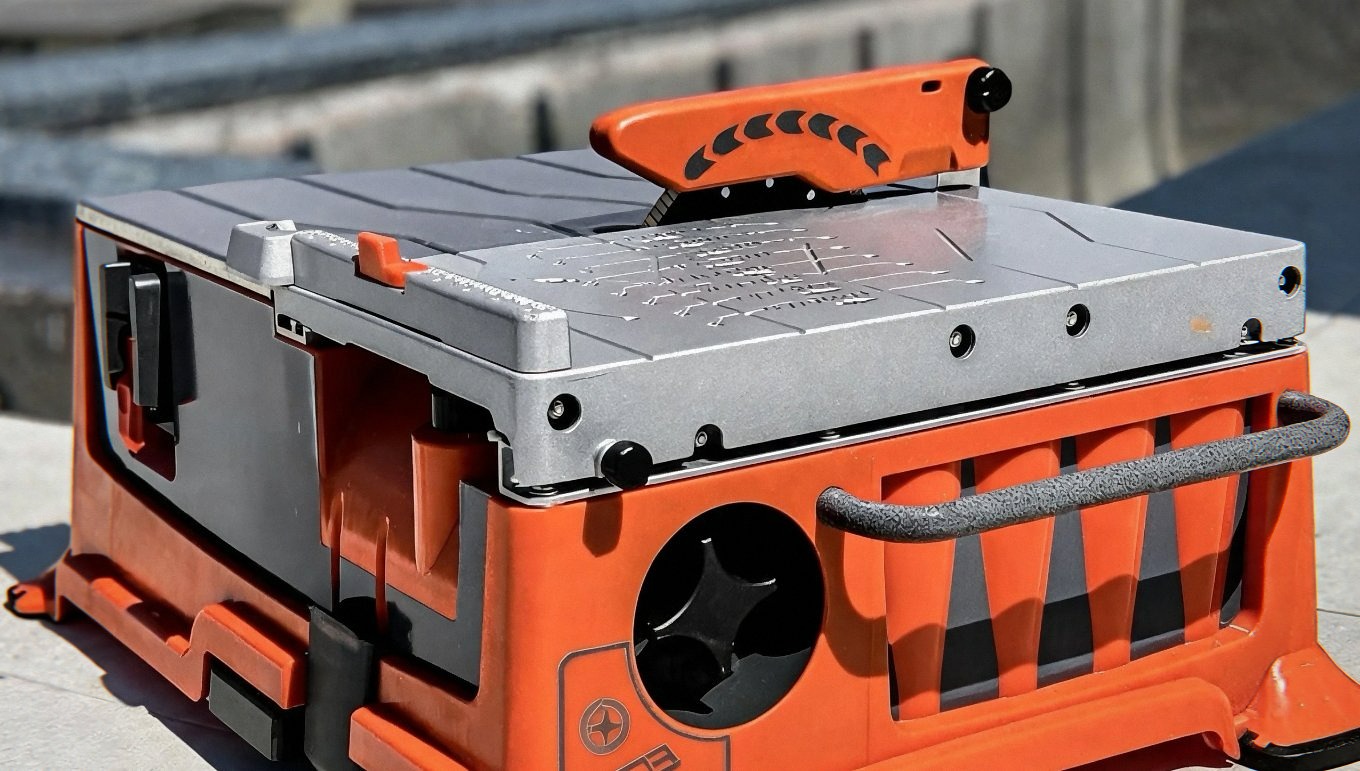
The iQ Power Tools saw weighs maybe 35 pounds. That’s nothing. I carried it up the stairs with one hand while holding a box of tile with the other. Compared to the 91-pound DEWALT D36000S, it feels like a toy. It’s compact, the rolling table slides smoothly on rails, and the whole thing fits on a standard workbench.
Setup took maybe five minutes. No water reservoir to fill, no pump to prime, no wondering if the spray was going to soak the drywall. You plug it in, attach a vacuum to the dust port, and you’re ready to go. That part is genuinely fantastic.
But then you turn it on. This thing is loud. I mean, screeching, high-pitched, making-my-dog-hide-behind-the-couch loud. It’s not the deep rumble of a wet saw. It’s more like a router on steroids. Ear protection isn’t optional—it’s survival gear.
The blade spins fast, and there’s no water to dampen the sound or the dust. Even with a vacuum attached, you get some fine particulate in the air. I wore an N95 mask and still felt like I’d been breathing chalk dust by the end of the day. The vacuum catches maybe 80% of it. The other 20% settles on the work surface and anything within five feet. But hey, that’s better than 100% of water spray on a hardwood floor.
How It Cuts: Clean Enough, With Some Quirks
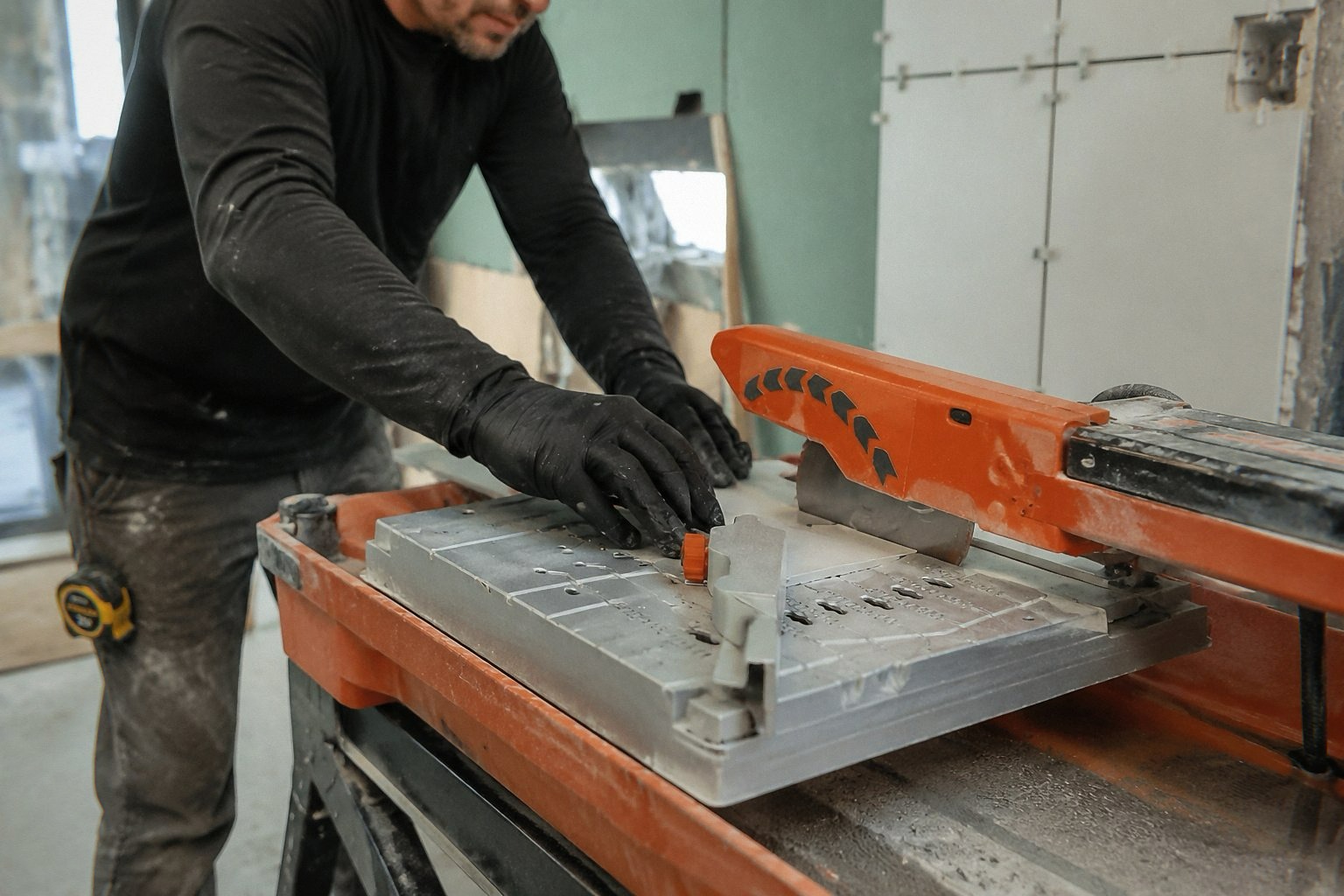
The TRU-CUT system is a measurement fence with a fine adjustment knob. You dial in the cut width, lock it down, and slide the tile on the rolling table. It’s supposed to give you consistent, repeatable cuts without measuring each time. And it mostly works. The fence locks solid, and the adjustment is precise enough for tile work. I cut a dozen 4-inch strips for a niche, and they were within a 16th of each other. That’s acceptable.
The cut quality? Mixed. On ceramic subway tile, it’s great. Clean edges, minimal chipping, fast. On glazed porcelain, there’s some chipping along the cut edge—maybe 1/16 of an inch, sometimes a bit more. A diamond hand pad cleans it up in seconds, but if you’re doing visible edges without a bullnose trim, you’ll be doing some extra finishing work. The Q-Drive blades help reduce chipping, but they’re sold separately and they’re not cheap. The saw doesn’t come with a blade. That’s a $50 to $80 surprise right out of the gate.
I did a lot of ripping on 12x24 porcelain. The saw handled it, but the cut was rougher than I’d expect from a wet saw. The edges were clean enough for grout to hide, but not “install this on a shower edge” clean. I wouldn’t use this saw for miters on highly visible corners. For that, I’m still reaching for a wet saw. The cut quality on a wet saw is just smoother because the water cools the blade and washes away debris. Dry cutting generates heat, and heat causes micro-fractures. The iQ does better than I expected, but it’s not magic.
The Dust Control: Better Than Nothing, Not Perfect
The integrated dust port is standard 2.5-inch fitting. I hooked it up to a shop vac with a HEPA filter. Most of the dust went into the vacuum. A fine layer of dust still accumulated on the table and around the saw. I used it in a bathroom with a closed door, and by the end of the day, I could see a haze on the mirror. I had to wipe everything down. It’s way better than the dust cloud you’d get from cutting tile dry without any dust collection—which is a nightmare—but it’s not a “dustless” system. The packaging uses the word “dust control,” not “dust elimination.” That distinction matters.
The nice thing about dry cutting is you can do it indoors without mopping up afterward. The downside is you’re breathing whatever the vacuum misses. I wore a mask, kept the door closed, and ran a small air purifier in the room. That seemed to work. But I wouldn’t use this saw in a finished, occupied space without serious protection. And if you’re cutting a lot of material, you’ll need to stop and let the vacuum catch up—the fine dust can clog the filter faster than drywall sanding.
The Sliding Table and Its Design Flaw
There’s a weird design issue with the rolling table. The sliding part sits slightly higher than the stationary side. It’s maybe a millimeter or two, but it’s enough that a long tile can break or chip at the end of a cut as it transitions from the moving table to the fixed support. I noticed it the first time I cut a 24-inch plank. The edge had a little fracture right at the end. I adjusted my technique—I supported the tile with my hand as it cleared the table—and that helped. But it’s a flaw. One reviewer mentioned building up the lower side with masking tape. I did the same. It helped, but I shouldn’t have to modify a $500 saw to make it work.
Also, the fence adjustment screw came loose after about three hours of cutting. I had to tighten it mid-job. It’s a small thing, but it’s annoying. For a saw that costs as much as an entry-level wet saw, I expected better hardware.
Comparing to a Wet Saw for Smaller Jobs
If you’ve read my SKIL 3550-02 review, you know I’m a fan of cheap, portable wet saws for DIY work. The SKIL costs $169, uses water, and makes a mess. The iQ costs $516, doesn’t use water, and makes dust. Which one wins depends on your job site. If you’re working outdoors or in a garage, the SKIL is fine. If you’re working in a finished home, the iQ is a game-changer.
But the iQ is not a replacement for a big wet saw for serious work. For a full floor of 24x24 porcelain, I’m still using the DEWALT D24000 because it’s faster, more accurate, and produces a better finish. The iQ is a specialty tool for smaller jobs, bathrooms, remodels, and situations where water is a dealbreaker. It’s not an either/or—it’s a “both, depending on the job” kind of thing.
If you grab one through the links here, I might get a small cut — costs you nothing extra and keeps the lights on. iQ Power Tools 7 Inch Dry Cut Tile Saw on Amazon
The Cost Equation
The saw costs $516. The blade is separate, add another $60 to $80. And if you want the $16.99/month protection plan, factor that in too. That puts you close to $600 for a 7-inch tile saw that doesn’t even come with a blade. That’s a tough sell when you can get a 7-inch wet saw for less than half that. The value proposition is the convenience—no water, no muddy cleanup, no trips to the driveway in the rain. That convenience is worth something. But it’s not worth everything.
A full 30-day return policy through Amazon gives you some breathing room to test it out, which is smart. If it doesn’t work for your workflow, you can send it back. But I’d make sure you’re comfortable with the potential chipping and dust before committing.
The Winter Job That Made Me a Believer
I used this saw during a cold snap in the Midwest. The temperature was in the teens. My wet saw was frozen solid in the garage. I brought the iQ Power Tools saw into the house, set it up on a piece of plywood in the living room, and cut the entire bathroom tile job in an afternoon. No water dripping on the floors. No trips outside. No numb fingers. The dust was manageable, and I ran the vacuum while I worked. It was genuinely easier than any wet saw setup I’ve ever done for an indoor job. The cuts weren’t perfect—I had to clean a few edges with a hand pad—but the schedule stayed on track.
That’s the use case. That’s why I kept it.
Things Only an Owner Would Know
The dust port vibrates loose. I had to check the connection every few cuts. And the blade doesn’t come with the saw—that caught me off guard. It’s not advertised clearly. The instructions are minimal, basically a fold-out sheet with pictures. The TRU-CUT fence works, but the knob is small and feels cheap in your hands. The power cord is short—maybe six feet—so you’re probably using an extension cord. The rolling table’s aluminum surface gets hot after repeated cuts. I noticed it warming up and thought something was wrong. It’s just friction heat.
The Verdict
I’m keeping the saw. I use it for indoor remodels where water is a risk. I use it for small jobs where dragging out the D24000 is overkill. I use it when I’m working alone and don’t have a helper to run back and forth. It’s not perfect, but it’s useful. The cut quality is okay, not great. The dust control is good, not perfect. The portability is fantastic. The price is high for what you get.
Would I recommend it? Yes, if you’re a professional doing indoor renovations where water is a problem. Yes, if you hate cold weather and want to cut tile inside. No, if you’re a DIYer doing one kitchen backsplash—rent a wet saw or buy the SKIL. No, if you’re cutting visible edges on expensive tile and need perfection.
I’m going to go clean out the vacuum filter. It’s caked with dust. Again. The dog is still giving me side-eye from the hallway. I think I’ll call it a day.