The Last Tile Snapped at 9:04 PM
I want to tell you about the exact sound a 24-by-48 porcelain plank makes when a cheap breaker bar snaps its corner off. It’s a tick. Not a crack, not a snap — a tick, like the tile clearing its throat before it becomes garbage. I heard it at 9:04 on a Tuesday night, on the last plank I had, with the kitchen floor three feet from done and the tile place closed until Thursday.
Thirty-eight dollars. That’s what I paid for the manual snap cutter that did it. I’d already forgiven that thing twice that day — once for chipping a glazed edge, once for a score line that wandered like it was drunk — because forgiving cheap tools is a skill you build when you’re too stubborn to rent. The plank cost about eleven bucks a square foot. Do the math on my genius. My wife appeared in the doorway, looked at the two halves, looked at me, and left without a word, which was worse than anything she could have said.
So when the box holding the 2300W Electric Tile Cutting System showed up — the one with the 71-inch rail guide, the 8000RPM orbital cutter head, wet and dry blades, suction cups, clamps, pump, bag, the whole spread — I was not excited. I was tired and suspicious. Tools had hurt me recently.
What This Thing Actually Is See Today’s Deal on Amazon
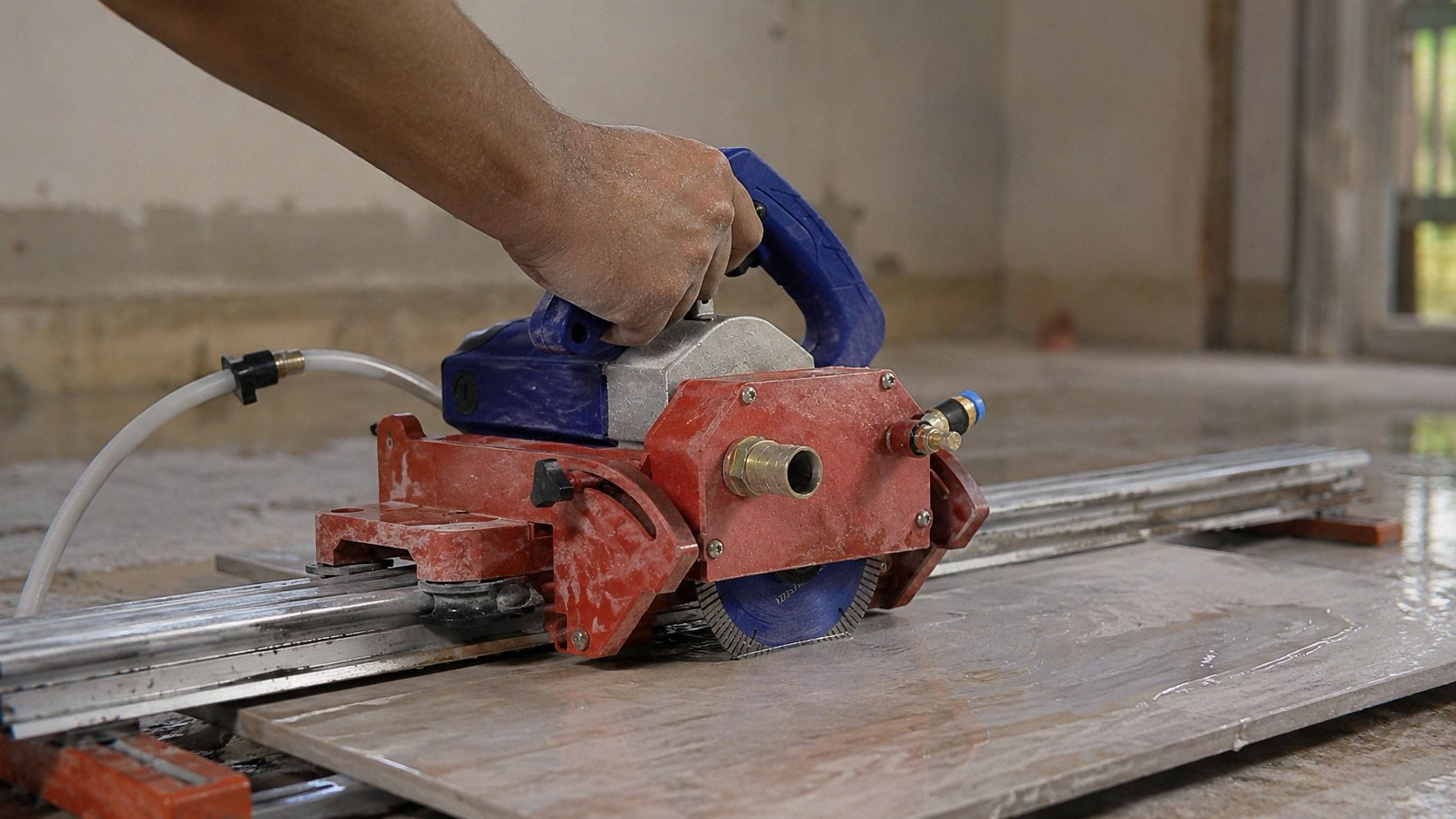
Quick orientation, because the name is a mouthful and the category is strange. This is not a wet saw. Not a snap cutter either. It’s a 2300-watt grinder-class motor spinning a diamond blade at 8000RPM, bolted into a wheeled aluminum carriage, and that carriage rides along two guide rails — each 1.05 meters, roughly 71 inches joined end to end — that you stick directly onto the face of the tile with suction cups, backed up by clamps. The tile stays put. The saw travels over it. There’s a small submersible pump that feeds water to the blade for wet cutting, a dry blade for when water’s a bad idea, and the head tilts for bevel and chamfer work up to 45 degrees.
It runs around six hundred bucks. No brand name you’d tattoo on your forearm. The manual reads like it was translated by someone who once had tiles described to them over a bad phone connection.
And yet. It solves the one problem that broke me in April: cutting a four-foot plank, dead straight, full length, in one pass, without a snap. Snap cutters — even genuinely good ones like the Rubi TX-1250-MAX I keep circling online — still end every cut in a controlled break, and a controlled break is exactly the moment my $38 disaster chose to eat a corner. A blade doesn’t break anything. It just grinds its way down the line and minds its business.
Unboxing, or Me vs. the Bag
The packaging deserves its own paragraph, because I spent a genuinely stupid amount of my Saturday on it. Everything comes inside the carry bag, and the carry bag comes inside the box, and the box is lined with that brittle white foam that detonates into static-charged confetti no matter how slowly you open it. I found foam pellets in my sock drawer two rooms away. The rails are nested in one long compartment, the grinder head and carriage in another, blades in a cardboard sleeve taped to the side like an afterthought, and the pump — the pump is in a zippered side pocket of the bag, which I did not discover until the next morning, after I’d already spent twenty minutes convinced they’d forgotten to include it and drafting a moderately rude email in my head. The bag itself smells faintly of machine oil and new nylon. That smell fades in about a week. The foam in my house will outlive me.
Setting It Up: Two Rails and a Learning Curve
Setup is simple the second time. The first time it’s a mild puzzle. You wipe the tile face — this step is not optional, and I’ll get back to why — press the rail down so the three suction cups on each track grab, then snug the clamps at the ends. The rubber cup edges are slightly tacky, and on polished porcelain they leave a perfect little ring print that you wipe away with your thumb. That detail is free. Nobody puts it in the listing.
On matte or lightly textured tile, one of my cups slowly loses vacuum. You get maybe ten minutes, and before it lets go there’s a faint hiss, like a tire deciding whether to go flat. First time I heard it I froze mid-cut. Now I just clamp everything on textured tile and treat suction as a bonus, not a plan.
The two rails join with an internal connector bar, and here’s the other owner-detail nobody tells you: if you don’t shove the rail ends fully together before tightening, the carriage gives a tiny tink as its wheels cross the seam. A hiccup. You can feel it through the handle more than hear it. Assembled properly, the wheels make one continuous sound instead — a soft, zipper-ish shhh the whole length of the pass. That shhh became my quality check. Shhh means good. Tink means stop and redo the joint.
The First Real Cut
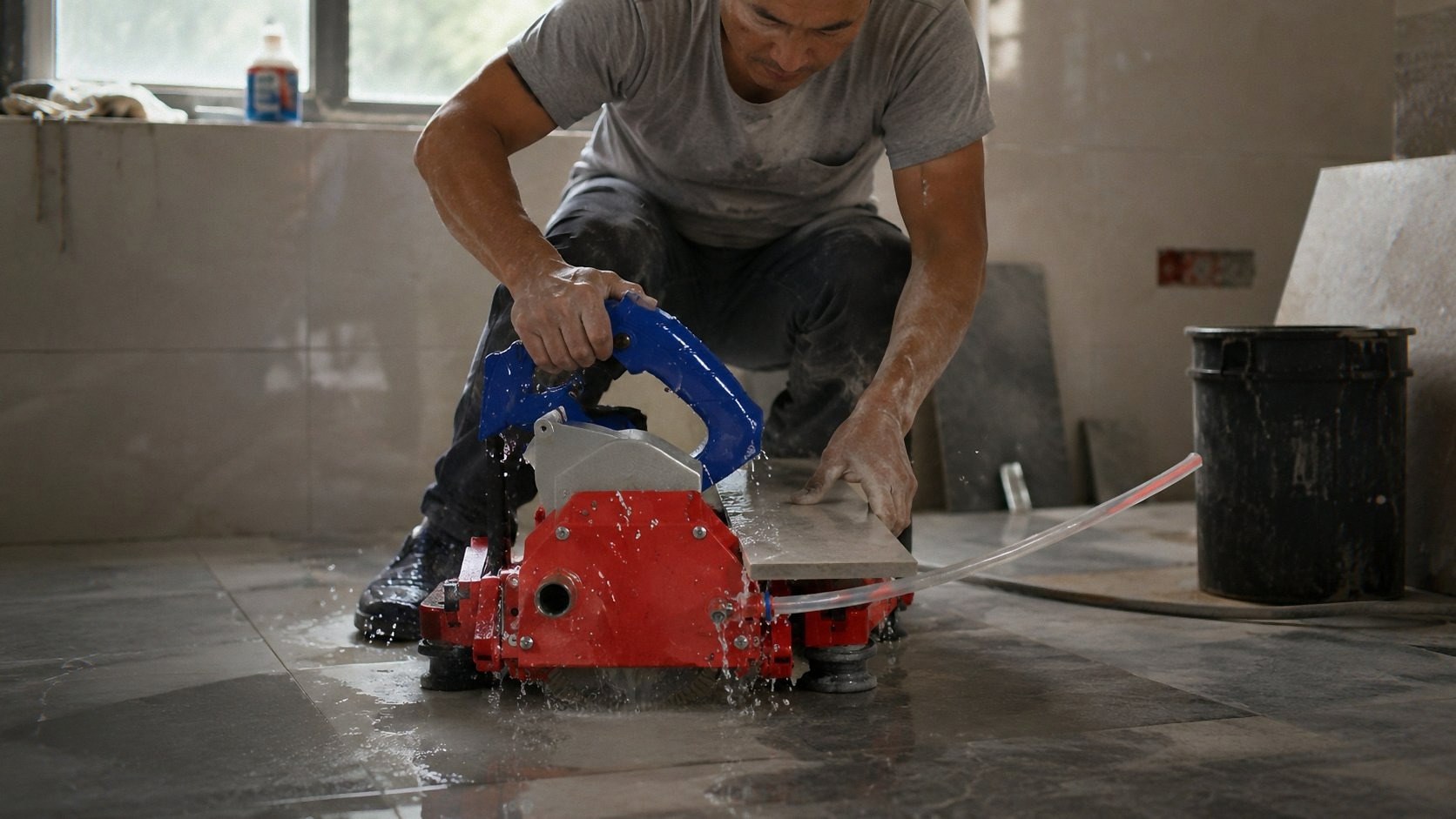
I set up on a fresh 24-by-48, dropped the pump into a bucket of water, and made the rip that killed my April.
The grinder at 8000RPM is not quiet. It’s grinder loud — wear the ear protection you own and never use. But the cut itself was almost boring, and I mean that as the highest compliment I own. Water kissed the blade, a grey slurry ribboned off to one side, the carriage rolled its long shhh down the rail, and at the end of forty-eight inches I had two pieces of tile and an edge so clean I ran my finger along it like an idiot who has never met a diamond blade. Glazed face, no chips. Not one. The mist drifts back at your forearm the whole pass, so your left arm gets slowly, pleasantly damp, and the pump keeps dribbling for a good ten seconds after you kill the motor, which scared me the first time and means nothing.
One pass. The thing my snap cutter turned into a coin flip, this did on the first try, while I was still braced for disaster.
This is the point where I stop complaining and admit the 2300W Electric Tile Cutting System earned its floor space in a single evening. And once, because it matters: if you grab one through the links here, I might get a small cut — costs you nothing extra and keeps the lights on.
Bevels, Chamfers, and the Shower Niche I Procrastinated On
I put off the niche trim for nine days because miters are where my confidence goes to die. The head on this thing tilts to 45 degrees, locks, and suddenly the chamfer I’d been dreading was a rail cut like any other — slower, wetter, but the same shhh, the same straight line. My old approach to a 45 was a handheld grinder, a steady hand I don’t actually have, and prayer. The bevel edges came off the rail cleaner than anything I produced in my entire table-saw era. I keep turning one offcut over in my hands at the kitchen table while my tea goes cold. It’s sitting next to me right now. The tea is cold. The dog next door is losing his mind at a squirrel, and I keep picking up the offcut anyway.
The Uncomfortable Comparisons
I own wet-saw opinions the way other men own regrets, so let’s go.
The DEWALT D24000 is the little yellow wet saw everyone rightly loves, and I’d still recommend it for normal tile in a heartbeat — but it’s a table saw with a 24-inch-class rip capacity, and ripping a 48-inch plank lengthwise on it is interpretive dance around a water tray. The DEWALT D36000S stretches that to 36 inches and charges you real contractor money plus a hernia for the privilege. Neither touches 71. Different tools, sure — but if your life is large-format plank, the rail system is simply the shape the answer comes in now, and it costs less than the big DeWalt while doing it.
Against the manual world: the Rubi TX-1250-MAX is the one snap cutter I genuinely respect, and on soft ceramic it’s faster than any of this. On hard, dense, expensive porcelain it is still, at the end of every cut, a machine that breaks your tile on purpose and hopes. My $38 big-box special was the same idea, executed by idiots. The orbital cutter took the break out of the equation entirely, which is the whole reason I can write this without twitching.
Dust people will ask about dry cutting, so: yes, it ships with a dry blade, and yes, it works — but dry cutting tile is a dust event no matter what the marketing says, and if dustless dry work on smaller tile is your religion, the IQ Power Tools 7-inch dry cut saw has a vacuum system this thing doesn’t pretend to match. I run the rail saw wet ninety percent of the time and dry only when the room says so. And if you’re tempted to freehand long cuts with something like the Makita 4101RH instead — I’ve done that dance too, and it ends with a wavy line and a white coating on everything you love. The Makita’s great for a notch. It’s not a 48-inch plan. (The Hoteche 14-inch concrete saw is a different animal entirely — that’s for demolition-grade nonsense, not finished edges anyone will ever see.)
The Parts That Annoy Me
Because there are parts that annoy me.
The carry bag zipper is garbage. It feels borrowed from a twelve-dollar gym duffel, and I give it one season before I’m storing rails in a tarp. The stock dry blade is fine — emphasis on fine — and if you cut a lot of hard porcelain you’ll want a better turbo-rim blade within the first project or two. Wet cutting dries a grey slurry film inside the rail channel, and if you don’t pick it out with a brush, your next pass rides slightly lumpy and you’ll spend ten minutes blaming the rails like I did before figuring out it was my own dried concrete-y neglect. Storage is awkward: two 1.05-meter rails lean in my garage like a pair of skis for a sport I don’t play. It’s loud, genuinely grinder-loud, and my neighbor’s dog filed a formal protest by barking for the entire second Saturday. And the pump’s hose barb wept onto my shoe until I really cranked the clamp — a slow, mocking drip that found the one seam in my boot.
None of it is a dealbreaker. All of it is the kind of thing you only learn by owning the thing, which is why you’re reading this instead of the listing.
Who This Is Actually For See Today’s Deal on Amazon
If your project is a 12x12 backsplash, walk away. Buy nothing. A basic seven-inch wet saw will do your whole life for a fraction of the money and none of the setup ritual. This system is for the other situation: 24-by-48 planks, 48-by-48 slabs, whole-room floors, patio porcelain, the kind of material where one ruined tile costs more than a nice dinner and the nearest wet saw that fits it costs more than a used car. Contractors doing large format will pay this off in a single job. Serious DIY people doing one big floor will pay it off in tile they didn’t destroy — I ran the numbers on my own kitchen, and the avoided breakage covers a real chunk of the gap between this and pretending my $38 cutter was fine.
Six hundred bucks felt insane until I priced my own stupidity per square foot. Then it felt like tuition.
The two halves of that last snapped plank are still leaning against my garage wall. I keep them there like a cautionary tale and also because I haven’t figured out the trash situation for them. My tea’s been cold for an hour. I’m going to microwave it and pretend that’s acceptable.