I love my DEWALT D24000. It’s a beast. But sometimes, you don’t need a beast. Sometimes, you need to make a dozen straight cuts on 2-foot tiles in a living room with hardwood floors, and you don’t want to haul a 69-pound wet saw up the stairs, fill the water tray, and spend twenty minutes cleaning up afterward. Sometimes, you just want a quiet, clean, fast way to break a tile along a line.
That’s where manual tile cutters come in. And the Rubi TX-1250 MAX is about as big as they get. It’s a 49-inch manual tile cutter that uses a scoring wheel and a breaking mechanism to snap tiles cleanly. No water. No electricity. No dust, really—just a little ceramic powder on the floor. It weighs 77 pounds, which is heavier than my toddler, and it costs $1,283. That’s a lot of money for a tool that doesn’t have a motor.
I borrowed one for a weekend to cut a bunch of 24x48 porcelain planks. Let me tell you how it went.
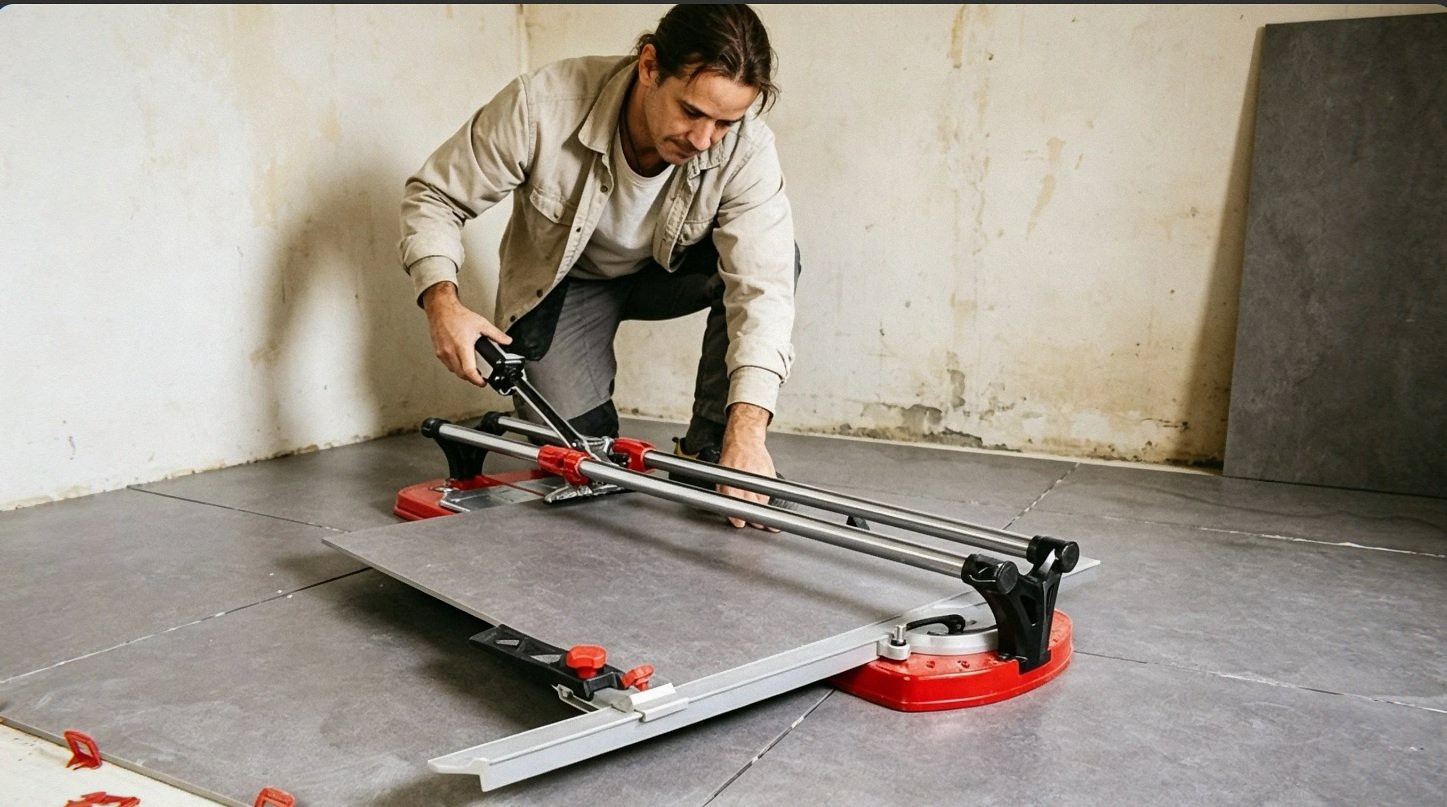
What Is This Thing?
A manual tile cutter is basically a heavy rail, a scoring wheel, and a breaking foot. You mark your tile, run the scoring wheel along the line, and then press down a lever that pushes a breaking bar into the tile. The tile snaps along the score line. It’s the same principle as cutting glass, but on a massive scale. The Rubi TX-1250 MAX has a 49-inch cutting capacity and 2,200 pounds of breaking force. It can cut straight lines on tiles up to 50 inches long and 36 inches on a diagonal.
If you’ve used a wet saw, this is the opposite experience. It’s quiet. It’s clean. It’s fast for straight cuts. And it’s absolutely terrifying the first time you press down that breaking lever and hear the tile crack.
The Setup: Heavy, But Simple
The Rubi TX-1250 MAX comes in a large case. The case is sturdy, with wheels and a handle, but it’s heavy. My back complained. I set it up on a sturdy workbench, and the instructions were minimal but adequate. The scoring carriage slides along precision-ground rails, and the breaking mechanism is a heavy-duty steel lever.
The build quality is mostly excellent. The rails are smooth, the scoring wheel is sharp, and the breaking bar is solid. It feels like a tool that will last for decades if you take care of it. But there are some issues. The angle guide, which is essential for diagonal cuts, didn’t come with the tightening knob. That’s a quality control problem. One reviewer mentioned the same thing. I had to improvise with a bolt and a wing nut. For a $1,300 tool, that’s unacceptable.
Cutting Performance: Fast and Clean
I tested the Rubi TX-1250 MAX on 24x48 porcelain planks. These were large, heavy tiles. On a wet saw, I’d have to carefully guide them through the blade, dealing with water spray and the risk of the tile cracking if I pushed too fast.
On this manual cutter, I scored the tile in one smooth pass, then pressed the breaking lever. The tile snapped cleanly, right along the line. No chips, no jagged edges. The cut edge was smooth, comparable to a wet saw cut. And it took about ten seconds per cut. It was fast. And quiet. I could have used this in the middle of the night without waking anyone up.
The straight cuts are the Rubi’s main job, and it does them well. The 2,200 pounds of breaking force handle thick porcelain easily. I also tried it on a 36-inch diagonal cut, and it worked fine, though the angle guide issue made setup annoying. For repetitive straight cuts, like ripping tiles to width, this thing is a time-saver.
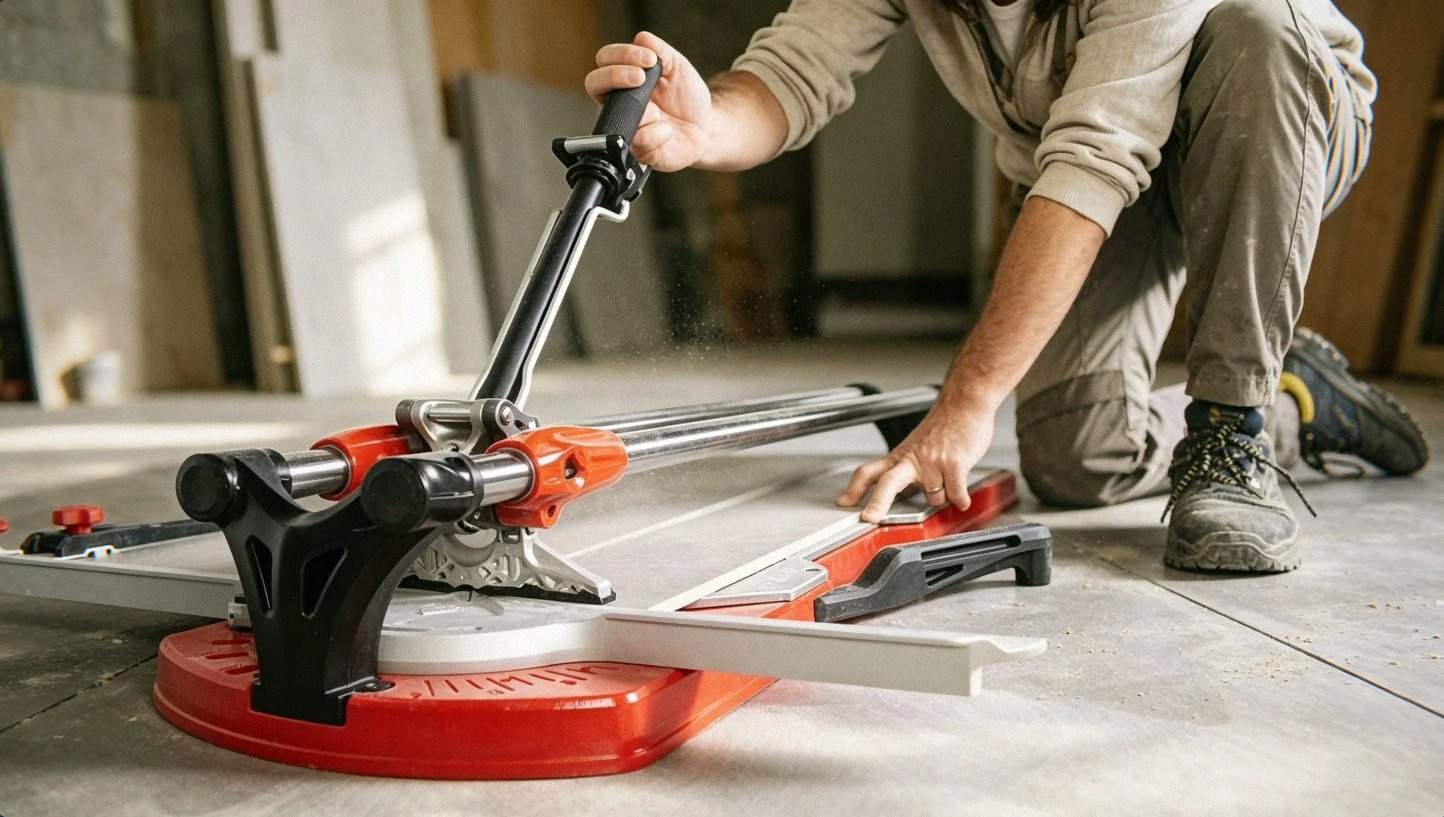
The Comparison: Manual vs. Wet Saw
I already own the SKIL 3550-02, which is a good cheap wet saw. I also own the DEWALT D24000, which is a pro-level wet saw. The Rubi manual cutter is a different tool for a different job.
If you need to cut large-format tiles in a finished space, the Rubi is ideal. It’s quiet, clean, and doesn’t require water or a power cord. It’s also faster for straight cuts than a wet saw, because you don’t have to set up the water, line up the tile, and slowly push it through the blade. You just score and snap.
If you need to cut curved, angled, or notched cuts, the Rubi is useless. You’ll need a wet saw or a grinder. The manual cutter is for straight lines only. And the cost is high. You can buy a decent wet saw for less than the Rubi, and a good wet saw does more things. The Rubi is a specialized tool.
What I Don’t Like
-
The quality control. The missing tightening knob is a red flag. For this price, everything should be perfect. I’ve reviewed the Makita 4101RH and the iQ Power Tools dry saw, both of which had minor design flaws, but this is a basic missing part.
-
The weight. 77 pounds is heavy. The case has wheels, but you still have to lift it into and out of a truck or up a step.
-
The price. $1,283 is a lot. You can get the Rubi TX-1020 MAX 40-inch version for a bit less, or the TX-900N for even less. The 49-inch version is for jobs with very large tiles.
-
The angle guide. It’s not as intuitive or precise as I’d like. The missing knob didn’t help.
-
The breaking bar. It leaves a tiny mark on the tile surface. It’s usually along the edge that will be covered or grouted, but you should be aware of it.
Who Is This For?
If you’re a professional tile setter doing large-format tiles, this is a tool you’ll use often. It’s faster and cleaner than a wet saw for straight cuts, and it saves you the hassle of water and electricity on a job site.
If you’re a DIYer doing a single large-format project, I’d think twice. The cost is high, and you could rent one or use a wet saw. But if you’re tiling a whole house with large planks, the time savings might justify the investment.
If you already own a wet saw like the DEWALT D24000, you might still want this for quick straight cuts in finished rooms. It’s a complement, not a replacement.
If you grab one through the links here, I might get a small cut — costs you nothing extra and keeps the lights on. Rubi TX-1250 MAX Tile Cutter on Amazon
A Quick Note on Other Rubi Models
I’ve also used the Rubi TX-900N, which is a smaller version. It’s lighter, cheaper, and works the same way. If you’re not cutting 4-foot tiles, that might be the better choice. I’ve seen some bad reviews for the TX-1250 MAX on Amazon, including a report of a damaged box and a non-working machine. That’s concerning. I’d buy from a reputable seller and inspect the tool carefully upon arrival. The 30-day return policy through Amazon is your safety net.
Final Thoughts, Interrupted
The Rubi TX-1250 MAX is a high-quality manual tile cutter with some quality control issues. It’s fast, quiet, and clean for straight cuts on large tiles. It’s also expensive, heavy, and limited to straight cuts. If you do that one thing a lot, it’s worth it. If you don’t, it’s a luxury.
I used it for a weekend. I got all my cuts done quickly, and my back hurt from lifting the thing. The missing knob annoyed me, but the cuts were perfect. I’m glad I borrowed it. I’m not sure I’d buy one. But I see why professionals love them.
Now I need to sweep up the ceramic dust. It’s not much, but it’s there. The dog is watching me with suspicion. I think he’s waiting for the loud noise that never came.