The old 7-inch grinder with a diamond wheel finally gave up on a Thursday afternoon. It didn’t go out with a bang. Just a whimper, a puff of acrid smoke, and that specific burnt-electronics smell that tells you it’s not a fuse, it’s a funeral. I was halfway through cutting a channel for a new French drain, knee-deep in concrete dust, sweating through a shirt I’d already changed twice. The rental place was closed. My neighbor’s Husqvarna was, predictably, not an option. So I did what any desperate, slightly delirious homeowner does around 8 PM: I opened Amazon, filtered by “Prime,” and bought the cheapest 14-inch concrete saw that had a half-decent rating. That saw, my friend, was the Hoteche.
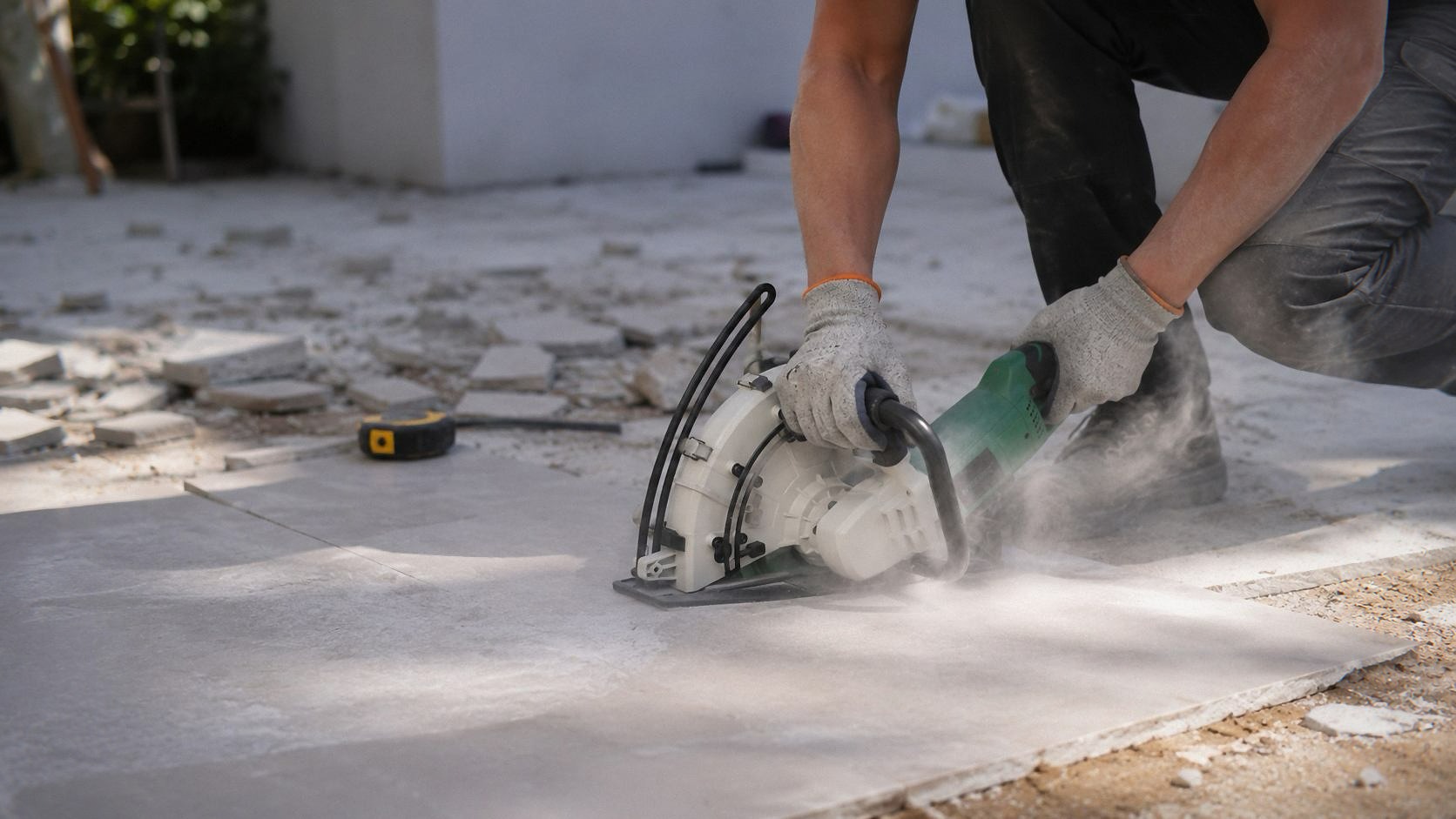
It arrived two days later, which was fast, and I spent the next hour in my garage wrestling with the packaging. The box was surprisingly heavy—a good sign, or at least a sign that it wasn’t filled with packing peanuts. Inside, nestled in that familiar, frustratingly tight black foam, was the saw, a surprisingly hefty diamond blade, a wrench, a pair of carbon brushes, and a manual that looked like it was translated from Chinese by someone who learned English from an old version of Google Translate. And I mean the really old version.
The manual is a work of art in its own right. It features diagrams where the parts are labeled with numbers that point to nowhere, and safety warnings like “Do not use this saw while sleeping.” I’m paraphrasing, but only slightly. It makes the Makita 4101RH masonry saw review manual look like a masterpiece of technical writing. I get it—these budget brands are all about the hardware, not the paper. But a single sheet with a decent exploded view would have saved me ten minutes of head-scratching.
First Impressions: She’s a Heavy Girl See Today’s Deal on Amazon
Lifting this thing out of the box, my back gave a little twinge. It’s a solid, dense unit. It doesn’t have the finesse or precision feel of something like the IQ Power Tools 7-inch dry cut tile saw, which feels like a surgical instrument in comparison. This is a sledgehammer. The aluminum and plastic body has that particular green-and-black color scheme that says “we’re trying to look like a DeWalt but we’re definitely not a DeWalt.” The plastic feels durable enough, but it’s not the fiber-reinforced nylon you get on higher-end tools. The grips, though, were a pleasant surprise. They’re large and have a soft-touch rubber that fits my XL hands well. The safety trigger has a satisfying click-thump when you disengage it, and the trigger itself has just enough resistance to feel deliberate, not flimsy.
One small detail the listing doesn’t mention? The power cord is about ten feet long. That’s decent, but it’s stiff. Working on a big slab, you’ll still be fighting with it, especially if you’re moving the saw along a long cut. It’s those boring, real-world hassles that the spec sheet never captures.
Cutting the Concrete (and a Little Bit of My Sanity)
Alright, the moment of truth. Firing it up for the first time, I was ready for the thing to try and rip my arms off. The soft-start feature, which I genuinely appreciate, is a godsend. It spools up to its 4300 RPM with a whine that’s loud, but not terrifyingly so. There’s a bit of vibration on startup, but once it’s at speed, it settles into a steady, mechanical hum.
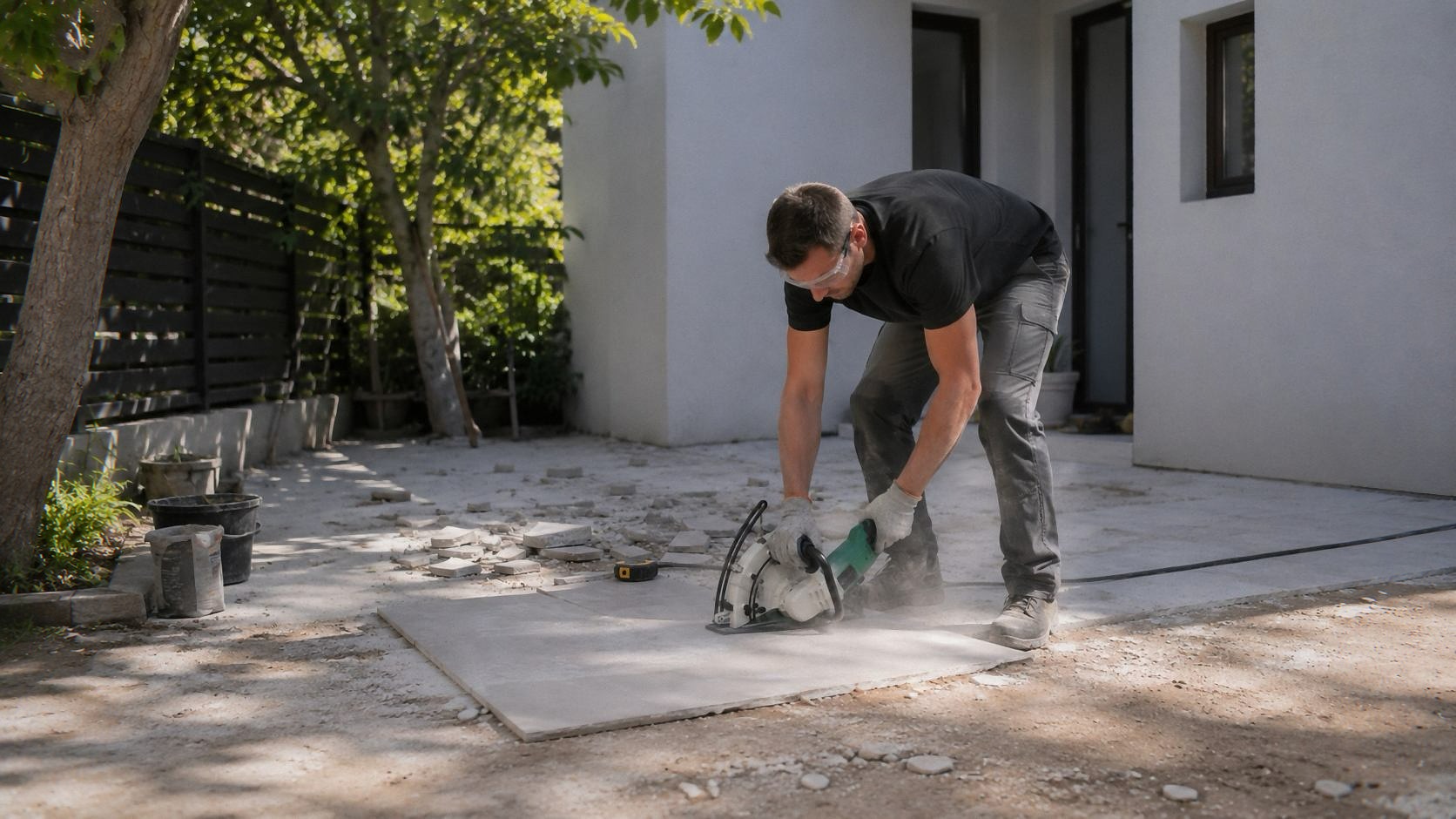 I set it on the marked line for the drain channel. The depth adjustment is simple enough—loosen a lever, slide the foot, tighten it. I set it to the max 5-inch depth and let it eat. This is where the 2600W motor earns its keep. The Hoteche, despite its 14-inch blade, doesn’t bog down easily. It chewed through the 4-inch thick concrete slab with a graceless, grindy fury, spitting out a slurry of fine dust that coated absolutely everything in my immediate vicinity.
This is where I remembered the “dust port” mentioned in the product description. I attached my shop vac hose to it. I’m here to report that it does, technically, direct dust somewhere. The problem is, the “somewhere” is mostly still the air. A lot of fine particulate still billows out of the front and sides, right into your face. You absolutely need a respirator. Don’t be like me and try to get away with just safety glasses and a bandana. That was a mistake I made for about thirty seconds before I regretted it.
I had to cut through about four feet of reinforced slab. The saw handled the concrete like butter. When it hit a piece of rebar, there was a distinct clang, a brief grinding buzz that sounded like it was struggling, but it pushed through. You can’t just force it, though. The blade will bind, and the kickback is real. I had a moment where the saw jumped up about an inch off my line and scared the hell out of me. The design of the roller wheels on the bottom is supposed to make it smooth, and it does on a clean surface. But when you’re cutting outdoors on a rough slab, the rollers are useless. You’re fighting the wheel, the cord, and the uneven ground the entire time. It’s more a technique thing.
I used it continuously for about 30 minutes on that first run, and I felt a wave of heat coming off the machine. This is the detail the customer review mentions, and they’re dead right. The area near the motor gets blisteringly hot. Not “warm,” not “toasty.” I’m talking “don’t touch it for more than a second” hot. The motor itself didn’t fail or slow down, but I was wary. I let it cool down for a solid fifteen minutes before the next cut. Considering the price, I’m not sure that’s a design flaw as much as it’s a consequence of a copper motor being pushed to its absolute limit in a budget housing. It makes you appreciate the thermodynamics of something like the DeWalt D24000 wet tile saw, which stays cool even after a full day of work, but that’s a completely different tool for a completely different job (and price point).
The (Very) Good and the (Very) Ugly
So, it cuts. It cuts well. The 5-inch depth is a lifesaver, and the sheer power is undeniable. If you have a single, large job like a patio demo or a trench to dig, this thing is a diamond in the rough. I will say that I have a newfound respect for the heft and stability the saw offers. It feels planted, and while that makes it heavy to carry, it does make it easier to control once it’s on the ground. It reminds me of the durability you see in some of the bigger units, but without the astronomical cost.
But here’s the ugly. The blade that comes with it? It’s a “free” blade. It worked for the drain project and a few other cuts, but I can already tell it’s wearing down faster than a quality segmented blade. The one I saw on the ‘Frequently bought together’ section, the ORIXTREME one, looks like a necessary upgrade if you’re planning to do any serious work. The included blade is serviceable for a weekend job, but it’s not long-term. [If you grab one through the links here, I might get a small cut — costs you nothing extra and keeps the lights on.]
The most terrifying moment: I was almost done with the project when the RCD (Residual Current Device) kicked in. I think I hit a slightly wet patch on the slab or nicked the cord—whatever it was, the saw just shut off. I panicked. I checked the breaker, unplugged it, pressed the reset button, and it fired back up like nothing happened. That safety feature literally saved the tool. And possibly me.
I also noticed the carbon brushes are a pain to access. The listing boasts they’re included, which is great, but replacing them isn’t as simple as it could be. You need a specific screwdriver that isn’t the one in your standard homeowner’s kit, and the little plastic covers are tight. I managed to get one off, but the other refused. I gave up before I stripped the plastic. That’s an “only-an-owner-would-know” detail.
The Honest Reckoning See Today’s Deal on Amazon
I came into this skeptical. The Hoteche brand isn’t exactly a household name in the professional circuit. Most serious contractors I know would scoff at the idea of a $300 14-inch saw. But you know what? I’m not a contractor. I’m a guy with a concrete slab. And for that, this thing was a revelation.
I also couldn’t help but compare it to the DeWalt D36000S wet tile saw a friend has. Again, a different tool for a different job, but the difference in the overall user experience is night and day. The DeWalt is about precision and cleanliness. The Hoteche is about brute force. It’s loud, it’s dusty, and it’s not pretty, but it gets the job done. It’s not the kind of tool you’d use to cut a perfect curve, but it’s perfect for a straight demolition line.
So, was it a waste of money? No. I saved myself the cost of a rental and the hassle of returning a heavy piece of equipment. It feels like a tool that’s designed to do one job for two projects and then probably be forgotten in the corner of the garage. The one customer review that said “only good for a few cuts” gives me pause. That’s a real concern. If the motor burns out after a year of occasional use, I’ll be pissed. But for the immediate need, it was a hero.
Would I use this for a living? Absolutely not. The heat issue alone makes me worry about its long-term durability. That “Ron Danel” review in the customer Q&A section is haunting me. “Only good for a few cuts.” Yikes. So far, I’ve made about twenty cuts, and it’s still kicking. I’ll be the one to update my review if it all goes south. But in the meantime, I have a brand new French drain, and no one had to die or go broke to get it. My back, however, is a different story.See Today’s Deal on Amazon
Anyway, the saw is now cooling down on the garage floor, my shop vac is full of concrete dust, and I’m out of excuses to avoid cleaning up. I’m gonna go take a shower.