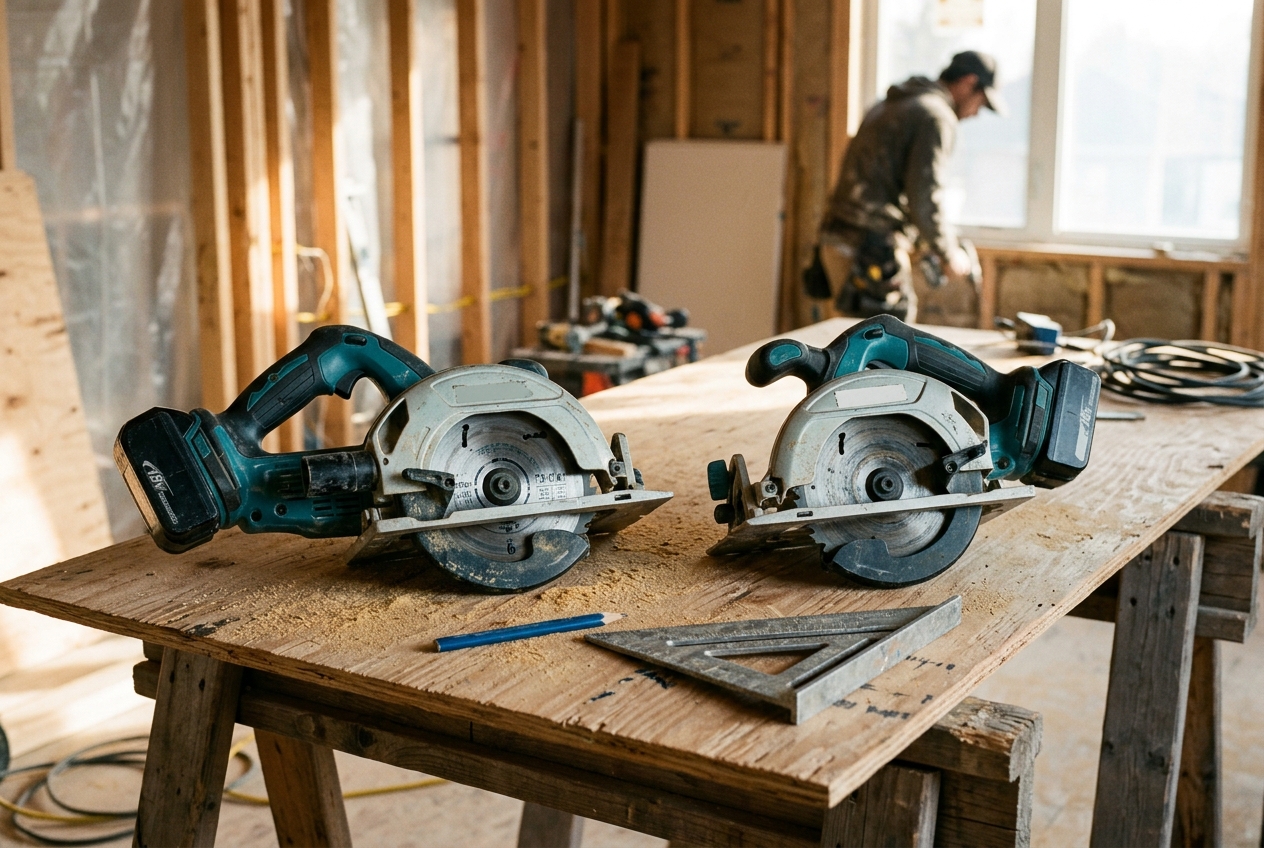
When you are already invested in Makita’s 18V LXT battery platform and need a full-size 7-1/4-inch cordless saw for subfloor plywood, shower curb framing, or deck joists, the decision usually narrows down to two kits: XSR01PT vs. XSH06PT. Both tools run two 18V packs in series for 36V power, both include two 5.0Ah batteries and a dual-port rapid charger, and both sit in the same price bracket.
The real difference has nothing to do with battery voltage. It comes down to handle ergonomics, blade-side visibility, and choosing between raw worm-drive-style leverage or a lighter sidewinder body you can swing all afternoon without wrist fatigue.
2026 Quick Verdict: Choose the Makita XSR01PT if you are right-handed and spend most of your time ripping 4x8 subfloor sheets, framing walls, or cutting heavy dimensional lumber where left-blade line-of-sight and rear-handle reach matter. Choose the Makita XSH06PT if you want nearly 2 pounds less weight (10.5 lbs vs. 12.4 lbs), faster 6,000 RPM crosscuts, and a shorter front-to-back footprint for remodel carpentry inside tight rooms.
Head-to-Head Spec Comparison: XSR01PT vs. XSH06PT
| Specification | Makita XSR01PT (Rear-Handle) | Makita XSH06PT (Top-Handle) |
|---|---|---|
| Motor & Layout | Rear-handle (blade left) | Sidewinder / top-handle (blade right) |
| Power System | 36V (Dual 18V LXT batteries) | 36V (Dual 18V LXT batteries) |
| No-Load Speed | 5,100 RPM | 6,000 RPM |
| Weight (with two 5.0Ah packs) | 12.4 lbs | ~10.5 to 10.9 lbs |
| Max Cut Depth at 90 Degrees | 2-9/16 inches | 2-5/8 inches |
| Bevel Capacity | 0 to 53 degrees (stops at 22.5 / 45 / 53) | 0 to 56 degrees (stops at 22.5 / 45 / 56) |
| Electric Brake | Yes | Yes |
| Included Kit Hardware | Saw, (2) 5.0Ah packs, DC18RD dual charger, bag | Saw, (2) 5.0Ah packs, DC18RD dual charger, bag |
| Best Fit | Subfloor sheet rips, framing, deck joists | Remodel trim, overhead cuts, tight stud bays |
1. Ergonomics, Weight, and Balance on the Job
Pick up both saws back-to-back and the 1.5-to-2-pound difference is obvious before you pull a trigger. The XSH06PT keeps its magnesium base and motor tucked directly beside the blade guard, bringing the total weight with two 5.0Ah packs to roughly 10.5 to 10.9 lbs. Because the center of gravity sits right under your wrist, cutting blocking overhead or trimming a joist inside an open bathroom wall feels natural.
The XSR01PT stretches out to 12.4 lbs and is noticeably longer front-to-back because both 18V batteries ride behind your rear hand. On sawhorses or flat subfloors, that extra length is actually an asset—it pushes the front shoe further across a 4-foot sheet of 3/4-inch tongue-and-groove plywood so you do not have to drape your chest across the sheet to finish a rip. Inside a narrow hallway or between floor joists, however, the long tail bumps into studs.
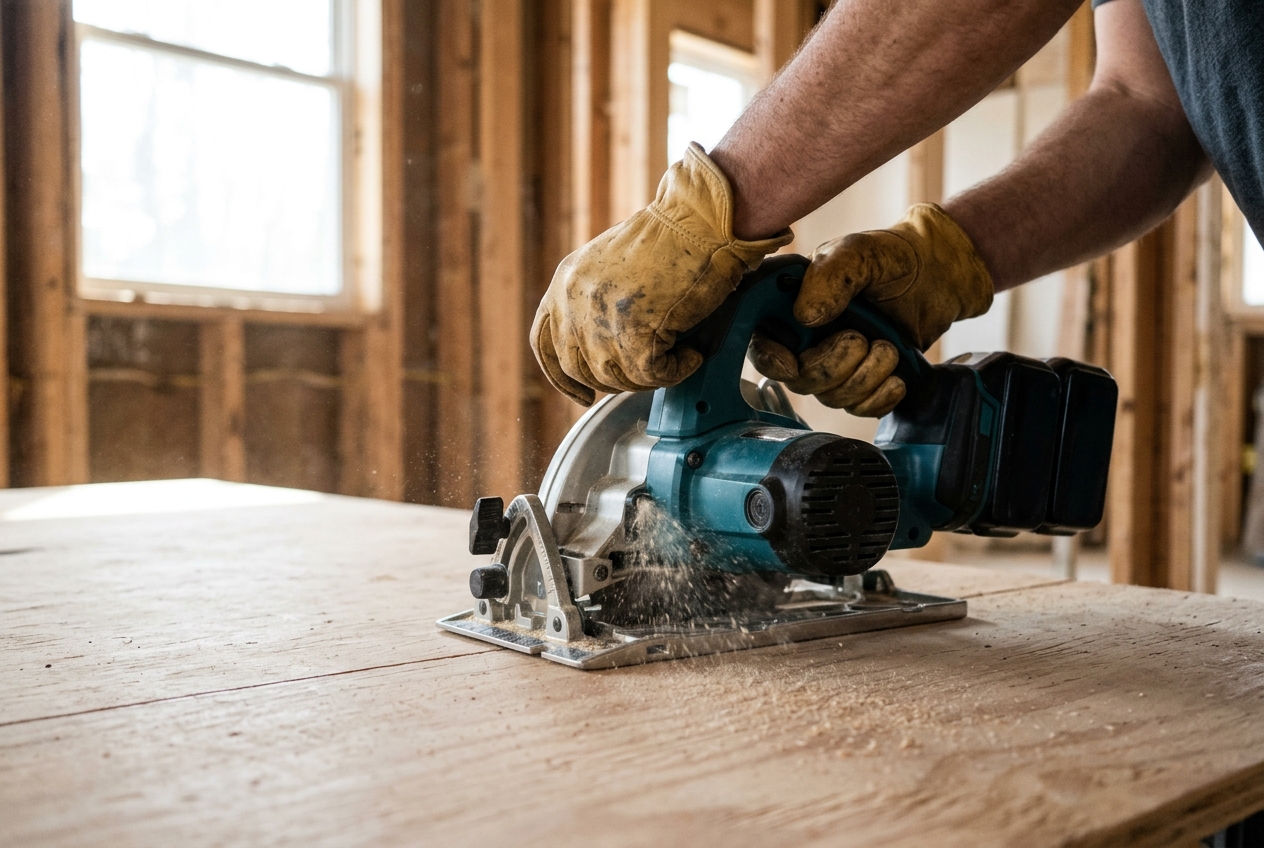
2. Blade Visibility: Blade-Left vs. Blade-Right
For right-handed carpenters, blade placement decides accuracy faster than RPM specs ever will.
- XSR01PT (Blade Left): Because the blade sits on the left side of the motor housing, your left eye looks straight down onto the kerf and pencil line without leaning over the saw body. If you cut freehand lines on stair stringers or subfloor patches all day, blade-left sightlines reduce guesswork immediately.
- XSH06PT (Blade Right): On a right-blade sidewinder, the motor housing sits between your face and the blade if you hold the trigger with your right hand. You either rely on the front shoe notch and dust blower or tilt your head left to watch the teeth enter the wood. On the flip side, the wider right-side shoe sits flat on the keeper piece during trim cuts, keeping the saw stable when slicing off a narrow 1-inch strip.
3. Speed vs. Torque in Wet Framing Lumber
On paper, the XSH06PT spins faster at 6,000 RPM compared to 5,100 RPM on the XSR01PT. Both brushless motors include Makita’s Automatic Speed Change, which lowers speed and ramps up torque electronically when the blade hits a knot or wet pressure-treated lumber.
In practice, the XSH06PT slices dry 2x4s and 3/4-inch OSB fractionally faster because of the higher rim speed. Where the XSR01PT earns its keep is heavy, sustained ripping in wet 2x10 deck joists or doubled LVL beams—the rear-handle inline push lets you lean straight behind the blade without twisting your wrist sideways if the wood pinches slightly.
4. Kit Value: Should You Buy the “PT” Bundle?
Both the XSR01PT and XSH06PT ship as full kits containing the saw, two 5.0Ah 18V LXT batteries, and the DC18RD dual-port rapid charger (which charges two depleted 5.0Ah packs simultaneously in about 45 minutes).
Battery Planning Note: Running two batteries in series gives you 36V power, not double the amp-hours. Heavy framing through 2-inch lumber empties two 5.0Ah packs surprisingly fast—if you plan to run either saw full-time on a jobsite, you will want four 5.0Ah batteries on rotation.
If you do not already own a dual-port charger and multiple 5.0Ah packs, buying the PT kit is almost always cheaper than buying the bare tool (XSR01Z or XSH06Z) plus separate batteries. Look for seasonal Makita promos that throw in two extra 5.0Ah batteries at no extra charge.
Check Makita XSR01PT Kit Price on Amazon
Check Makita XSH06PT Kit Options on Amazon
5. Subfloor Prep vs. Tile & Masonry Work: Use the Right Tool
Because many readers on this site use circular saws during bathroom and kitchen remodels, one boundary is worth stating clearly: neither the XSR01PT nor the XSH06PT is designed for cutting tile or stone. Mounting a dry diamond blade onto a wood-cutting circular saw throws abrasive silica dust straight into unprotected motor bearings and coats finished rooms in fine grit.
- For ceramic, porcelain, and outdoor stone pavers: Use a dedicated water-fed cutter like the ones covered in our Makita wet tile saw and circular cutter guide, or check our hands-on Makita 4101RH masonry saw review and Makita XCC01Z cordless wet cutter review.
- For laminate, vinyl plank, and engineered hardwood flooring: A compact sliding flooring saw like the one tested in our SKIL 3601-02 flooring saw review handles miter and rip cuts indoors far more cleanly than setting up sawhorses for a 7-1/4-inch framing saw.
- For dedicated tile project buying advice: Browse our complete 2026 tile saw reviews comparison before ordering blades or wet saws.
Frequently Asked Questions (FAQ)
Which is stronger: Makita XSR01PT or XSH06PT?
Both saws deliver essentially identical cutting power because they run the same 36V (18V X2) brushless battery architecture, though the XSH06PT spins faster at 6,000 RPM while the XSR01PT prioritizes rear-handle push leverage at 5,100 RPM. Neither saw bogs down in dry dimensional lumber when fitted with a sharp 24-tooth framing blade.
Why is the Makita XSR01PT heavier than the XSH06PT?
The XSR01PT weighs 12.4 lbs (roughly 1.5 to 1.9 lbs more than the XSH06PT) because its elongated rear-handle chassis, gear housing, and rear battery cradle use heavier structural castings to mimic a traditional corded worm-drive saw.
Can the XSR01PT or XSH06PT cut 3x lumber in one pass?
Yes, both saws handle 3x nominal lumber (2-1/2 inches thick) in a single pass at 90 degrees, with the XSH06PT offering 2-5/8 inches of max depth and the XSR01PT offering 2-9/16 inches.
Which saw should a left-handed user buy?
Left-handed operators often prefer the top-handle XSH06PT because holding a blade-right saw in the left hand puts the blade on the visible inner side, whereas holding the blade-left XSR01PT in the left hand blocks the blade behind the motor housing.
Final Buying Decision
- Buy the Makita XSR01PT Rear-Handle Kit if you are right-handed, frame walls or decks regularly, rip full sheets of subfloor plywood, and want worm-drive reach without dragging a cord.
- Buy the Makita XSH06PT Top-Handle Kit if you want a lighter, faster-spinning 6,000 RPM saw for remodel carpentry, tighter indoor spaces, or overhead cuts.