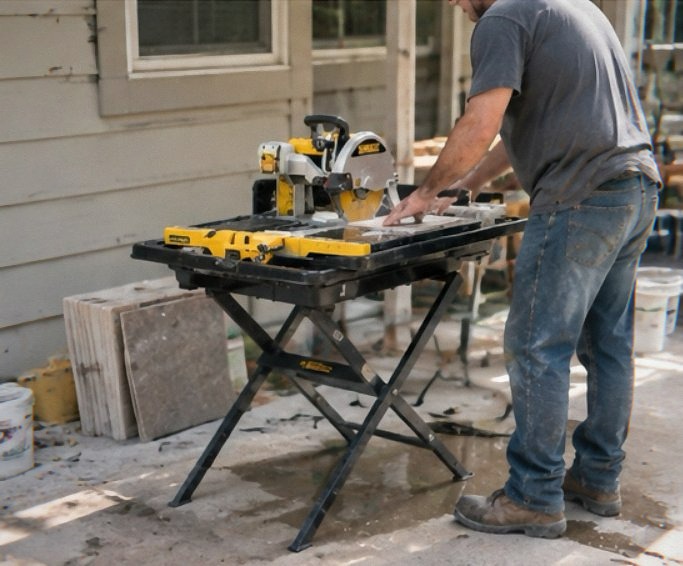
Shopping for an electric tile saw usually goes wrong in one of two ways: you either spend $90 on a plastic tabletop saw that sprays gray slurry across your driveway and stalls halfway through 3/8-inch porcelain, or you drop $1,200 on a 10-inch contractor rail saw that weighs 100 pounds and spends eleven months a year taking up space behind your lawnmower.
Over the past four years of bathroom remodels, mudroom floors, and large-format shower builds, I have run cheap 7-inch homeowner saws, mid-range HydroLock benchtops, 10-inch overhead sliding saws, waterless cyclonic dry cutters, and 48-inch manual snap cutters side by side. This guide pulls those individual tile saw reviews into one honest comparison so you can match the right machine to your tile material, room size, and budget.
2026 Verdict Summary: For most homeowners remodeling one or two bathrooms with 12x12 or 12x24 ceramic and porcelain tile, the SKIL 3550-02 is the best value electric wet tile saw under $200 because its HydroLock guard contains overspray indoors. For full-time tile setters or anyone cutting 24x24 and 24x48 rectified porcelain, the DEWALT D24000S remains the benchmark 10-inch sliding rail saw, while the iQTS244 is the top waterless dry-cut electric tile saw for finished indoor jobsites where wet slurry is unacceptable.
Master Comparison: Best Electric and Manual Tile Saws Tested
| Model | Saw Category | Blade Size | Motor / Power | Max Rip Cut | Street Tier | Best Use Case |
|---|---|---|---|---|---|---|
| DEWALT D24000S | 10-In Sliding Wet Saw | 10 inch | 15 Amp / 4,200 RPM | 24 inch | Pro ($950 - $1,100) | Bathroom & floor contractors, 24x24 porcelain |
| DEWALT D36000S | 10-In High-Capacity Wet Saw | 10 inch | 15 Amp / 4,200 RPM | 36 inch | Pro ($1,300 - $1,450) | 36-inch plank tile, diagonal 24-inch cuts |
| SKIL 3550-02 | 7-In HydroLock Wet Saw | 7 inch | 4.8 Amp / 3,600 RPM | Unlimited (fixed deck) | DIY ($160 - $190) | Homeowner backsplashes, guest baths, indoor splashes |
| SKIL 3540-02 | 7-In Budget Wet Saw | 7 inch | 2.3 Amp / 3,600 RPM | Unlimited (fixed deck) | Budget ($105 - $125) | Single weekend ceramic project outdoors |
| iQTS244 | 10-In Dry-Cut Cyclone Saw | 10 inch | 15 Amp / 3,800 RPM | 24 inch | Pro ($1,550 - $1,750) | Occupied homes, high-rises, winter indoor work |
| Rubi DT-250 MAX | 10-In Overhead Bridge Saw | 10 inch | 1.5 HP / Plunge | 33.5 inch | Pro ($1,150 - $1,350) | Plunge cutouts, thick stone pavers, 45-deg miters |
| Makita 4101RH | 5-In Handheld Wet Saw | 5 inch | 7.9 Amp / 12,000 RPM | Unlimited (freehand/rail) | Trade ($220 - $260) | Thick granite cutouts, outdoor stone pavers |
| Rubi TX-1250 MAX | 49-In Manual Snap Cutter | 22mm scoring wheel | Manual (2,645 lb breaker) | 49 inch | Pro ($800 - $950) | Fast, silent straight cuts on 48-inch porcelain |
1. Best Overall Electric Wet Tile Saw for Serious Remodels: DEWALT D24000S
If you talk to working tile setters who haul their own gear up stairs without a crew, the DEWALT D24000S comes up in almost every conversation. The reason is not raw horsepower—plenty of 10-inch bridge saws spin a 15-amp motor—it is the combination of a cantilevered stainless-steel rail system and a 69-pound saw head that one person can actually lift off the folding stand.
In our dedicated DEWALT D24000S wet tile saw review, the saw held within 1/32 inch of dead straight across a 24-inch rip on dense BIa-rated matte porcelain. The rear and side water catchers capture roughly 90% of the spray from the 10-inch continuous-rim blade, which matters when you are set up on a tarp in a garage or an unfinished basement.
If you frequently install 36-inch wood-look porcelain planks or cut 24-inch tiles on a 45-degree diagonal, you will hit the limit of the D24000S carriage and should look closely at our DEWALT D24000S vs. D36000S comparison before buying.
- Pros: Cantilever rail stays accurate under pressure; plunge feature makes outlet cutouts clean; light enough for solo transport.
- Cons: Stock DEWALT blade chips glazed ceramic edges until swapped for a thin-kerf porcelain blade; water pan plastic clips wear over multiple seasons.
Check DEWALT D24000S Price on Amazon
2. Best Budget Electric Tile Saw for Homeowners: SKIL 3550-02
Most 7-inch tabletop wet saws under $200 have the same fatal flaw: the diamond blade sits partially submerged in a shallow water pan and slings dirty water straight down your shirt front and across the drywall behind the saw. SKIL solved most of that headache on the 3550-02 with a wrap-around HydroLock plastic shroud that channels spray back into the lower tray.
I tested this machine across bathroom wall tiles and dense floor porcelain in our full SKIL 3550-02 wet tile saw review. Its 4.8-amp motor has noticeably more torque than the cheaper SKIL 3540-02 reviewed here, and the sliding aluminum side extension supports 18-inch tiles without tipping off the deck. You still cannot rush a 3/8-inch porcelain cut—push too hard and the blade deflects slightly—but at a steady feed rate, it leaves crisp, usable edges that hide cleanly under grout or Schluter trim.
- Pros: Best water containment in the under-$200 tier; corrosion-resistant stainless steel deck; sliding rip fence locks squarely on both ends.
- Cons: Fixed blade with sliding tile feed requires more table space behind the saw when cutting 18-inch or 24-inch tiles; pump-less bottom bath gets sludgy fast.
Check SKIL 3550-02 Price on Amazon
3. Best Waterless Electric Tile Saw for Indoor Work: iQTS244
Wet tile saws have two enemies: freezing winter temperatures outdoors and finished hardwood floors indoors. The iQ Power Tools iQTS244 eliminates water completely by pairing a 15-amp motor with an integrated cyclonic vacuum and three-stage HEPA filtration chamber built directly under the sliding tray.
As detailed in our iQTS244 dry cut tile saw review and broader iQ tile saw reviews lineup comparison, cutting dry requires a completely different technique. You cannot force the tile into the Q-Drive blade like a wet saw; you let the blade spin at full speed and feed gently so air cooling prevents thermal glazing. When operated properly, you can set the saw inside a finished master bedroom, make fifty cuts in porcelain, and sweep up zero mud at 5 PM.
- Pros: Zero water slurry, zero hose freeze-ups, OSHA Table 1 compliant silica dust capture; cuts dry right next to the installation area.
- Cons: Heavy upfront cost ($1,600+); requires proprietary Q-Drive blades for proper cooling; louder than a standard wet saw because of the integrated vacuum turbine.
4. Best Overhead Bridge & Large-Format Rail Cutters: Rubi DT-250 MAX vs. 2300W Track Systems
Standard sliding-cart wet saws like the DEWALT D24000S move the tile past a stationary blade. Once tile sizes jump past 24x48 inches or 30mm thick porcelain pavers, pushing a 40-pound slab on a rolling tray feels awkward and invites corner chipping at the end of the cut.
Overhead bridge saws flip that physics: the tile sits dead still on a wide stationary deck while the motor head glides overhead on dual steel rails. In our Rubi DT-250 MAX wet tile saw review, that overhead carriage delivered noticeably cleaner 45-degree miter bevels on thick rectified porcelain because the tile never wobbles mid-pass.
For remodelers dealing specifically with oversized 48-inch to 70-inch thin porcelain panels on a tight budget, a rail-guided electric cutter like the 2300W electric tile cutting system lets you clamp a track directly onto the slab on sawhorses instead of lifting the tile onto a heavy saw frame.
Check 2300W Electric Tile Cutting System on Amazon
5. Handheld Electric Masonry Saws & Manual Snap Cutters: When a Table Saw Isn’t the Answer
Not every cut belongs on a tabletop saw. Two specialty tools routinely outperform benchtop electric tile saws depending on the material:
- Handheld Wet Circular Saws (Makita 4101RH): When cutting 2cm outdoor porcelain pavers, concrete block, or sink cutouts in granite countertops, a 5-inch handheld wet saw with a garden-hose feed gives you unlimited cut length without hauling heavy stone onto a tray. Read our Makita 4101RH masonry saw review for how it handles thick stone versus cordless 18V alternatives.
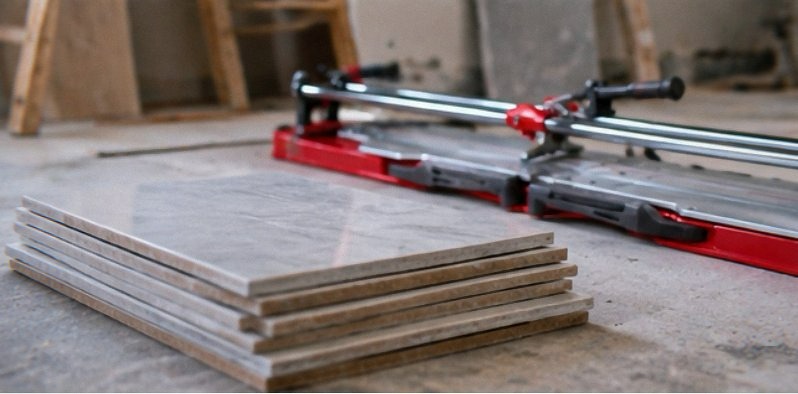
- Heavy-Duty Manual Snap Cutters (Rubi TX-1250 MAX): If you have 800 square feet of straight hallway cuts on 12x24 or 24x48 porcelain, an electric wet saw slows you down by 50%. A manual scorer-and-breaker like the one tested in our Rubi TX-1250 MAX review makes zero noise, zero dust, zero slurry, and snaps a straight cut in four seconds. You still keep a small electric wet saw on site for L-cuts around door jambs and toilet flanges, while the snap cutter handles 85% of the floor.
How to Choose the Right Electric Tile Saw (Buying Checklist)
Core Selection Rule: Match the saw’s blade diameter and carriage length to the longest diagonal cut in your project, not just the width of the tile. A 12x12 tile laid on a 45-degree diamond pattern measures 17 inches corner-to-corner, and a 24x24 tile measures nearly 34 inches diagonally.
- Tabletop Fixed-Blade vs. Sliding-Cart Wet Saw: Fixed-blade tabletop saws (like the SKIL 3550-02) cost under $200 because the table does not move—you push the tile across a wet plate into the blade. They are accurate for 12-inch tiles and backsplashes, but difficult to keep square on 24-inch planks. Sliding-cart saws lock the tile onto a rubberized tray running on linear bearings, preventing the tile from twisting mid-cut.
- Motor Amperage and RPM Under Load: Ignore peak horsepower marketing claims on budget boxes. For 7-inch electric tile saws, look for at least 4.5 to 7 amps (3,600 RPM) so the blade does not stall in hard porcelain. For 10-inch contractor saws, a 15-amp motor is mandatory.
- Blade Rim Type Matters More Than Saw Price: Even a $1,000 DEWALT saw will chip glossy ceramic or glass mosaic if it is running an aggressive segmented turbo blade. Always pair an electric wet tile saw with a thin-kerf continuous-rim diamond blade for glazed ceramic, glass, or polished porcelain.
- Water Management and Cleanup Space: A wet saw throws micro-mist even with good splash guards. If you must cut inside a finished condo or winter jobsite without running water, budget either for a waterless cyclone system like the iQTS244 or combine a manual snap cutter with a small 7-inch HydroLock saw placed on a 6-mil plastic tarp.
Frequently Asked Questions (FAQ)
Can a cheap electric tile saw cut porcelain without chipping?
Yes, a $150 to $180 electric wet tile saw like the SKIL 3550-02 can cut hard porcelain cleanly if you upgrade the factory blade to a quality thin-kerf continuous-rim diamond porcelain blade and feed the tile slowly. Chipping happens mostly because the stock blade is too thick or the operator pushes the tile faster than the diamonds can grind through the glaze.
Wet tile saw vs. dry tile saw: which one lasts longer?
Wet tile saws are mechanically simpler and typically last longer per dollar because water continuously cools the diamond blade and keeps abrasive silica grit out of the motor bearings. Dry-cut cyclonic saws like the iQTS244 require diligent filter shaking and proprietary cooling blades, making their per-cut consumable cost higher in exchange for waterless indoor convenience.
7-inch vs. 10-inch electric tile saw: when do you actually need 10 inches?
You need a 10-inch electric tile saw when your project involves large-format 24x24 or 24x48 tiles, diagonal cuts over 18 inches, thick natural stone or 2cm pavers (over 1-1/4 inches thick), or precise 45-degree miter edges for bullnose-free outside shower corners. For standard subway tile, mosaic sheets, and 12x12 floor tile, a 7-inch wet saw is lighter, cheaper, and easier to store.
What is the best electric tile saw setup for a single bathroom remodel?
For a DIY bathroom remodel using 12x24 floor tile and ceramic subway wall tile, pair a SKIL 3550-02 7-inch HydroLock wet saw ($170) with a $25 aftermarket continuous-rim porcelain blade and a cheap folding plastic work table. You get clean mitered niches and straight floor cuts without spending $1,000 on a heavy contractor saw you will use once.
Final Recommendation by Budget and Project Type
- Under $200 (DIY & Single Bathroom Remodels): Buy the SKIL 3550-02 Wet Tile Saw and swap in a fresh thin-kerf porcelain blade on day one.
- $900 - $1,100 (Full-Time Tile Setters & Multi-Room Renovations): Buy the DEWALT D24000S with Stand for proven 24-inch sliding accuracy and easy one-person loading.
- $1,500+ (Waterless Indoor Remodels & Commercial Occupied Spaces): Invest in the iQTS244 Dry-Cut Cyclone Tile Saw to eliminate slurry cleanup entirely.
- Large-Format Straight Floor Production (48-Inch Slabs): Pair a Rubi TX-1250 MAX Manual Cutter for silent straight rips with a compact wet saw for L-cuts and plumbing holes.